
In summary:
- True home security isn’t about fear, but about implementing simple, repeatable systems to manage your front door.
- Scammers rely on creating urgency and confusion; your defence is to slow down and follow a clear verification protocol.
- Layered deterrence, from visible signals to technology, creates multiple barriers that discourage criminals before they even try.
- Connecting with trusted neighbours is your most powerful shield against isolation and doorstep crime.
The sound of an unexpected doorbell can trigger a wave of anxiety. For many, especially seniors, what should be a simple interaction becomes a moment of dread. Is it a friend, a delivery, or someone with ill intent? This fear is real, and it can lead to a feeling of being a prisoner in your own home. Common advice like “use a door chain” or “check ID” is well-meaning, but it’s a list of rules, not a strategy. These rules often fail under pressure when a sophisticated scammer is manufacturing urgency on your doorstep.
The truth is, feeling safe isn’t about building a fortress or memorising a hundred things you *shouldn’t* do. It’s about regaining control. It’s about turning your front door from a point of vulnerability into a controlled checkpoint that you operate with calm confidence. The key is to move beyond simple rules and embrace a tactical mindset built on layered deterrence and information control. This isn’t about living in fear; it’s about having a professional-grade plan that works so well you no longer have to be afraid.
This guide provides that plan. We will break down the exact tactics scammers use and give you the step-by-step protocols to defeat them. From verifying an ID properly to setting up simple, powerful communication systems with your neighbours, you will learn how to secure your home without sacrificing your peace of mind. By the end, you won’t just feel safer; you will be in control.
To help you navigate these crucial strategies, this article is structured to address the most common and dangerous doorstep scenarios. The following summary outlines the key systems and protocols we will establish to empower you.
Summary: Doorstep Scammer Tactics: A Police Officer’s Guide to Securing Your Home
- Do window stickers actually stop salespeople or just signal vulnerability?
- How to check a utility worker’s ID card properly before unlocking the chain?
- Bank or Fraudster: the “safe account” lie that catches 80% of seniors?
- The mistake of being so isolated that scammers become your only “friends”
- How to use the “Nominated Neighbor” scheme to filter callers?
- Video doorbell or Intercom: which is safer for seniors with slow mobility?
- When to set up a “curtains open” signal system with the street?
- The “Lions Message in a Bottle”: Why this free plastic bottle saves lives?
Do window stickers actually stop salespeople or just signal vulnerability?
This is a common concern: does a ‘No Cold Callers’ sticker mark you as an easy target? The answer lies in a professional security concept called layered deterrence. A sticker, on its own, is a weak barrier. Determined criminals will ignore it. However, it should never be your only line of defence. It is the first, most basic layer in a system that signals a resident who is alert, informed, and not to be trifled with. The problem isn’t the sticker; it’s relying on the sticker alone.
The scale of the threat is significant. In the UK, research by Age UK found that 43% of older people aged 65+ believe they have been targeted by scammers. This is not a minor issue; it’s a constant pressure. Your goal is to make your home appear like a ‘hard target’—not through aggression, but through visible signs of care and attention. A well-maintained garden, clear sightlines to your entrance, and no overflowing mail all send a powerful message that this home is occupied by a vigilant resident.
Think of the sticker not as a magic shield, but as the first sentence in a statement. The rest of the statement is told by the state of your property. An official sticker obtained from your local council or Trading Standards, combined with a tidy exterior, tells a potential scammer, “This person knows the procedures, is connected with local authorities, and is not a soft target.” It filters out the casual opportunist and is the first step in a much deeper security strategy.
How to check a utility worker’s ID card properly before unlocking the chain?
The most dangerous scammers are those who come disguised as legitimate authority figures. A high-vis jacket and a clipboard can be a powerful costume. Their goal is to rush you into a decision. The standard advice, “check their ID,” is correct but dangerously incomplete. A scammer will happily show you a fake ID, banking on you giving it a cursory glance through the door. A proper check is a deliberate, multi-step verification protocol that puts you in control.
Before you even think about the lock, use your door viewer or a window to look. The first step is to tell the caller—through the closed door—to hold their ID badge up to the letterbox or a window. You are looking for a photo that matches the person. But you don’t stop there. Here is the protocol you must follow without exception:
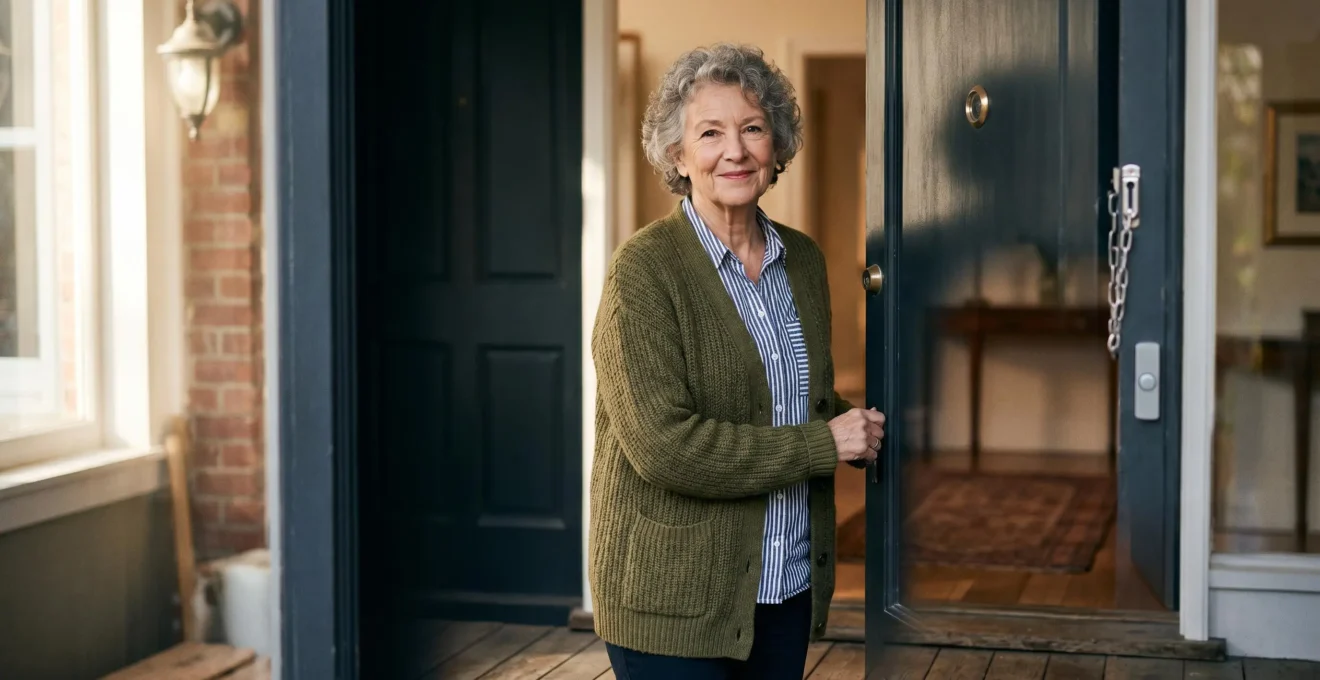
As this image demonstrates, the verification is a deliberate, physical action. With the chain still on, you then ask them to describe the specific work they are there to do. A real employee has a clear job ticket and can explain their task. Finally, and this is the most crucial step, you state that you will be calling their company to verify their presence. Never use a phone number they provide. Close the door, find the official number from your own utility bill or the company’s website, and call their head office. Only when the company confirms the employee’s name and purpose do you let them in. If they are legitimate, they will understand and wait. If they are a scammer, they will vanish.
Bank or Fraudster: the “safe account” lie that catches 80% of seniors?
This scam is devastating because it turns your own sense of security against you. It doesn’t start at the door, but on the phone. A caller, sounding professional and urgent, claims to be from your bank’s fraud department. They tell you your account is compromised and you must act *immediately* to protect your money by moving it to a new, “safe account” they have set up for you. This is a lie. The “safe account” belongs to the scammer. They are using the bank’s authority to create panic and override your critical thinking.
The financial and emotional toll is immense. In the US, for example, imposter scams caused losses of over $700 million for older adults in 2024 alone, with a dramatic increase in high-value cases. Victims are often intelligent, capable people who are simply caught off guard by the sheer professionalism and urgency of the scam. The callers use insider jargon and create a scenario where not co-operating seems like the riskier option. They exploit your trust in the banking system.
The defence against this powerful psychological trick is not complicated; it is a single, unbreakable rule that you must commit to memory: Your bank will NEVER, under ANY circumstances, ask you to move your money to another account for security reasons. They will never ask for your PIN, your full password, or for you to transfer funds to a “safe” location. The moment anyone on the phone asks you to do this, you know with 100% certainty that it is a scam. Your only action is to hang up, wait five minutes to ensure the line is clear, and then call your bank using the number on the back of your card to report the attempt.
The mistake of being so isolated that scammers become your only “friends”
One of the cruellest aspects of doorstep crime is how it preys on loneliness. For someone living in isolation, an unexpected caller—even a salesperson—can represent a rare moment of social contact. Scammers are experts at detecting this vulnerability. They will feign friendship, show interest, and build a rapport over time, slowly grooming a victim until they are seen not as a stranger, but as a “friend.” Once this trust is established, asking for money, favours, or personal information becomes tragically easy.
This isn’t just an anecdotal observation; it’s a documented risk factor. Data shows that one in three older adults now live alone and experience social isolation, making them a prime target. The scammer fills a void, and the human need for connection can overpower the instinct for caution. This is why simply being told to “be suspicious of strangers” is often ineffective advice. The scammer’s goal is to stop being a stranger.
The most effective defence against this form of exploitation is knowledge and social connection. By breaking the isolation, the scammer loses their primary weapon. Talking with family, friends, or neighbours about these tactics is not about scaremongering; it is a form of emotional and financial inoculation.
Case Study: Knowledge as a Vaccine Against Scams
Research by Professor Marti DeLiema at the University of Minnesota provided powerful proof of this concept. Her work demonstrated that when older adults are educated about specific scam tactics *before* they encounter them—such as a fake friend request on social media followed by a request for money—they become 80% less likely to respond to those scams. This highlights the critical protective role of advance knowledge and social discussion. Talking about these threats with a real friend is the best way to avoid falling for a fake one.
Maintaining social ties and participating in community groups are not just good for your wellbeing; they are fundamental components of your personal security strategy. They create a support network that makes it much harder for a predator to isolate you.
How to use the “Nominated Neighbor” scheme to filter callers?
The best security systems are often the simplest. The ‘Nominated Neighbour’ scheme is a brilliantly effective, low-tech way to take yourself out of the high-pressure situation at the front door entirely. It creates a human firewall, a trusted person who screens all unexpected visitors on your behalf. The principle is simple: instead of engaging with a stranger, you show them a card that directs them to a trusted, pre-arranged neighbour. You never even have to open the door.
This system, supported by local councils and Trading Standards across the UK, formally outsources the verification process. Your nominated neighbour—a trusted friend or relative who lives nearby—agrees to be the point of contact. When an unexpected caller arrives, you simply show them the card through a window or the letterbox. The card politely explains that you don’t deal with unexpected callers and instructs them to go to the neighbour’s address. This immediately removes you from the conversation and puts the scammer in a position where they must now deal with a second, more assertive individual.
The neighbour then performs the verification checks away from your door. They can check ID, call the company, and assess the situation without the emotional pressure of having a vulnerable person behind them. If the caller is legitimate, the neighbour can either send them back with an “all-clear” or even accompany them during the visit. This system is a powerful community shield, turning an individual vulnerability into a collective strength.
Your Action Plan: Setting Up a Nominated Neighbour Pact
- Choose a trusted neighbour, friend, or relative who lives nearby and agrees to act as your screener.
- Obtain official Nominated Neighbour cards from your local Trading Standards or council.
- Fill in the card with your nominated person’s contact details and address.
- Establish a simple password or ‘all-clear’ phrase your neighbour can text you after vetting a caller.
- Keep the card visible near your front door so you can show it through the window without opening.
Video doorbell or Intercom: which is safer for seniors with slow mobility?
For many seniors, especially those with mobility challenges, the race to answer the door can be a source of stress and a significant security risk. A traditional intercom requires you to get to a fixed wall unit, often in a hallway, before the caller gives up and leaves. This pressure to move quickly can lead to falls and means you are making security decisions while flustered. Technology, when chosen wisely, can eliminate this risk entirely.
A video doorbell (or “smart” doorbell) fundamentally changes the dynamic. It moves the point of interaction from your hallway wall to a smartphone or tablet you can keep beside you in your chair. There is no rush. You can see who is at the door in clear video, speak to them, and even use pre-recorded messages (“I am unable to come to the door right now, please leave the package on the step”) without ever having to get up. This removes the physical pressure and allows for calm, considered decision-making.
The benefits extend beyond convenience. Video doorbells create an evidence trail, recording every interaction. They are often more compatible with hearing aids (as you can control the volume on your smartphone) and offer a much clearer visual than a traditional peephole. While a traditional intercom is better than nothing, a video doorbell is a superior solution for anyone with limited mobility.
To make the choice clearer, this table compares the key features of both systems from a senior safety perspective.
| Feature | Video Doorbell (Smart) | Traditional Intercom |
|---|---|---|
| Response Time Required | Answer from seated position via smartphone – no rush needed | Must reach wall unit quickly before caller leaves |
| Mobility Accessibility | Excellent – no movement required | Poor – requires walking to fixed location |
| Visual Verification | Full video feed with zoom and recording capability | Limited or no visual confirmation |
| Pre-recorded Messages | Available – can send automated response without live interaction | Not available – requires real-time conversation |
| Hearing Aid Compatibility | Adjustable volume on smartphone, can use captions | Fixed speaker volume, may cause feedback with hearing aids |
| Recording Evidence | Cloud storage of all visitor interactions | No recording capability |
| Setup Complexity | Requires WiFi and smartphone app familiarity | Simpler wired installation, basic operation |
When to set up a ‘curtains open’ signal system with the street?
Not all security systems are about keeping bad people out. Some of the most effective are about letting good people know that you are okay. A ‘curtain signal’ is a beautifully simple, non-verbal communication system established with a trusted neighbour. It’s a proactive way to signal your well-being each day, providing quiet reassurance to your community and an early warning system if something is wrong. This transforms your home from an isolated box into a connected part of the neighbourhood.
The basic premise is an agreed-upon visual cue. For example, “curtains on the front window open by 9 AM” means “All is well today.” If a neighbour who is part of the agreement sees the curtains are still closed at 10 AM, they know to enact the next step of the protocol. This doesn’t mean immediately calling emergency services. It means starting a gentle escalation: first, a phone call. If no answer, perhaps a check of a video doorbell. Only if these checks fail would they escalate further. It’s a system built on mutual trust and care.
This system can be made more sophisticated with graduated signals. For instance, both curtains open might mean “all is well,” while one open and one closed could mean “I’m okay, but feeling a bit under the weather and would appreciate a phone call later.” A truly urgent signal, like a specific lamp turned on in the window during the day, can be reserved for emergencies. The key is to agree on the system in writing and share it with 2-3 trusted neighbours to create redundancy.
This daily ritual of opening the curtains, letting in the light, becomes more than just a routine. It becomes an active signal of safety and connection. It’s a silent, daily “good morning” to your neighbourhood watch, strengthening community bonds and providing immense peace of mind for you and those who care about you.
Key takeaways
- Security is a system, not a single action. Layer your defences, from visible deterrents to verification protocols.
- You control the flow of information. Never be rushed. Slowing down a situation is your greatest tactical advantage.
- Your community is your strongest shield. Schemes like Nominated Neighbour and signal systems turn isolation into connection.
The “Lions Message in a Bottle”: Why this free plastic bottle saves lives?
Our focus has been on preventing crime from entering your home, but a complete safety plan also considers what happens during a medical emergency. In a crisis, every second counts. Paramedics and first responders need information fast: What medications are you on? What are your allergies? Who is your next of kin? Often, this information is scattered, hard to find, or the patient is unable to communicate. This is the “information gap” where precious, life-saving minutes are lost.
The ‘Lions Message in a Bottle’ scheme is a simple, free, and universally recognised solution to this problem. It consists of a small, clearly marked plastic bottle, a form, and two stickers. You fill out the form with all your critical medical information: prescriptions, allergies, doctor’s details, next-of-kin contacts, even information about any pets that need care. You then place the form inside the bottle and store it in the one place every paramedic will check: the refrigerator. You place one sticker on your fridge door and the other on your main entrance door. These stickers instantly tell any first responder that your vital information is stored and waiting for them.
This system closes the information gap. It ensures that even if you are unconscious or confused, the emergency services have everything they need to give you the best possible care during the critical ‘golden hour’. It’s not a high-tech gadget; it’s a piece of paper in a plastic bottle, but its impact on emergency outcomes can be monumental. It provides peace of mind not only for you but for your family, who know that your critical details are always accessible in an emergency. Updating the form every six months, or whenever your medical situation changes, is a small task with a huge potential payoff.
By implementing these tactical systems—from ID protocols and community shields to emergency information—you are not just installing locks or rules. You are building a comprehensive strategy for safety and peace of mind, allowing you to live confidently, not in fear.