
Your home should evolve with you, not against you. As mobility decreases or vision changes, the house that once felt perfectly comfortable can become a maze of hazards: steps that seem steeper, bathrooms that feel treacherous, light switches positioned just out of comfortable reach. Yet with thoughtful planning and strategic modifications, your home can remain your sanctuary for decades to come.
Housing and comfort adaptations aren’t about transforming your home into a clinical facility. They’re about making intelligent, often subtle changes that preserve independence, prevent injuries, and enhance daily life. From the gradient of a entrance ramp to the placement of a motion sensor, each decision can mean the difference between ageing confidently in place and being forced to relocate prematurely. This guide connects the essential elements of accessible housing, explaining not just what to change, but why these modifications matter and when to implement them.
Whether you’re planning five years ahead or adapting urgently for a hospital discharge, understanding the full landscape of housing comfort will help you prioritise investments, avoid costly mistakes, and create a home that genuinely supports your changing needs.
The most successful home adaptations begin years before they’re urgently needed. Think of accessibility planning like maintaining a roof: address it proactively, and you’ll avoid emergency repairs at inflated prices when crisis strikes.
The five-year anticipation rule suggests starting bathroom renovations and major structural changes well before mobility significantly declines. Why? Because planning ahead means you can schedule works during off-peak periods when contractors charge less, remain living in your home during phased renovations, and access better financing options than the emergency loans many families resort to when someone falls and requires immediate modifications.
Budget considerations are equally critical. Recent surveys indicate that households planning ageing-in-place modifications often underestimate costs by 30-40%, failing to account for structural surveys, building regulations compliance, and the temporary accommodation sometimes needed during major works. Yet strategic planning can dramatically reduce expenditure:
Property value deserves honest consideration too. While accessible wet rooms and level-access entries appeal to increasingly ageing buyers, certain modifications like through-floor lifts can narrow your buyer pool significantly, particularly in suburban markets where families with young children dominate. The key is distinguishing between adaptations that add universal appeal and those that serve specific needs but may require reversal before sale.
Not all home modifications are created equal in the eyes of building regulations. Understanding what requires formal permission prevents costly compliance issues and ensures modifications are both legal and safe.
In the UK, structural safety adjustments often fall under Building Regulations even when Planning Permission isn’t required. Installing a ceiling track hoist, for example, might seem straightforward, but it places significant point loads on ceiling joists never designed for such forces. A structural engineer’s calculations aren’t bureaucratic box-ticking; they’re essential safety measures preventing catastrophic failures.
Similarly, converting a downstairs room into a wet room involves waterproofing, drainage modifications, and often joist reinforcement to support the level-access shower tray. While this typically qualifies under Permitted Development rights (avoiding Planning Permission), Building Regulations approval remains mandatory to ensure proper tanking prevents water damage to structural timbers.
Period properties present unique complications. Victorian terraced houses, beloved for their character, often suffer from damp-proofing vulnerabilities that ruin ground-floor adaptations. Installing a wet room without addressing rising damp or failed membranes means expensive finishes deteriorate within months, anti-slip flooring delaminates, and timber joists rot accelerates.
Budget-conscious adaptations in Victorian properties require prioritising the envelope first: damp-proofing, ventilation, and structural soundness before cosmetic accessibility features. A £3,000 investment in proper damp treatment protects a £15,000 wet room installation for decades.
When adapting a two-storey house, work sequence dramatically affects livability. The optimal order typically involves:
This sequencing keeps you living at home throughout works, avoiding the expense and disruption of temporary accommodation.
Mobility aids transform how we interact with interior spaces. A hallway that felt spacious becomes claustrophobic with a walker; doorways once stepped through easily now require shoulder-jarring manoeuvres in a wheelchair.
The 800mm doorway width represents the accessibility gold standard, accommodating most wheelchairs and allowing walker users to pass without painful contortions. Yet many assume this requires moving load-bearing studs—expensive structural work. In reality, replacing standard door frames with slimmer architraves and rehinging doors to swing fully back often gains the necessary centimetres without touching structural elements.
Hallway walls present another revelation. That narrow corridor forcing walker users to shuffle sideways? Removing the hallway wall (where structurally feasible) creates an open-plan ground floor that eliminates multiple fall hazards: tight corners, door thresholds, and the claustrophobic panic that causes rushing and stumbling. Consultation with a structural engineer determines whether walls are loadbearing, and if so, what beam can safely replace them.
Through-floor lifts solve multi-storey access completely but require careful consideration. Installation demands surprising ceiling height (typically 2.4m minimum), structural floor reinforcement, and permanent space dedication. More critically, they’re highly visible modifications that some buyers view as negatives, particularly in areas where properties predominantly sell to families rather than older adults.
Your front entrance sets the tone for independence. If getting into your own home requires assistance or feels precarious, even the most accessible interior loses value.
The most common ramp error is excessive gradient. UK accessibility standards specify maximum 1:12 gradients (1 metre of ramp length for every 12cm of height change) for safe independent use. Steeper ramps become dangerous, particularly in wet conditions or for electric wheelchair users whose batteries strain against sharp inclines.
For steep driveways, this creates length challenges: a 60cm step requires a 7.2-metre ramp. Where space prohibits this, modular ramp systems with intermediate landing platforms allow users to rest, preventing the dangerous fatigue that causes handlebar grip failures. Landings should occur every 9 metres maximum and measure at least 1.5m x 1.5m.
Climate dictates material selection. Metal ramps, while quick to install and fully modular, require serious winter maintenance in the UK. Ice accumulation creates lethal slip risks, while the de-icing salts used to combat it accelerate corrosion unless ramps feature galvanised or powder-coated protection with regular resealing.
Concrete ramps, though slower to install and requiring professional construction, offer superior long-term durability and weather resistance. They can also be textured for enhanced grip and landscaped to blend with garden design, addressing the aesthetic concerns many homeowners prioritise.
Even homes with perfect ramp gradients stumble at the final barrier. A “low” threshold of 15-20mm—barely noticeable to walking residents—represents a significant obstacle to electric wheelchair users, whose small front castors catch and jolt violently. True accessibility demands fully flush thresholds (0-5mm maximum), achievable through specialist threshold systems or modest floor level adjustments inside the doorway.
External access isn’t just about physical pathways. Porch lighting positioned behind the door leaves keyholes in darkness—a minor inconvenience for most, but genuinely dangerous for seniors with reduced vision taking two minutes to unlock doors. Forward-positioned lighting, ideally motion-activated to trigger before you reach the door, prevents the fumbling that leads to dropped keys and frustration.
Similarly, a canopy transforms the entrance experience. Older adults often need significantly longer to manage keys and locks; standing exposed to rain during this process isn’t just uncomfortable, it’s destabilising and increases fall risk on wet surfaces.
Flooring decisions have profound safety implications. The wrong surface doesn’t just risk slips—it can trap wheelchair wheels, create visual confusion, or demand exhausting physical effort to traverse.
Not all “non-slip” flooring performs equally. The R-rating system (R9 through R13) measures slip resistance on inclined planes. Many installers default to R10 for wet rooms, assuming it’s adequate. It’s not. R10 flooring, tested on a 10° incline, offers insufficient grip in shower areas where water flow, soap residue, and shampoo create genuinely hazardous conditions. Senior-focused wet rooms should specify R11 minimum, with R12 preferred for shower zones specifically.
Both materials can achieve appropriate slip resistance, but their characteristics differ significantly:
Deep-pile carpets and certain rugs create genuine wheelchair traps, where wheels sink and require exhausting forward force to move. Even thick carpet padding can destabilise walker users. Accessible homes prioritise low-pile carpets (under 10mm) or hard flooring with smooth transitions between surfaces. Threshold strips should be bevelled, not square-edged, allowing wheels to roll over rather than impact and stop.
An easily overlooked risk: busy patterned carpets can trigger visual confusion and even hallucinations in low light, particularly for seniors with macular degeneration or dementia. High-contrast geometric patterns the brain interprets as obstacles cause hesitation, missteps, and falls. Solid colours or subtle, low-contrast patterns prove significantly safer.
Bathrooms represent the highest-risk rooms in any home. Combining hard surfaces, water, and necessary transfers (in and out of baths, on and off toilets), they account for a disproportionate share of serious domestic falls.
Wet room conversions eliminate the most dangerous element: the bath edge requiring users to lift legs high while balancing on one foot. A fully level-access shower with flush floor drainage removes this entirely. However, proper installation demands more than tiling skills. Timber joist reinforcement prevents floor flexing that cracks waterproofing membranes, while multi-layer tanking systems protect structural timber from the moisture damage that silently weakens buildings.
A grab bar improperly fixed to plasterboard walls creates catastrophic false security. Users trust them completely, applying full body weight during transfers. When fixing fails and the bar rips out, falls occur from unstable positions with hands outstretched—a recipe for wrist fractures and head injuries.
Safe grab bar installation requires one of three approaches:
The paradox: the cheapest option during initial bathroom installation (adding solid backing boards behind tiles in likely positions) becomes the most expensive to retrofit later.
Standing water dramatically increases slip risk. Underfloor heating in wet rooms isn’t luxury—it’s pragmatic safety technology. By maintaining floor temperatures 2-3°C above ambient, underfloor heating accelerates water evaporation, meaning floors dry within minutes rather than remaining treacherously wet for hours. This proves particularly valuable for households where cognitive decline means users don’t reliably wipe spills.
Highly polished tiles and chrome fixtures create the clean, modern aesthetic many desire. They also create “skating rink” conditions when wet. Water sheeting across polished surfaces offers virtually zero traction. Matte-finish tiles with slight texture maintain attractive appearances while providing essential grip. Similarly, brushed or matte metal fixtures prevent the blinding glare reflections that disorient users.
Lighting transformations often cost less than flooring changes yet deliver comparable safety improvements. The key insight: seniors don’t just need more light—they need it positioned strategically to illuminate hazards without creating new ones through glare or harsh shadows.
Macular degeneration, cataracts, and age-related lens yellowing mean older adults require two to three times more illumination than younger people to perceive the same detail. Standard 60W-equivalent LED bulbs, adequate for most households, leave seniors struggling to distinguish depth, read labels, or spot hazards.
Yet simply installing brighter bulbs creates problems. Unshielded high-lumen bulbs cause painful glare, and the contrast between brightly lit and shadowed areas actually worsens visibility. The solution involves layered lighting: ambient background illumination combined with task-specific focused lights.
Staircases lit by a single pendant create the most dangerous lighting scenario in homes. Light shining downward casts the leading edge of each tread into shadow, making it invisible. Users misjudge where treads end, place feet incorrectly, and tumble. Staircase lighting should come from wall-mounted fixtures positioned to cast light across treads, creating visible depth definition.
Under-cabinet LED strips solve a persistent kitchen problem: overhead lights position your body between the light source and work surface, casting your own shadow precisely where you’re chopping or reading recipes. Under-cabinet lights, installed toward the front edge of cabinets rather than the back, eliminate shadows and reduce the glare reflecting off glossy worktops that makes tasks uncomfortable.
Modern battery-powered LED strips require no electrical qualifications to install—adhesive backing and rechargeable batteries mean anyone can add them in minutes, unlike hardwired solutions requiring certified electrician work.
Motion-activated lighting prevents the dangerous transition from dark to lit spaces. The critical placement: sensors should detect motion before you enter hazardous zones. A sensor at the top of stairs triggers too late—you’ve already stepped into darkness. Position it 2-3 metres before the staircase, in the hallway approach, so lights activate before you reach the first step.
Similarly, porch sensors should face the approach path (driveway or garden gate), not the door itself, ensuring lights activate while you’re navigating the path, not after you’ve already reached the darkened entrance.
How you arrange furniture influences fall risk as significantly as the flooring beneath it. Cluttered traffic routes, awkward reaches, and poorly positioned furniture create dozens of daily hazards.
In small lounges, the sofa-versus-armchair decision isn’t aesthetic—it’s safety planning. A three-seater sofa against one wall creates a clear, wide traffic route through the room. Replace it with multiple armchairs, and you’ve created a furniture maze requiring navigation around obstacles, particularly problematic for walker users who need at least 90cm clearance for comfortable passage.
Counter-intuitively, fewer pieces of larger furniture often creates more usable space than multiple smaller items, each representing another obstacle and fall risk.
Standard UK sockets sit 15-30cm above floor level—perfect for installation convenience, terrible for arthritic backs. Every phone charging, every vacuum plugging requires painful bending or dangerous squatting and rising movements.
Repositioning sockets to waist height (90-100cm) eliminates this entirely. While this requires qualified electrician work and plastering to conceal cable routes, the daily quality-of-life improvement proves profound. For those unable to undertake full rewiring, socket extenders that sit on side tables bring connection points up to accessible heights, though they create trip hazards from trailing cables.
Kitchen modifications extend beyond lighting. Standard worktop heights (90cm) suit average-height standing users but create leverage problems for shorter individuals or those working seated. The effort required to chop vegetables or knead dough increases exponentially when working at incorrect heights, accelerating fatigue and reducing independence.
Solutions include installing one lowered worktop section (75-80cm) or, more simply, using a sturdy chair to sit while preparing food—working at ergonomically correct relative heights regardless of worktop position. Similarly, front-loading washing machines on plinths raise doors to waist height, eliminating the back-wrenching bend into top-loaders or floor-level front-loaders.
Quality sleep becomes increasingly elusive with age, yet it’s fundamental to health, cognitive function, and fall prevention. Comfortable bedroom environments directly impact sleep quality and therefore overall wellbeing.
The recommended 18°C bedroom temperature presents challenges in draughty period properties where single-glazed sash windows and uninsulated walls mean heating bills spiral to maintain comfort. Before installing expensive heating systems, address the envelope: secondary glazing, heavy thermal curtains, and targeted draughtproofing around doors and floorboards often achieve comfortable temperatures while reducing heating costs 30-40%.
For Victorian terraced houses, the original fireplaces—often blocked but unsealed—act as direct cold air channels from outside. Chimney balloon insertions cost under £20 yet eliminate major heat loss routes without permanent alterations.
Arthritic hips demand careful mattress selection. Memory foam mattresses offer pressure relief by contouring to body shape, reducing painful pressure points. However, they create difficulties with movement—the contouring that relieves pressure also resists position changes, problematic for those who struggle to turn over.
Pocket-sprung mattresses with medium-firm support often provide the best compromise: sufficient support to prevent painful sinking while allowing easier position changes through the night. The individual springs respond independently, meaning partner movement causes less disturbance—valuable when one person experiences nighttime pain or frequent toilet visits.
Safety systems protect against the hazards you can’t see, smell, or predict. Yet standard installations often fail to account for age-related sensory changes.
Smoke and carbon monoxide alarms save lives—but only if they wake you. Age-related hearing loss and the deep sleep some medications induce mean standard alarms may not rouse seniors until dangerous smoke inhalation has already occurred.
Interconnected alarm systems solve this. When the kitchen smoke alarm detects fire, it triggers the bedroom alarm simultaneously, providing maximum warning time. Modern wireless interconnected systems require no new wiring—battery-powered units communicate via radio frequency, making whole-house coverage achievable in an afternoon.
For profoundly deaf individuals, vibrating pillow alarms triggered by smoke detectors provide the necessary alert even when sound cannot.
The “daisy chain” temptation—plugging multi-socket adapters into each other to gain more outlets—creates genuine fire risks. Each connection point generates heat; multiple connections compound it. Older socket outlets with worn springs create poor electrical contact, increasing resistance and heat generation further.
Properties with insufficient sockets require professional electrical expansion, not dangerous daisy-chain workarounds. Modern regulations require socket outlets every 1.8 metres along walls; older homes typically have far fewer. The investment in proper electrical installation prevents the house fires that kill hundreds annually.
A key safe mounted outside appears to compromise security. In reality, it dramatically improves it. When someone inside experiences a medical emergency and cannot reach the door, emergency services face a choice: delay treatment trying to locate family keyholders, or force entry, causing £500-£1,500 damage to doors and frames.
A police-approved key safe (hidden from street view, with a unique code shared only with emergency services and trusted individuals) costs £40-£80 and prevents both treatment delays and expensive forced entry. Police consistently recommend them for older or vulnerable occupants living alone.
Technology adaptations needn’t involve complex smart home systems. Simple retrofits can transform daily frustrations into effortless routines.
Curtain opening, seemingly trivial, becomes genuinely difficult with arthritis in hands and shoulders. Grasping curtain cords, reaching across furniture, and applying the pull force required challenges many seniors. Electric curtain track systems solve this completely—wall-mounted remotes or even voice control makes curtain operation finger-touch simple.
For those reluctant to replace existing tracks, SwitchBot retrofit devices clip onto existing curtains and mechanically pull them open on schedule or command. Battery-powered and requiring no electrical work, they represent the simplest automation upgrade available.
Those anticipating eventual live-in care should plan space accordingly. Attracting quality carers requires offering quality accommodation. A decent spare bedroom with good natural light, adequate storage, and reliable internet connectivity makes your home attractive to professional carers, expanding your options significantly.
Properties offering only box rooms with poor mobile signal struggle to recruit and retain carers, often forcing residents into institutional care earlier than medically necessary. The spare room isn’t wasted space—it’s insurance for future independence.
Adaptations themselves require maintenance. External elements particularly demand seasonal attention.
Gutter cleaning prevents overflow that saturates walls, accelerates damp problems, and creates icy pathways in winter when overflow freezes on access routes. Yet the autumn rush when falling leaves block gutters means contractors book solid for weeks. Scheduling gutter cleaning for late August, before the autumn rush but after most leaf fall has finished, ensures availability and often better pricing.
Similarly, ramp maintenance schedules prevent deterioration. Metal ramps need annual inspection of fixings, welds, and anti-slip surfaces, with repainting every 3-5 years to prevent corrosion. Concrete ramps require crack sealing and surface texture maintenance. Deferred maintenance doesn’t save money—it creates safety hazards and eventual replacement costs far exceeding preventive care.
Housing and comfort adaptations form an interconnected system where each element supports the others. Strategic lighting makes anti-slip flooring more visible. Proper temperature control improves sleep quality that reduces fall risk. Accessible electrical sockets reduce dangerous bending that strains backs already challenged by poor mattress choices. Understanding these connections helps you prioritise modifications that deliver compounded benefits, creating homes that genuinely support ageing in place with dignity, safety, and comfort.
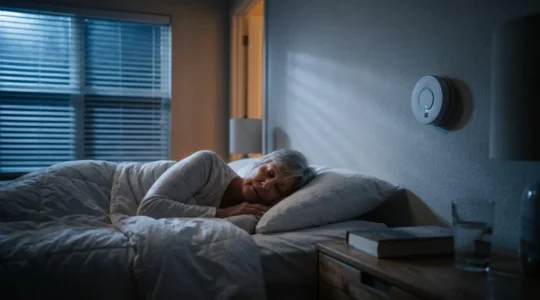
Contrary to common belief, a standard smoke alarm is not sufficient protection for seniors with sensory decline; it often creates a dangerous false sense of security. Standard high-pitch alarms are frequently inaudible to individuals with age-related hearing loss or those…
Read more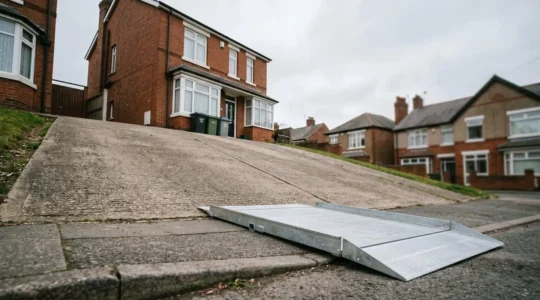
The critical choice between a concrete and modular ramp is not about materials, but about risk management for your specific circumstances. A permanent concrete ramp carries significant upfront financial risk and inflexibility, whereas a modular system offers adaptability for uncertain…
Read more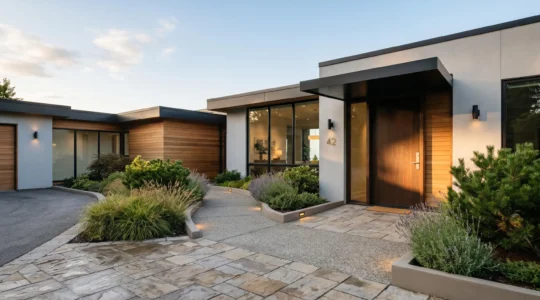
Accessibility doesn’t require sacrificing your home’s beauty for a clinical-looking ramp; it demands better design. Successful accessible entry is achieved by creating an “integrated pathway” using thoughtful landscaping, not by simply adding a utilitarian ramp. The entire “arrival sequence”—from the…
Read more
The frustrating inability to see clearly, even in a well-lit room, is not a personal failure but a technical one: standard lighting is simply the wrong tool for eyes affected by macular degeneration. Effective lighting is a prescription combining high-quality…
Read more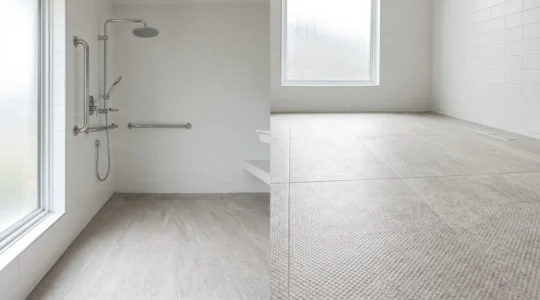
The choice between vinyl and tile is secondary; true wet room safety for a senior is an engineering system where the floor’s specific barefoot rating, cleaning protocol, and integration with the room’s elements are the only factors that matter. A…
Read more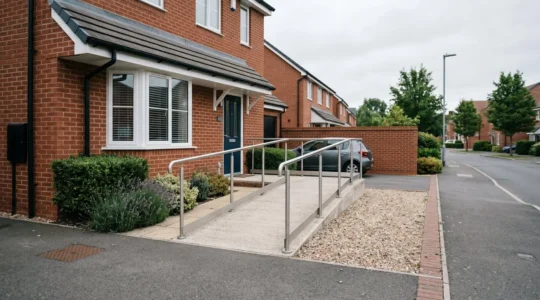
The critical distinction for any UK home adaptation is not whether you need approval, but which specific statutory framework—Planning Permission or Building Regulations—governs the work, as they address entirely different legal and safety concerns. Planning Permission assesses the external impact…
Read more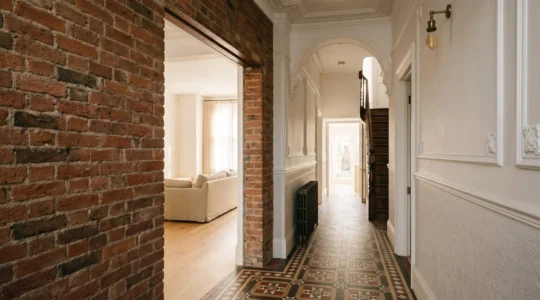
In summary: Focus on improving movement flow (‘movement choreography’) rather than just installing features. Prioritize small, high-impact ‘hacks’ like offset hinges and flooring transitions to reclaim inches and prevent falls without major construction. Use furniture layout, smart technology, and ergonomic…
Read more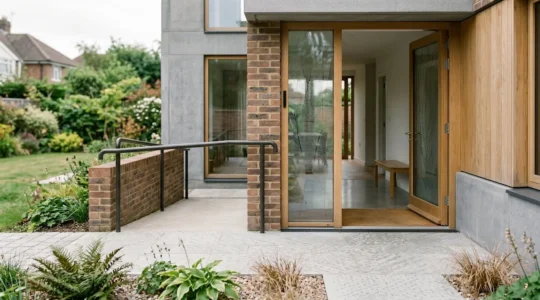
Making a home accessible is a critical financial decision that can either preserve or destroy your property’s value for your heirs; it is not merely about comfort. Highly specialised, irreversible adaptations like through-floor lifts can severely limit your buyer pool…
Read more