
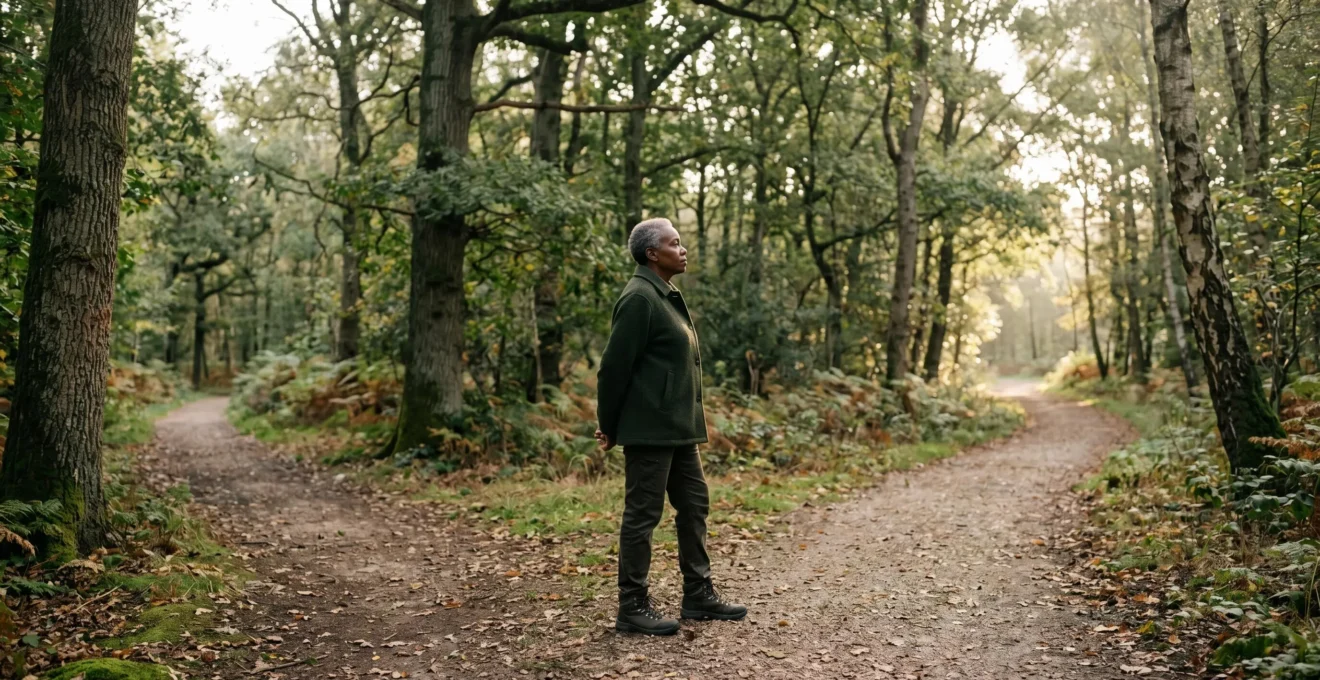
The abrupt loss of a professional identity in retirement creates a psychological void that cannot be filled with simple leisure activities.
- A structured schedule is not a remnant of work-life but a crucial psychological scaffold against depression.
- Replacing status requires a strategic choice between roles offering impact (hands-on) versus governance (strategic).
Recommendation: Instead of seeking hobbies, begin a deliberate process of ‘purpose architecture’—designing a new life structure that provides internal validation, not just external distraction.
The leaving parties have ended, the congratulatory cards have been put away, and a strange, echoing silence has settled in. This is the retirement void. It’s a profound sense of dislocation that arrives when the professional identity you’ve spent decades building is suddenly gone. For many recently retired professionals, the question is not “What will I do with my time?” but a far more unnerving, “Who am I now?”. The well-meaning advice from friends—to take up golf, travel, or simply “relax”—often misses the point. These are activities, not identities. They are ways to pass the time, but they rarely fill the deep human need for structure, status, contribution, and purpose that a career provided.
The truth that few discuss is that navigating this transition is a significant psychological undertaking. It is the work *after* the work. But what if the solution wasn’t to run away from the discipline of your former life, but to repurpose its most powerful tools? What if the key to preventing the void was not to embrace formless freedom, but to consciously architect a new, more meaningful kind of structure? This is not about finding a hobby; it is about a deliberate deconstruction of your old identity and the strategic rebuilding of a new one, based on what truly provides you with a sense of worth.
This article serves as a psychological roadmap for that reconstruction. We will explore not just *what* to do, but the existential *why* behind each strategy. From leveraging schedules to combat depression to choosing volunteer roles that truly replace lost status, you will learn how to build the psychological scaffolding necessary to thrive in this new, powerful chapter of your life.
Summary: The “retirement void”: a psychologist’s guide to rebuilding purpose
- Why treating your leisure time like a job schedule prevents depression?
- Trustee or Shop Volunteer: which role replaces the status you lost?
- The “good old days” trap that blocks you from enjoying the present
- How to learn a language after 65 to prove your brain is still sharp?
- When to take “time apart” in the house now that you are both home 24/7?
- Why loneliness is as damaging as smoking 15 cigarettes a day for UK seniors?
- Why u3a groups are the best antidote to intellectual boredom?
- How to walk into a community hall alone for the first time without anxiety?
Why treating your leisure time like a job schedule prevents depression?
The sudden removal of a daily work schedule is one of the most destabilising aspects of retirement. What feels like liberation on day one can morph into a sense of aimlessness by month three. This is not a failure of imagination; it’s a predictable psychological response. The structure of a job provides more than just a place to be; it offers a rhythm, a set of expectations, and a clear demarcation between effort and rest. Without this psychological scaffolding, the days can blur into one another, leading to a state of low-grade lethargy that can easily curdle into depression. In fact, research shows that retirement depression affects up to 40% of people, often linked directly to this loss of routine.
The counter-intuitive solution is to treat your newfound freedom with the seriousness of a project manager. This is not about recreating the stress of a 9-to-5 job, but about repurposing its most effective tool: the schedule. By intentionally blocking out time for specific categories of well-being—social connection, contribution, learning, and physical movement—you create an external framework that supports your internal state. You are telling your brain that your time still has value and purpose, even if it is not being compensated with a salary.
This ‘purpose architecture’ is a proactive defence against the void. It transforms you from a passive recipient of endless free time into an active designer of a meaningful life. The schedule becomes a personal constitution, a daily declaration of what matters to you now. It provides the gentle, predictable pressure that helps us get out of bed in the morning, not because we *have* to, but because we have made a commitment to ourselves.
Your Action Plan: The Time Blocking Framework for Retirement Well-being
- Relationships block: Schedule specific time for calls, lunches with friends, and family visits to maintain social connections.
- Contribution block: Allocate weekly hours for volunteer work, mentoring, or community service that uses your strengths.
- Learning block: Dedicate time to classes, reading, or skill development to keep your mind engaged.
- Movement block: Plan regular physical activity, walks, or exercise to support both physical and mental health.
- Rest block: Intentionally schedule unstructured time for leisure, reflection, or spontaneous activities.
Trustee or Shop Volunteer: which role replaces the status you lost?
One of the most unspoken losses in retirement is that of status. Whether you were a CEO, a senior manager, or a respected expert, your professional title came with a degree of authority and social standing. The advice to “just volunteer” often fails because it doesn’t account for this critical need. Filling shelves at a charity shop, while a valuable contribution, may not satisfy the psychological needs of someone accustomed to shaping strategy in a boardroom. The key is not to abandon the need for status—which is a deeply human trait—but to find a new, more authentic way to fulfil it.
This requires a strategic, almost clinical, assessment of volunteer opportunities. You must ask yourself: am I seeking to replicate the governance and strategic influence of my former role, or am I seeking a more direct, hands-on sense of immediate impact and social connection? A role as a trustee or board member for a non-profit directly uses high-level professional skills, involves strategic decision-making, and offers a clear sense of authority. Conversely, a role as a frontline volunteer provides tangible, daily results and a rich network of social interactions, which may be more fulfilling than quarterly meetings.
Neither role is inherently better; they simply serve different psychological purposes. The mistake is to take on a role that is misaligned with your core needs, leading to frustration and a sense of “this isn’t what I thought it would be.” By analysing roles through this lens, you can make a conscious choice that rebuilds your sense of self-worth on your own terms, not just as a way to fill time.
This comparative table can help you diagnose which type of role is more likely to satisfy your specific needs for status and purpose, moving you from generic volunteering to strategic contribution.
| Dimension | Trustee Role | Shop Volunteer Role | Founder Role |
|---|---|---|---|
| Status Replication | High – Board meetings, strategic decisions | Low – Hands-on service | Highest – Create your own organization |
| Social Connection | Moderate – Quarterly meetings | High – Daily face-to-face interaction | Variable – Depends on model |
| Time Commitment | 5-10 hours/month | 4-8 hours/week | Flexible, self-determined |
| Professional Skills Used | Strategic thinking, governance | Customer service, organization | All lifetime skills applicable |
| Immediate Impact Visibility | Low – Long-term strategic | High – See results daily | Medium to High |
| Entry Barrier | High – Requires credentials/network | Low – Welcoming to all | Medium – Requires initiative |
The “good old days” trap that blocks you from enjoying the present
Nostalgia can be a warm, comforting blanket in retirement, but it can also become a suffocating trap. When we constantly look back at the “good old days” of our career—the achievements, the camaraderie, the sense of importance—we inadvertently devalue the present moment. This “glory days” syndrome creates a distorted reality where the past is eternally golden and the present seems pale and insignificant in comparison. It is a form of self-sabotage that blocks us from discovering new sources of joy and meaning. The past becomes a museum you live in, rather than a library you learn from.
Breaking this cycle requires a conscious act of grounding yourself in the “now.” The existential challenge is to find a “why” for living today, not just to reminisce about the “why” of yesterday. As the philosopher Friedrich Nietzsche famously argued, this search for purpose is fundamental to human endurance.
According to Nietzsche, he who has a why to live can bear almost any how.
– Friedrich Nietzsche, Referenced in Man’s Search for Meaning context for retirement
The “how” of breaking the nostalgia loop is often surprisingly simple and physical. It involves shifting your focus from the abstract, romanticised memories in your head to the concrete, sensory reality of your immediate environment. A simple grounding exercise can act as a powerful circuit-breaker, pulling your awareness back from the past and anchoring it firmly in the present. This isn’t just a mindfulness trick; it’s a psychological reset that affirms your existence and value in *this* moment, independent of past glories.
- Pause and identify 5 things you can see right now in your immediate environment.
- Notice 4 things you can physically feel (the texture of your clothing, the chair supporting you, the temperature).
- Listen for 3 distinct sounds you can hear in this moment.
- Identify 2 things you can smell in your current space.
- Focus on 1 thing you can taste (even if subtle, like the taste in your mouth).
How to learn a language after 65 to prove your brain is still sharp?
The fear of cognitive decline is a significant source of anxiety for many retirees. After a lifetime of solving complex problems and managing information, the unstructured nature of retirement can feel like a mental atrophy. The desire to “stay sharp” is not just about health; it’s a defiant act of identity, a way of proving to yourself and the world that your mind is still a powerful and capable tool. While crossword puzzles have their place, undertaking a complex, long-term project like learning a new language is a far more profound statement of cognitive vitality.
Learning a language after 65 is not about achieving perfect fluency. It’s about engaging in a process that is inherently challenging and rewarding. It forces your brain to build new neural pathways, to grapple with ambiguity, and to practice the discipline of incremental progress—all skills that were honed during your professional life. This process itself is the victory. And the science supports this; a recent study found that even limited language learning provides significant cognitive benefits. A study of 76 adults aged 65-75 showed measurable cognitive improvements from the process itself.
The most liberating insight from this research comes from one of its leading scientists, who reframes the entire goal of the endeavor.
The participants in our study showed significant cognitive improvements without becoming nearly fluent in Spanish, which suggests that you don’t have to be bilingual for your brain to benefit from working with another language.
– Ellen Bialystok, PhD, OC, FRSC, Distinguished Research Professor, Department of Psychology, York University
This is crucial. The goal shifts from an intimidating external outcome (fluency) to an achievable internal process (engagement). Every new word learned, every grammatical rule understood, is a small, concrete victory—a piece of evidence that you are still growing, learning, and evolving. It’s not about becoming a different person; it’s about becoming a more capable version of the person you already are.
When to take “time apart” in the house now that you are both home 24/7?
For decades, a couple’s home life is structured by the natural rhythm of work. The house is a base of operations you leave and return to, providing built-in time apart and defined shared time in the evenings and weekends. Retirement shatters this structure. Suddenly, two individuals are in a shared space 24/7, and the home transforms from a sanctuary into a potential pressure cooker. The issue is not a lack of love, but a lack of psychological space. The need for solitude, for uninterrupted thought, or simply for “being” without performing for another person is a fundamental human need that work schedules used to provide automatically.
The solution is to redesign your home’s social architecture. This requires moving beyond implicit understandings and establishing clear, negotiated boundaries about time and space. It’s about creating a “zoning strategy” for your home, not unlike a city planner. This means designating certain times or areas for individual use and others for shared activities. It’s about finding a new rhythm that respects both togetherness and autonomy. This proactive communication prevents resentment from building over seemingly small things, like an interrupted reading session or a TV on during a quiet morning.
Implementing a clear strategy for managing shared space is not a sign of a struggling relationship; it’s the hallmark of a mature and resilient one. It acknowledges that both partners are individuals with distinct needs for space and solitude. Below is a practical framework for creating these healthy boundaries.
- Create time-based zones: Designate the same room for different purposes at different times (e.g., living room as a quiet zone in the mornings, a social zone in the evenings).
- Establish visual signals: Use simple, agreed-upon indicators when you need solitude (e.g., headphones on, door partially closed).
- Schedule solo time on a shared calendar: Block out ‘personal time’ with the same importance as appointments to legitimize individual space needs.
- Rotate space ownership: Alternate which partner has priority use of shared spaces on different days or times.
- Plan a weekly ‘relationship check-in’: Hold a structured 30-minute meeting to discuss what’s working and adjust arrangements.
Why loneliness is as damaging as smoking 15 cigarettes a day for UK seniors?
Of all the challenges in retirement, loneliness is the most insidious and the most dangerous. The workplace, for all its faults, is a powerful antidote to social isolation. It provides a default network of acquaintances, colleagues, and casual interactions that form the bedrock of our social lives. When this network dissolves, the resulting silence can be profound. The comparison to smoking is not hyperbole; it is a stark medical reality. According to the U.S. Surgeon General, loneliness increases the risk of premature death by a staggering 26%, with a mortality impact comparable to smoking up to 15 cigarettes a day. It is a chronic condition that silently corrodes both mental and physical health.
To combat loneliness effectively, we must first diagnose it correctly. It is not a monolithic feeling but a complex state with different root causes. A psychologist’s approach is to deconstruct “loneliness” into three distinct types, each requiring a different solution.
- Emotional loneliness: The lack of deep, intimate connection with a confidant. The solution is not a party, but a scheduled, focused one-on-one conversation with a trusted friend or family member.
- Social loneliness: The absence of a wider network of friends and acquaintances with shared interests. This is addressed by joining hobby groups or classes where you have repeated exposure to the same people over time.
- Collective loneliness: The feeling of not belonging to a community or group that shares your values and identity. This is remedied by connecting with groups tied to your heritage, past profession, or core beliefs.
By identifying which type of loneliness you are experiencing, you can move from a vague sense of sadness to a targeted plan of action. Are you missing one deep friendship, a lively social circle, or a sense of shared purpose? Each requires a different strategy. This analytical approach transforms a daunting emotional problem into a series of solvable, practical steps. It empowers you to rebuild your social world with the same intentionality you once applied to your career.
Why u3a groups are the best antidote to intellectual boredom?
For many retired professionals, the end of a career brings a sudden and unwelcome intellectual silence. The daily cut-and-thrust of problem-solving, debate, and learning is replaced by a void that endless daytime television cannot fill. This is not just boredom; it’s a form of intellectual starvation. The University of the Third Age (U3A) movement offers a powerful and elegant solution to this problem, providing a framework for peer-to-peer learning that is uniquely suited to the retired mindset.
Unlike traditional academic institutions, U3A is not a top-down model of experts teaching students. It is a learning cooperative built on a revolutionary principle: that the members themselves are the greatest resource. It operates on the philosophy that everyone has something to teach and everyone has something to learn. This peer-to-peer structure is profoundly validating. It dismantles the traditional hierarchy of teacher and student, creating a community of equals where a retired physicist might learn about art history from a former librarian, who in turn learns about gardening from a retired accountant. It is a global movement, and its scale is a testament to its effectiveness; the U3A movement has grown to include over 1,600 groups in 16 countries, with more than 280,000 members.
The core philosophy of the U3A is its most powerful aspect, creating an environment built on mutual respect and the shared joy of discovery.
Local U3As are learning cooperatives which draw upon the knowledge, experience and skills of their own members to organise and provide interest groups in accordance with the wishes of the membership. The teachers learn and the learners teach.
– The Third Age Trust, Official U3A organizational description
This model brilliantly solves two of retirement’s biggest challenges simultaneously. It provides endless intellectual stimulation by offering courses on virtually any subject imaginable, from quantum physics to ancient Greek. At the same time, it rebuilds the social network that was lost when work ended. It’s not just a class; it’s a community built around a shared passion for knowledge, making it a near-perfect antidote to the twin threats of boredom and isolation.
Key takeaways
- Retirement depression is often caused by the loss of structure; recreating a schedule is a psychological necessity.
- Volunteer roles should be chosen strategically to replace the specific needs (status vs. impact) that your career fulfilled.
- Loneliness is a serious health risk that can be deconstructed into solvable problems: emotional, social, and collective.
How to walk into a community hall alone for the first time without anxiety?
All the strategies for rebuilding a life—joining groups, volunteering, taking classes—hinge on one terrifying moment: walking into a room full of strangers, alone. For an individual who was once a respected leader or an integral part of a team, this return to the status of “newcomer” can be intensely humbling and anxiety-provoking. The fear of being judged, of not knowing anyone, of standing awkwardly in a corner, is a powerful deterrent that keeps many people isolated at home. Overcoming this specific fear is perhaps the most critical and courageous act of building a post-retirement life.
The solution lies in shifting from a passive, anxious mindset (“I hope someone talks to me”) to an active, strategic one. You can manage this social anxiety with the same kind of preparation and tactical thinking you once applied to a challenging business meeting. It’s about giving yourself a mission, an “anchor point,” and a clear exit strategy. This is not about faking confidence; it’s about creating the conditions that allow real confidence to emerge. It’s about taking control of the variables you can, so the variables you can’t control—like who you’ll meet or what the atmosphere will be—feel less threatening.
The following “Social Entry Toolkit” is a set of practical, actionable steps to reduce the anxiety of that first encounter. It’s a psychological field guide for navigating new social terrain.
- Reconnaissance mission: Visit the venue at a quiet time before the event to familiarize yourself with the layout, parking, and entrances.
- The digital handshake: Email or message the organizer beforehand saying you’re new and a bit nervous—good organizers will watch out for you.
- The helper role: Arrive 5-10 minutes early and ask the organizer, “Can I help with anything?” This gives you an immediate purpose and a natural conversation starter.
- Identify your anchor point: Choose a “safe” spot, like near the refreshments or the entrance, where you can stand and observe without feeling exposed.
- Shift to external focus: When anxiety rises, consciously observe the room’s details (posters, decorations, what others are doing) rather than focusing on your internal feelings.
- Set a minimum viable attendance: Promise yourself you will stay for just 20 minutes. You can always leave, but often the anxiety decreases significantly after this initial threshold.
Ultimately, navigating the retirement void is an active, not a passive, process. It is the final and most personal project of a long career. By applying structure, strategic choice, and a small dose of courage, you can transform this period of transition from an ending into your most meaningful beginning.