
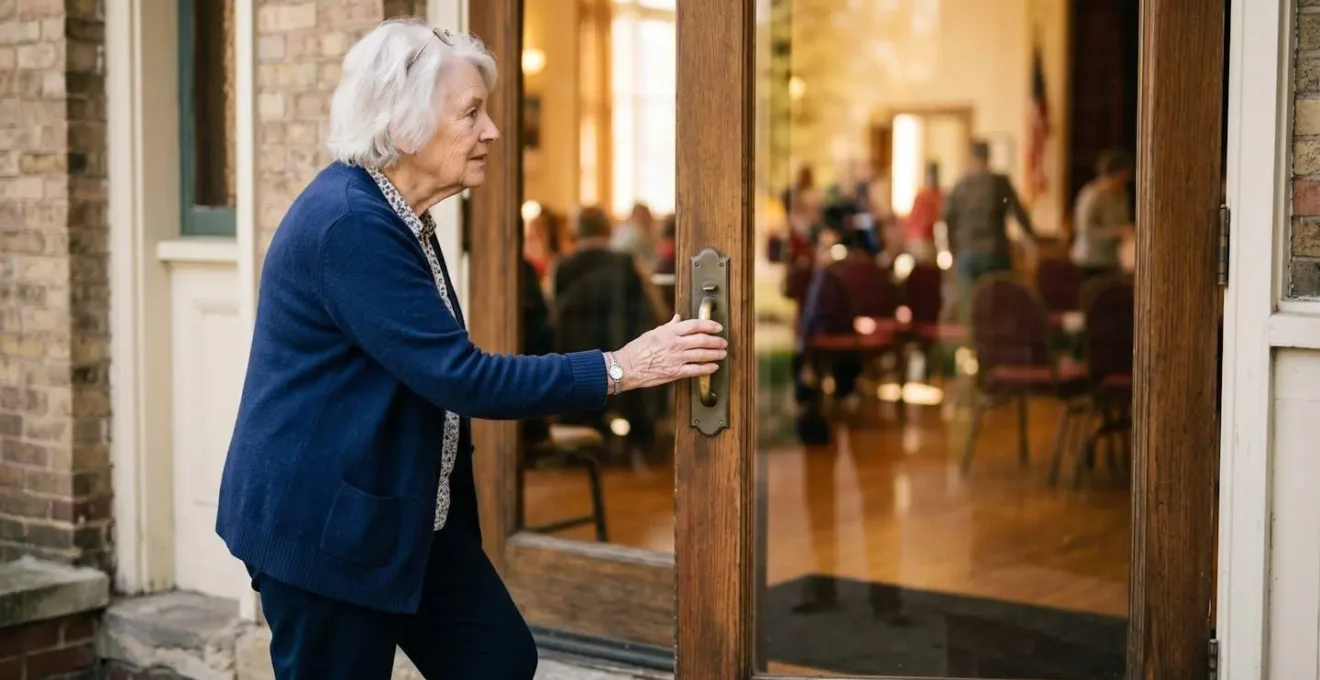
The secret to overcoming social anxiety isn’t fighting your feelings—it’s strategically choosing an environment that works with them.
- Focus on groups built around a “parallel activity” (like knitting), which lowers the pressure to make constant conversation.
- Create a simple “entry point strategy” by identifying a key person (like an organizer) to approach first, giving you a clear, manageable mission.
Recommendation: Master the art of strategic observation and learn to leave an event early and on a high note. This builds positive momentum and preserves your energy for next time.
The moment is instantly recognizable: you’re standing at the threshold of a community hall, a library meeting room, or a church basement. Inside, the low hum of conversation is punctuated by laughter. You want to join, to connect, to be part of it. But an invisible wall of anxiety holds you back. This “threshold fear” is incredibly common, especially for introverted seniors re-entering the social world. Well-meaning advice to “just be yourself” or “be more confident” often misses the point entirely.
These platitudes ignore the very real, physical sensations of anxiety and the mental hurdle of walking into a room of strangers alone. They place the burden entirely on you to change your fundamental personality. But what if the problem isn’t your confidence? What if the secret lies not in changing *who you are*, but in strategically changing *how* you engage? The key is to stop trying to overpower anxiety and start using social architecture to your advantage.
This isn’t about faking extroversion; it’s about being a smart introvert. It’s about choosing the right environment, having a plan, and knowing how to manage your social energy like the precious resource it is. By shifting your focus from internal feelings to external strategy, you can turn an intimidating experience into a manageable, and even enjoyable, one. This guide will walk you through the practical, step-by-step mechanics of doing just that.
To help you navigate this process, we’ve broken down the key strategies into manageable steps. This structured approach will give you the tools and the confidence to not just enter the room, but to find your place within it.
Summary: How to Walk into a New Social Group Alone (and Actually Enjoy It)
- Why knitting circles are often more welcoming than book clubs for newcomers?
- How to identify the key organizer to make your entry smoother?
- Dial-a-Ride or Taxi: finding reliable transport for evening events?
- The mistake of joining a committee too soon and burning out
- When to leave a social event early to preserve energy (and how to do it politely)?
- How to find “Men in Sheds” or WI groups nearby without using Facebook?
- When to schedule the weekly Zoom to match the family’s Sunday routine?
- Living in a “chocolate box” village: how to fight isolation when the bus route is cut?
Why knitting circles are often more welcoming than book clubs for newcomers?
The choice of group is the single most important factor in managing entry anxiety. A common mistake is to choose based solely on interest, without considering the group’s “social architecture.” For instance, a book club seems like a great idea, but its core activity is debate and direct, face-to-face conversation—a high-pressure scenario for a newcomer. In contrast, a knitting circle, a painting class, or a woodworking group operates on the principle of parallel activity. The shared craft provides a central focus, allowing for comfortable silences and organic, low-stakes interactions.
This isn’t just a feeling; it’s backed by research. The structure of a craft-based group provides a natural buffer. You can be present and engaged in the group without the constant pressure to perform conversationally. Your hands are busy, giving you a reason to look down and focus, and any conversation that emerges is often about the shared task, which is an easy, built-in topic. One study on the therapeutic benefits of knitting groups found that they create a psychologically safer environment for building social connections. In fact, research demonstrates that anxiety decreased significantly in newcomers after just one session.
This concept of a shared focus allowing for both connection and quiet solitude is powerful. An analysis of a 4-week knitting program for youth with neurodevelopmental challenges, the KneuroKnits program, highlighted this dynamic. Participants experienced a significant increase in meaningful interactions because the craft provided a shared purpose that made silence comfortable, not awkward. Choosing a group with this kind of built-in social scaffolding is a strategic move that sets you up for success before you even walk through the door.
How to identify the key organizer to make your entry smoother?
Once you’ve chosen a promising group, your next step is to create a simple, actionable “entry point strategy.” The goal is to replace the paralyzing thought of “What do I do when I get in there?” with a clear, mechanical mission. One of the most effective missions is to find the key organizer. This person is your bridge into the group. They hold the social map and are often actively looking for new faces to welcome.
Approaching a designated organizer is far less intimidating than trying to break into an established circle of friends. You have a legitimate reason to talk to them: “Hello, I’m new here, is this the right place for the watercolour group?” This simple, scripted question removes the pressure of coming up with brilliant small talk on the spot. As Gincy George, a licensed social worker, notes in the Care.com Senior Anxiety Guide, finding out if a group has a welcoming system in place can make all the difference. She explains:
Seeing if the community offers a buddy system or ‘warm welcome’ for new participants can turn a new environment from intimidating to welcoming.
– Gincy George, MSW, LSW, Care.com Senior Anxiety Guide
Finding this key person or system transforms you from a lost outsider to a proactive newcomer. But how do you spot them in a busy room? It requires a bit of strategic observation before you even leave your chair.
Your Checklist for Spotting a Welcoming Organizer
- Scan the Room: Look for the person who is actively scanning the room and making eye contact, especially with people standing alone. They are the group’s radar.
- Observe Movement Patterns: Note who moves between different small groups, connecting them, rather than staying planted in one closed-off circle. This is often a social facilitator.
- Do Pre-Event Recon: Check event flyers, newsletters, or online notices beforehand for a contact name. This gives you a name and a face to look for, and a perfect opening line: “Excuse me, are you Susan? I’m the one who emailed yesterday.”
- Identify the ‘Social Hub’: Observe who others naturally turn to when they need something—more coffee, a schedule question, or an introduction. This person is the functional, if not official, organizer.
- Ask About a Buddy System: When you find a staff member or the organizer, directly ask if they have a ‘buddy system’ or a ‘warm welcome’ program for new attendees. This signals your need and gives them a clear way to help.
Dial-a-Ride or Taxi: finding reliable transport for evening events?
Social anxiety isn’t just about the event itself; it’s fueled by all the uncertain variables surrounding it. One of the biggest sources of “what if” thinking is transportation, especially for evening events. “What if the bus is late?” “What if I can’t find parking?” “What if I feel tired and want to leave, but I’m stuck waiting for a ride?” Eliminating these worries is a crucial step in preserving your mental energy for the social interaction itself.
Pre-arranging your transport with a reliable service like Dial-a-Ride or a trusted taxi company does more than just get you from point A to point B. It provides a structural solution to an emotional problem. By booking your ride in advance, you create certainty. You know how you’re getting there, and more importantly, you have a guaranteed, no-excuse-needed exit plan. This knowledge alone can dramatically lower the baseline anxiety you feel leading up to the event. Many local senior programs understand this need, and many senior transportation programs now offer services for evenings and weekends, though they often require advance booking.
To make this strategy work for you, think like a logistics manager. Schedule your arrival for 10 minutes before the event starts to give yourself a buffer. When booking your return trip, set a definite time. This isn’t just about getting home; it’s about giving yourself permission to leave. If you know your ride is coming at 8:30 PM, you have a perfect, polite, and non-negotiable reason to depart, which we’ll cover more in a moment. Always keep a backup number—a local taxi firm or a family member—on hand. The goal isn’t just to have a ride, but to eliminate the *fear* of being stranded.
The mistake of joining a committee too soon and burning out
When you’re new to a group and eager to fit in, it can be tempting to say “yes” to every opportunity, especially if you’re invited to join a committee or take on a formal role. This feels like a fast track to belonging, but it’s often a trap that leads to overwhelm and burnout. Committing too early is a classic mistake. It bypasses the crucial phase of observation and places you in a high-pressure, high-responsibility position before you’ve even learned the group’s unspoken rules and dynamics.
Instead, give yourself permission to embrace the “strategic observer” role. For the first few meetings, your job is not to contribute, lead, or organize. Your job is simply to watch and learn. This isn’t being passive or shy; it’s data collection. Who are the key players? What are the group’s rituals? Where are the points of friction? By observing from the periphery, you gain a deep understanding of the social landscape without draining your energy reserves. This approach also protects you from the very real risk of volunteer burnout, a problem that organizations are deeply concerned about. In fact, recent studies show that over 76% of nonprofit leaders said burnout already affects their ability to carry out their mission.
Think of your social energy as a finite battery. A committee role is a major power draw. Simply attending and observing is a low-energy activity that allows you to charge your “social battery” with positive, low-pressure experiences. Only after you feel genuinely comfortable and have a clear sense of the group’s function should you even consider taking on more responsibility. Resisting the urge to jump in is a sign of wisdom, not weakness. It’s how you ensure your engagement is sustainable for the long haul.
When to leave a social event early to preserve energy (and how to do it politely)?
One of the most empowering skills an introvert can learn is the art of the graceful early exit. For someone with social anxiety, the thought of being “trapped” at an event is a major deterrent. Knowing you have a polite and effective exit strategy in your back pocket can be the very thing that gives you the confidence to go in the first place. The key is to reframe leaving early: it’s not a social failure, it’s a strategic success. You are actively managing your energy to ensure a positive experience.
The golden rule is to leave while you are still having a good time. Don’t wait until you’re exhausted, overwhelmed, or desperate to escape. By leaving on a high note, your final memory of the event is positive, which makes you much more likely to want to return. Your goal is to build a series of small, positive social experiences. A brief, pleasant visit is infinitely more valuable than a long, draining one. As the experts at Care.com advise, this is a core principle for rebuilding social comfort.
Small, structured steps are key to rebuilding social comfort. Brief outings, low-pressure activities and predictable daily routines can help anxious seniors re-engage without feeling overwhelmed.
– Care.com Expert Panel, When your senior loved one has social anxiety
So how do you do it politely? The trick is to be brief, positive, and final. You don’t need a long, elaborate excuse. A simple, warm statement is all that’s required. About an hour before you plan to leave, you can “seed” your exit by casually mentioning to the organizer or someone you’re chatting with, “I’ll have to head off around 8, but this has been lovely.” When the time comes, find the host, make eye contact, smile, and say, “This was wonderful. I need to get going, but I’m really looking forward to the next one.” Then, turn and walk away. Don’t linger for “just one more conversation.” The brief, positive, and final formula is your ticket to a perfect exit.
How to find “Men in Sheds” or WI groups nearby without using Facebook?
In our hyper-digital world, it’s easy to assume that all community groups live on Facebook. But for many seniors, this platform is either unfamiliar or undesirable, and importantly, many of the most established, hyper-local groups have little to no digital presence. Finding them requires a return to “analog” search methods. This is actually an advantage, as these offline networks are often more robust and deeply embedded in the community fabric. It’s encouraging to remember you are not alone in seeking these connections; research from the Pew Center shows that in the U.S., two-thirds of Americans ages 65 and older participate in at least one community organization.
Your first stop should be the physical hubs of your community. The humble notice board is still a powerhouse of local information. Check the ones at your local library, the GP surgery waiting room, the Post Office, and your local church or village hall. These are often filled with flyers and posters for groups like the Women’s Institute (WI), Men in Sheds, walking clubs, and craft circles that don’t rely on social media.
Next, tap into local publications. Your Parish or Town Council newsletter is a goldmine. These are often delivered to every home and contain contact details for community organizers who may not even have an email address. Don’t underestimate the power of your “weak-tie network”—the people you interact with casually but regularly. Your pharmacist, a friendly shopkeeper, or your hairdresser often have their finger on the pulse of local happenings. Simply asking, “I’m looking to join a group of some kind, do you know of anything happening locally?” can unlock a wealth of information. Finally, a visit to your local senior center or Age UK branch in person is invaluable. Staff there maintain up-to-date lists and can often make a personal introduction.
When to schedule the weekly Zoom to match the family’s Sunday routine?
The principles of managing social energy and anxiety don’t just apply to in-person events. They are just as relevant to the world of digital connection, like the weekly family Zoom call. For many, the “Sunday call” has become a fixture, but it often falls during the busiest, most chaotic part of a family’s weekend, leading to distracted participants and a feeling of obligation rather than connection. To make these calls more meaningful, you can apply the same strategic thinking: challenge assumptions and collaborate on the “social architecture” of the call.
Instead of defaulting to a long Sunday afternoon call, consider proposing a change. A shorter, more focused 20-minute mid-week check-in on a Wednesday evening might be more welcome and receive more focused attention than an hour-long call competing with Sunday dinner prep and homework. The goal is quality of connection, not quantity of time. You can also use the “Bookend Ritual” strategy. Frame the call as a specific, cherished event by scheduling it as a “Sunday Morning Coffee Catch-up” before the day’s activities begin, or a “Sunday Evening Wind-Down” after the day’s chores are done.
Shift your role from being a passive recipient of a schedule to an active collaborator. Instead of asking “When are you free?”, offer a structured choice: “I’m free between 10-11 am on Sunday or after 7 pm, what works better for you all?” This informal poll gives others agency and shows you are working with them. The key is to frame the call as a valued ritual you want to protect, not another task to be squeezed into a busy day. Experimenting with a shorter, more frequent call can often feel less like an obligation and more like a welcome, regular touchpoint for everyone involved.
Key takeaways
- The most effective way to manage social anxiety is to strategically choose the right environment; opt for groups with a “parallel activity” (like crafts) over those focused solely on conversation.
- Replace anxiety with action by creating a simple “entry point strategy,” such as making it your mission to find the group’s organizer first.
- Treat your social energy as a finite resource. Master the art of observing first and leaving early on a high note to build positive momentum for future events.
Living in a “chocolate box” village: how to fight isolation when the bus route is cut?
The picturesque “chocolate box” village can be a wonderful place to live, but it often hides a growing problem of isolation, especially when essential services like a bus route are cut. This loss of mobility can feel like a devastating blow, severing connections to the wider community and deepening feelings of loneliness. This is a widespread issue; recent national polling reveals that 34% of older adults in 2023 reported feeling socially isolated, a figure that has risen since the pandemic. When you can no longer travel *to* social events, the strategy must shift from being a social participant to becoming a hyper-local social architect.
The solution is to stop thinking about traveling to the community and start thinking about bringing the community to you, one tiny piece at a time. This doesn’t mean hosting large, stressful parties. It means creating “micro-community” hubs right where you are. Instead of mourning the loss of the bus, what if you initiated an informal lift-sharing scheme with a few neighbours for a weekly trip to the supermarket? This single act transforms you from an isolated individual into an active, helpful organizer.
As one community health expert from the NCOA guide on social isolation notes, the barriers are multifaceted:
Mobility challenges, hearing loss, a lack of transportation, grief—all of these things can prevent seniors from feeling connected to the outside world.
– Community Health Expert, NCOA Online Therapy for Social Isolation Guide
The answer is to create opportunities for connection that bypass these barriers. You could start a “front garden coffee morning” once a month for your immediate neighbours—a simple gathering that requires no travel for anyone. Or create a book or puzzle swap box by your front gate; it becomes a tiny, passive community hub, a point of connection that works even when you’re not there. By focusing on creating these small, manageable, hyper-local events, you become the destination. You become the new, vital node in your village’s social network, proving that connection is possible, even when the bus stops running.
Start by choosing one small, manageable action from this guide. Your journey to connection begins not with a sudden leap of faith, but with a single, well-placed, strategic step. Evaluate the options available to you and begin building the social life that works for you, on your terms.