
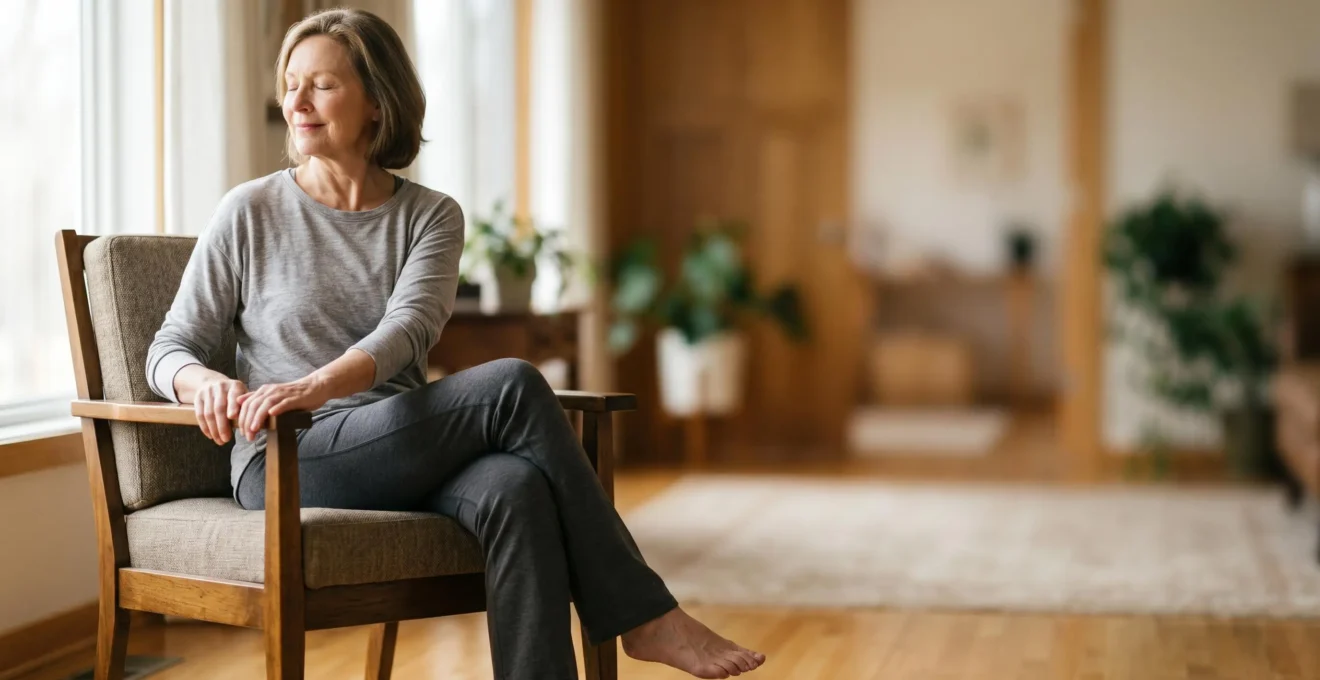
The fear of falling often makes balance-improving exercises feel inaccessible, but the solution might not be on your feet. Chair yoga is a precise system that rebuilds stability from the core outwards, making it a powerful tool for fall prevention.
- It focuses on neuromuscular re-education, strengthening the brain-body connection essential for steady movement.
- Specific breathing techniques actively lower blood pressure and calm the nervous system, reducing the “startle and fall” reflex.
Recommendation: Start by mastering core engagement and controlled breathing from a chair to build a safe and effective foundation for better balance.
For many seniors, the risk of a fall is a constant, low-level anxiety. Well-meaning advice often centers on standing exercises that, for someone with poor balance, can feel more like a risk than a solution. We’re told to be active, but the very activities meant to help can seem terrifying. It’s a frustrating paradox: the fear of falling prevents the practice that could prevent the fall. This is why more than one out of four older people fall each year, a statistic that looms large in daily life.
Many dismiss chair yoga as a “lesser” form of exercise, a diluted version for those who can’t do the “real” thing. This misses the point entirely. What if the key to preventing falls isn’t about pushing through difficult standing poses, but about methodically rebuilding your body’s balance system from a safe, stable base? The secret of effective chair yoga isn’t that it’s easy; it’s that it’s intelligent. It’s a form of targeted neuromuscular re-education.
This article will deconstruct exactly how and why chair yoga works. We will explore the science behind engaging your core while seated, how specific breathing techniques can regulate your body’s physical stress response, and the critical difference between productive stretching and harmful over-exertion. We will move beyond the simple poses to understand the principles that create true, functional balance—the kind that keeps you steady in the real world.
To help you navigate these essential concepts, this guide breaks down the core components of an effective and safe chair yoga practice. Explore the sections below to understand how each element contributes to building your confidence and stability, one seated movement at a time.
Summary: The Science and Strategy Behind Chair Yoga for Fall Prevention
- Why engaging your core while sitting is the secret to standing up steadily?
- How to use “box breathing” to lower blood pressure in 5 minutes?
- YouTube vs Local Hall: can you learn safe form from a screen?
- The error of forcing a stretch that causes ligament damage in older joints
- When to practice chair yoga to reduce morning stiffness?
- The “boom and bust” cycle error that leaves you bedridden for 2 days
- Why knitting circles are often more welcoming than book clubs for newcomers?
- Managing blood pressure at home: the 5 mistakes skewing your readings?
Why engaging your core while sitting is the secret to standing up steadily?
True balance doesn’t start in your feet or legs; it originates in your core. For seniors, the simple act of standing up from a chair can be a moment of high fall risk. This is often because the deep stabilizing muscles of the trunk aren’t activating properly. The body should automatically engage the core in a process called postural anticipation, bracing for the movement *before* it even begins. When this connection is weak, the body is unprepared, leading to unsteadiness.
Chair yoga directly addresses this by teaching you to isolate and strengthen these crucial muscles from a safe, seated position. Poses like seated cat-cow or gentle twists aren’t just for spinal mobility; they are drills in neuromuscular control. They force you to connect your mind to the muscles of your abdomen, lower back, and pelvic floor, re-establishing a line of communication that may have been dormant. This isn’t just about building strength, but about retraining the brain.
The Science of Sit-to-Stand Safety
Research confirms this principle. One study on sit-to-stand transitions found that exercises specifically targeting deep core muscles—like the transverse abdominis and pelvic floor—significantly improved the body’s anticipatory postural control. By strengthening these muscles, participants enhanced the neuromuscular control needed for the vulnerable movement of standing up, effectively reducing their fall risk during this common daily activity.
Think of it as waking up your body’s internal corset. Every time you consciously pull your navel toward your spine during a seated pose, you are practicing the very skill needed to stand up with confidence. This is why a simple seated practice has such a profound impact on standing balance, as it builds the foundational stability that makes all other movements safer.
How to use “box breathing” to lower blood pressure in 5 minutes?
Balance is not just a physical skill; it’s also deeply connected to your nervous system. A sudden noise, a moment of surprise, or anxiety can trigger a “startle reflex,” causing muscles to tense and blood pressure to spike, creating a perfect storm for a fall. Learning to regulate your nervous system is as important as strengthening your muscles. This is where controlled breathing, a cornerstone of any yoga practice, becomes a powerful tool for safety.
Box breathing, also known as Sama Vritti pranayama, is a simple yet profound technique that directly influences the parasympathetic nervous system—the body’s “rest and digest” mode. By creating a slow, rhythmic pattern of inhaling, holding, exhaling, and holding, you are sending a powerful signal to your brain to calm down. This isn’t a placebo effect; research from Harvard Medical School shows that consistent breathing exercises lead to documented declines in both systolic and diastolic blood pressure. A calmer cardiovascular system means a steadier body.
Here is a simple, step-by-step guide to practice box breathing for 5 minutes:
- Sit upright in a comfortable chair with your feet flat on the floor. Rest your hands in your lap with palms facing up to encourage relaxation.
- Exhale fully through your mouth, emptying your lungs completely to establish a baseline.
- Inhale slowly through your nose for a count of 4, feeling your belly expand.
- Hold your breath for a count of 4. Remain calm and still.
- Exhale slowly through pursed lips for a count of 4, as if gently blowing out birthday candles.
- Hold your lungs empty for a count of 4 before beginning the next cycle.
- Repeat this cycle for 5 minutes. This duration is key to activating the parasympathetic nervous system and realizing the physiological benefits.
Integrating this practice into your daily routine, especially before activities that cause you anxiety, can fundamentally change your body’s response to stress. It provides a tangible method to manage not just your mental state, but the physical responses that can contribute to instability.
YouTube vs Local Hall: can you learn safe form from a screen?
The accessibility of online classes has been a wonderful development, allowing anyone to start a practice from the comfort of their home. However, for a senior starting chair yoga specifically for balance, the question of safety is paramount. Can you truly learn the correct, safe form from a screen, or is an in-person class at a local community hall a better choice? The answer depends on several factors.
An online class offers unmatched convenience and affordability. You can practice any time, repeat sessions, and find instructors from all over the world. The major drawback, however, is the complete lack of personalized feedback. A YouTube instructor cannot see if you are holding your breath, slumping your shoulders, or putting undue strain on a joint. Self-assessment is a difficult skill, and what feels right may not be correct or safe.
This is where an in-person class shines. A qualified instructor can provide real-time corrections, offer personalized modifications for your specific limitations (like arthritis in one shoulder), and use tactile cues to help you understand a movement. The group energy and social connection also provide motivation that is hard to replicate alone in your living room.
Ultimately, a hybrid approach may be best. Attending a few in-person classes to learn the fundamental principles of alignment and breathing can provide you with the tools to then practice safely at home with online resources. The key is to build a foundation of body awareness under expert guidance first. This table breaks down the key considerations:
| Aspect | YouTube/Online Classes | Local In-Person Classes |
|---|---|---|
| Accessibility | Available 24/7, practice anytime at home | Fixed schedule, requires transportation |
| Cost | Free or low-cost ($0-20/month) | $10-25 per class or $50-100/month |
| Form Correction | No personalized feedback, self-assessment only | Instructor provides real-time corrections and adjustments |
| Modifications | Generic modifications shown, must self-select | Personalized modifications for individual limitations |
| Proprioceptive Learning | Visual cues only, no tactile guidance | Instructor touch and physical cues enhance body awareness |
| Social Connection | Isolated practice, no peer interaction | Group energy, co-regulation through shared breathing |
| Consistency | High—convenient daily practice without commute | Moderate—depends on class availability and travel |
| Safety Verification | Requires vetting instructor credentials (C-IAYT, senior specialization) | Facility typically pre-screens instructors for qualifications |
The error of forcing a stretch that causes ligament damage in older joints
One of the most dangerous misconceptions about yoga is that the goal is to become as flexible as possible. For seniors, this mindset is not just unhelpful; it can be actively harmful. Pushing into a stretch with force, trying to achieve a shape you saw someone else do, can lead to over-stretching ligaments—the connective tissues that stabilize your joints. Unlike muscles, ligaments have poor blood supply and do not heal well once damaged, potentially leading to chronic instability.
This is why a central tenet of safe chair yoga is the distinction between flexibility and mobility. As the Gentle Years Yoga Research Team eloquently puts it:
The goal of chair yoga is not flexibility, but mobility—distinguishing between passive range of a joint versus usable, controlled range of motion for daily activities.
– Gentle Years Yoga Research Team, NIHR Open Research study on chair-based yoga for older adults with multiple long-term conditions
Mobility is usable flexibility. It’s the range of motion you can control with your own strength. The goal isn’t to force your leg up to your ear; it’s to have enough controlled hip mobility to comfortably tie your shoes or step into a bathtub. This requires learning to listen to your body and differentiate between productive discomfort (a muscle stretching) and warning signs of pain (a joint being compromised).
Ignoring this distinction is a critical error. Instead of pushing for a deeper stretch, the focus should be on moving mindfully within your current range and gently exploring the edges. Using props like cushions to support you or simply reducing the range of a movement is a sign of wisdom, not weakness. It’s this intelligent approach that prevents injury and allows for a sustainable, lifelong practice that truly enhances your daily function.
Your Guide to Recognizing Pain vs. Discomfort
- GREEN LIGHT (Productive Discomfort): A gentle pulling sensation in the belly of a muscle, a feeling of mild warmth, or the sense of “waking up” stiff areas. This is the safe zone for stretching.
- YELLOW LIGHT (Caution Zone): Any sharp sensation that makes you hold your breath, a pulling feeling at the very end of a joint, or discomfort that feels different on one side of your body. Immediately reduce the intensity.
- RED LIGHT (Stop Signal): A pinching feeling in your hip socket or lower back, any shooting pain down a limb, dizziness, nausea, or any pain that lingers after you release the pose. Stop the exercise immediately.
- Recovery Rule: If you experience a “yellow” or “red” signal, return to a neutral position, take three deep, slow breaths, and only then attempt the movement again at 50% of your previous range.
- Daily Check-In: During any pose, ask yourself, “Could I hold a comfortable conversation right now?” If the answer is no, you have gone too far and need to ease back.
When to practice chair yoga to reduce morning stiffness?
Waking up feeling stiff and sore is a common complaint, making the first hour of the day a challenge. Joints that have been immobile overnight lack lubrication from synovial fluid, leading to that “rusty” feeling. While it might seem counterintuitive to exercise when you feel at your worst, a gentle, well-timed chair yoga session is one of the most effective ways to combat this morning stiffness and ease into your day with greater comfort and mobility.
The key is not to jump into a vigorous routine immediately. The body needs a gradual wake-up call. A two-stage approach is often most effective. The first stage can begin before you even get out of bed, performing small, gentle movements to start the flow of synovial fluid. The second stage, a more formal seated practice, is best done after a light meal or a warm drink, once your body’s natural cortisol levels have begun to rise, providing a small boost of energy.
Finding the right time is also about building a consistent habit. Tying your practice to an existing daily ritual—like after your morning coffee or before reading the newspaper—creates a powerful “habit anchor” that makes it much more likely you’ll stick with it. Even a 10-minute session can dramatically change how you feel for the rest of the day.
Here is a proven strategy for incorporating chair yoga into your morning to melt away stiffness:
- Stage 1 – Bed Yoga (3 minutes before rising): While still lying down, perform gentle ankle circles (10 each direction), wrist rotations (10 each way), and hug your knees to your chest one at a time (holding for 20 seconds each). This starts lubricating the joints.
- Stage 2 – Post-Breakfast Chair Session (10-15 minutes): After a light meal, sit in a sturdy chair and perform seated cat-cow stretches, gentle shoulder rolls, and easy spinal twists to mobilize the larger muscle groups of the torso and spine.
- Optimal Timing: The most benefit for morning stiffness is typically found 30-60 minutes after waking. However, short “movement snacks” of 3-5 minutes during the day (e.g., during TV commercials) are also highly effective at preventing stiffness from setting back in.
- The Consistency Anchor: The most important rule is to find a time that works for *you* and link it to something you already do every day. Consistency is far more important than the exact time of day.
The “boom and bust” cycle error that leaves you bedridden for 2 days
A common and discouraging pitfall when starting any new exercise program is the “boom and bust” cycle. On a day you feel good, you do too much—a full 45-minute class, extra repetitions—and feel a sense of accomplishment. But the next day, or even for two days after, you are exhausted, sore, and unable to do much of anything. This pattern of overexertion followed by a forced crash-and-recovery period is not only physically depleting but also emotionally demoralizing, often leading to people abandoning their practice altogether.
The solution is a radical shift in mindset: consistency beats heroics. The goal is not to have one “heroic” workout, but to finish every session feeling as good as, or even slightly better than, when you started. This requires leaving your ego at the door and practicing at 80% of what you *think* you can do. This 20% buffer is your insurance against post-exertional fatigue.
This principle is supported by research. A 2024 study following older adults for eight weeks found that those who participated in chair yoga twice a week showed significant improvements in balance and confidence. The key success factor was not the intensity of their sessions, but their regularity. Participants who maintained consistent 20-30 minute sessions recovered better and made more progress than those attempting sporadic, longer workouts, successfully avoiding the boom-and-bust pattern.
One of the most effective ways to manage your energy and avoid this cycle is by adopting a “Spoon Theory” approach to your practice. Imagine you start each day with a certain number of “spoons,” representing your finite energy. You can then choose a practice level that matches your available spoons for that day, ensuring you always stay within your energy envelope.
- 1-Spoon Day (Low Energy): 5-minute seated breathing practice only. No physical poses required, just focus on box breathing.
- 3-Spoon Day (Moderate Energy): 15-minute routine including seated breathing, gentle upper body movements like shoulder rolls, and easy seated twists.
- 5-Spoon Day (Good Energy): A full 25-minute practice including breathing, a wider range of seated poses, and even some standing balance work using the chair for support.
- The Golden Rule: Always finish your session feeling energized, not depleted. If you feel tired afterward, you have exceeded your energy envelope for that day and should scale back for the next few sessions.
Key takeaways
- True balance starts not in the legs, but with a strong, engaged core, which chair yoga specifically trains.
- Controlled breathing is a physical tool to calm your nervous system, reducing the “startle” reflex that can lead to falls.
- Consistency is more important than intensity. A gentle 15 minutes daily builds more long-term stability than one exhausting weekly session.
Why knitting circles are often more welcoming than book clubs for newcomers?
This question seems unrelated to yoga, but it holds a deep truth about what makes a successful and sustainable practice for seniors. A book club requires you to have read the book; there’s a prerequisite, a bar to entry. A knitting circle, however, welcomes you as you are. You can be a master or a complete novice just learning to cast on. Everyone works on their own project, at their own pace, in a shared space of quiet focus and mutual support. A good chair yoga class should feel more like a knitting circle than a book club.
Fear of judgment is a major barrier to joining any group activity. “What if I can’t keep up?” “What if I look foolish?” “What if I’m the only one who can’t do it?” These anxieties are valid, and they are amplified when it comes to physical exercise. A welcoming, non-competitive environment is therefore not a luxury, but a necessity for long-term adherence and success. The social and emotional components of practice are just as critical as the physical ones.
In fact, research published in a peer-reviewed health journal found that a yoga-based intervention had positive effects on the social status of female seniors, reducing feelings of nervousness and depression alongside improvements in balance. Feeling part of a community is a powerful health benefit in itself.
Participants in a qualitative study on chair yoga perfectly captured this sentiment, giving us the perfect metaphor for what to look for in a class:
A good chair yoga class is like a knitting circle, not a book club—everyone works at their own pace with no prerequisite except an ability to sit and a willingness to breathe.
– Gentle Years Yoga Qualitative Study Participants, Effectiveness and cost-effectiveness study of chair-based yoga for older adults
When seeking out a class, whether online or in-person, look for this “knitting circle” ethos. Look for an instructor who emphasizes personal experience over perfect poses, who celebrates modifications, and who fosters an atmosphere where everyone feels seen, safe, and successful just for showing up.
Managing blood pressure at home: the 5 mistakes skewing your readings?
For many seniors, managing blood pressure is a daily reality and a key indicator of overall health. The mindfulness and physiological regulation learned in chair yoga, particularly through breathing exercises, can have a direct, positive impact on these numbers. However, the benefits of your practice can be obscured by common mistakes made during at-home monitoring. Inaccurate readings can lead to unnecessary anxiety or, conversely, a false sense of security. Understanding how to take a proper reading is a crucial skill.
Many factors can temporarily elevate your blood pressure, leading to a reading that doesn’t reflect your true resting state. These include stress, recent physical activity, and even the position of your body. Learning to control these variables is just as important as the measurement itself. The calm, centered state you cultivate in chair yoga is the ideal state in which to measure your blood pressure, but you must ensure your process is correct.
Here are the five most common mistakes that can skew your home blood pressure readings, and how to correct them to get a true picture of your cardiovascular health:
- Mistake #1 – Measuring During ‘Reading Anxiety’: The stress about the measurement itself can elevate results. Solution: Perform 2-3 minutes of box breathing (as learned in your practice) immediately before measuring. This ensures the reading reflects your resting state, not your anxiety about the test.
- Mistake #2 – Wrong Body Position: Dangling feet, an unsupported back, or having your arm at the wrong height will all give false readings. Solution: Sit in a chair with your back supported and feet flat on the floor for 5 minutes before measuring. Your arm should be supported on a table at heart level.
- Mistake #3 – Post-Activity Timing: Measuring too soon after exercise, drinking caffeine, or eating can inflate your numbers. Solution: Wait at least 30 minutes after any physical activity, caffeine intake, or a meal before taking a reading.
- Mistake #4 – Ignoring Circadian Rhythm: Your blood pressure naturally fluctuates throughout the day. Solution: For accurate tracking, measure at the same times each day, ideally once in the morning and once in the evening, to establish a true pattern.
- Mistake #5 – Single Reading Dependence: One measurement can be an outlier. Solution: Take two or three readings, one minute apart. Discard the first reading and average the remaining ones for a more reliable result.
By avoiding these common errors, you can gain a much more accurate understanding of your blood pressure and see the tangible benefits of your chair yoga and breathing practices reflected in the data. This empowers you to have more informed conversations with your doctor about your health.
Your journey to better balance and renewed confidence doesn’t have to start with a risky standing pose. It can begin right where you are, with a single, conscious breath in a safe and supportive chair. By focusing on these foundational principles, you are not just exercising; you are intelligently retraining your body and mind for a steadier, more secure life. Begin your practice today.