
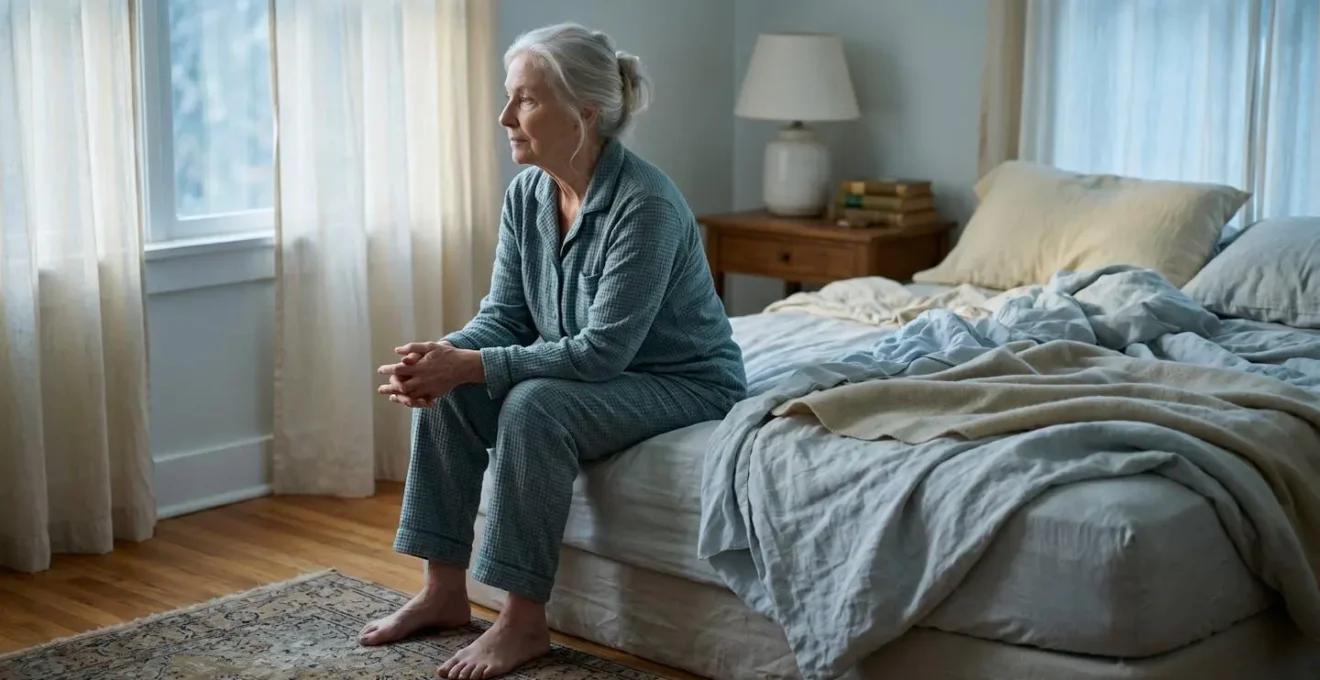
Waking early after 70 is a biological norm, but the inability to fall back asleep is an environmental problem you can solve.
- Your body’s internal clock (circadian rhythm) naturally shifts forward with age, causing earlier wake times.
- Fragmented sleep is often caused by a mismatch between your new physiology and an environment designed for a younger you—from room temperature to a lack of daily purpose.
Recommendation: Stop fighting your body and start re-engineering your environment. Begin by tackling the one factor you can control tonight: your bedroom’s thermal and light conditions.
That 4 AM wake-up call feels cruelly familiar to many over 70. You’re told it’s just “part of getting older,” a frustrating but inevitable decline. You’ve likely tried the standard advice: stick to a routine, avoid late-night television, cut back on tea. Yet, you find yourself wide awake in the pre-dawn quiet, your mind racing as the chance for more rest slips away. This experience is common, but the conclusion that it’s an unsolvable problem of aging is fundamentally wrong.
The truth is more complex and far more empowering. While a natural forward shift in your body’s internal clock does make earlier waking normal, the inability to get back to sleep is often a symptom of something else entirely: a mismatch between your current physiology and your living environment. The issue isn’t a personal failing; it’s an engineering challenge. Your home, your daily habits, and even your mattress may still be configured for the person you were at 50, not the person you are today.
This guide departs from the generic platitudes. We will not simply tell you to “keep your room cool.” We will delve into the science of *why* your body is now more sensitive to temperature and *how* to manage it in a drafty Victorian house. This is a manual for becoming a sleep engineer. By understanding the specific mechanisms behind sleep disruption—from the build-up of a chemical called adenosine to the precise colour of light that preserves your sleep hormones—you can make targeted, practical adjustments. It’s about shifting your mindset from one of passive acceptance to one of active, intelligent problem-solving.
This article provides a systematic approach to re-engineering your environment for restorative sleep. Each section tackles a specific, common challenge faced by seniors in the UK, offering evidence-based explanations and practical solutions. The following summary outlines the key areas we will address to help you transform your sleep quality.
Summary: A Practical Guide to Conquering Age-Related Sleep Disruption
- How to maintain a 18°C bedroom temperature in a drafty Victorian house without high bills?
- White Noise vs Earplugs: which blocks traffic sound safely for hearing aid users?
- Memory Foam or Pocket Sprung: which supports an arthritic hip best?
- The afternoon nap mistake that destroys your sleep pressure for the night
- When to stop drinking tea to prevent nocturia disruption?
- Why a lighted path from bed to toilet prevents 30% of night falls?
- When to schedule heating boosts to match your sedentary periods?
- The “retirement void”: how to find purpose when the job title goes?
How to maintain a 18°C bedroom temperature in a drafty Victorian house without high bills?
The advice to “keep your bedroom cool” is often too simplistic. For older adults, the ideal temperature isn’t just a matter of comfort; it’s a biological necessity for efficient sleep. Your body’s core temperature needs to drop to initiate and maintain sleep. As we age, our ability to regulate body temperature weakens, making us far more sensitive to environmental heat. In fact, research on older adults demonstrates that sleep efficiency can drop by 5-10% when the ambient temperature rises from 25°C to 30°C. Maintaining a consistent 18-20°C (65-68°F) is the goal.
In a classic British Victorian or Edwardian house, with single-glazed sash windows and uninsulated walls, achieving this without exorbitant heating bills requires a targeted “sleep engineering” approach. The key is to focus on preventing heat loss and concentrating warmth where it matters most. Instead of heating the entire house to a high temperature, you can create a stable thermal comfort zone around your sleeping area. This means sealing leaks and using personal heating solutions that are far more energy-efficient.
Start by becoming a “draft detective.” On a windy day, move a lit candle or incense stick around window frames, skirting boards, and door edges. A flickering flame reveals an air leak that is sabotaging your thermal environment. Sealing these gaps is your first priority. Heavy thermal curtains, closed at dusk, create an insulating air gap against cold windows. For a significant but low-cost upgrade, removable window insulation film can create a temporary double-glazing effect through the winter months, drastically reducing heat loss.
Finally, rethink your heating strategy. A 1500W electric space heater is an expensive and inefficient way to stay warm. A modern heated mattress pad, by contrast, uses only around 100W of power to deliver warmth directly to you, resulting in a potential 93% energy saving while ensuring your bed is a welcoming, warm sanctuary in a cool room.
White Noise vs Earplugs: which blocks traffic sound safely for hearing aid users?
For those living near a busy road, creating an acoustic sanctuary is paramount for unbroken sleep. The two most common solutions, earplugs and white noise machines, both come with significant drawbacks for seniors, especially those who use hearing aids. Earplugs can block out crucial safety sounds like a smoke alarm, a ringing telephone, or a partner calling for help. They can also exacerbate issues with earwax build-up, a common concern in older adults.
White noise machines, while effective at masking inconsistent sounds like traffic, can also be problematic. The high-frequency hiss of “white” noise can be irritating, and if played too loudly to cover external noise, it presents the same safety issue as earplugs—masking important alerts. A better alternative is often brown noise or pink noise. These lower-frequency sounds are more like a gentle rumble or steady rainfall, which many find more soothing. They are effective at masking the low-frequency drone of traffic without needing to be played at a high volume.
However, a breakthrough in sleep engineering for seniors addresses the safety concern head-on. This solution bypasses the ear canal entirely.
Case Study: Bone-Conduction Headphones for Safety-Conscious Sound Masking
Bone-conduction technology, often seen in sports headphones, allows seniors to play masking sounds like brown noise while keeping their ear canals completely open. The devices transmit sound vibrations through the cheekbones directly to the inner ear. This elegantly solves the critical safety problem of not hearing smoke alarms or other alerts during the night. It’s fully compatible with wearing hearing aids during the day, as it doesn’t block the ear, and it significantly reduces the risk of earwax impaction associated with in-ear devices.
This approach is a perfect example of sleep engineering: identifying a specific problem (safety vs. silence) and applying a targeted technology to solve it without compromise. It allows for the creation of a peaceful acoustic environment while maintaining full awareness of your surroundings.
Memory Foam or Pocket Sprung: which supports an arthritic hip best?
For anyone living with arthritis, the mattress is not just a piece of furniture; it is a critical piece of medical equipment. An unsupportive mattress can turn a night’s rest into an exercise in pain management, particularly for hip arthritis. The wrong surface can create pressure points and make turning over a painful ordeal, directly contributing to fragmented sleep. The two dominant technologies, memory foam and pocket sprung, offer very different approaches to support.
Memory foam is renowned for its exceptional pressure relief. It conforms to the body’s contours, distributing weight evenly and cradling the hip joint. This can feel wonderful for reducing pain when you are settled. However, this “sinking” quality can be a double-edged sword. For seniors with reduced mobility, getting out of a memory foam bed or even changing positions during the night can feel like escaping quicksand. Furthermore, the material is known to retain heat, which can disrupt sleep.
Pocket sprung mattresses, on the other hand, consist of hundreds of individual springs housed in their own fabric pockets. This allows them to move independently, offering more targeted support. The inherent responsiveness, or “push-back,” of the springs makes movement easier. A firm edge support, common in quality pocket sprung models, provides a stable platform for sitting on the edge of the bed and for getting in and out safely—a crucial factor in fall prevention. The following table breaks down the key considerations.
This comparative data helps to clarify the trade-offs involved in selecting the right sleep surface for arthritic hips.
| Feature | Memory Foam | Pocket Sprung | Adjustable Base Compatibility |
|---|---|---|---|
| Pressure Relief | Excellent – conforms to hip contours, distributing weight evenly | Good – targeted support from individual coils | Both compatible |
| Ease of Movement | Lower – ‘sinking’ sensation can make turning over difficult for seniors | Higher – responsive push-back aids repositioning | Adjustable base adds 30% easier bed exit |
| Edge Support | Often weak – sitting on edge or getting in/out is challenging | Strong – reinforced perimeter coils provide stable entry/exit platform | Critical for fall prevention |
| Temperature Regulation | Retains heat – can disrupt senior sleep (see optimal temp 20-25°C) | Breathable – air circulation between coils | Both benefit from cooling toppers |
| Budget Alternative | Add 2-3 inch memory foam topper to firm mattress | Add dense latex topper to soft mattress for added support | Topper cost: 10-15% of new mattress |
For many seniors, a hybrid mattress combining a pocket sprung base with a thinner top layer of memory foam or latex can offer the best of both worlds: the responsive support and ease of movement from the springs, with the pressure relief from the foam.
The afternoon nap mistake that destroys your sleep pressure for the night
The post-lunch dip in energy can feel overwhelming, and a short nap seems like the perfect solution. While a well-timed nap can be beneficial, the common mistake is napping too late or for too long. This seemingly harmless habit can completely sabotage your ability to sleep through the night by interfering with a fundamental biological process known as sleep pressure.
Think of sleep pressure like a “sleepiness debt” that you accumulate throughout your waking hours. This process is driven by a chemical in your brain called adenosine. From the moment you wake up, adenosine levels begin to rise, steadily increasing your desire for sleep. After a full day, the pressure is high enough to help you fall asleep and stay asleep. During deep, restorative sleep, your brain clears this adenosine away, resetting the clock for the next day. Indeed, compelling evidence from neurochemical research shows that adenosine accumulates during wakefulness and decreases during slow-wave deep sleep.
Herein lies the danger of the late afternoon nap. When you take a nap, especially one that lasts longer than 20-30 minutes and enters deep sleep, your brain begins to clear away the accumulated adenosine. You are effectively paying off some of your “sleepiness debt” mid-day. While you might feel refreshed in the short term, you have just reduced the sleep pressure that is essential for a consolidated night of sleep. When you go to bed at 10 PM, there simply isn’t enough adenosine-driven pressure to keep you asleep for a full 7-8 hours, making you much more likely to wake at 3 or 4 AM and be unable to get back to sleep.
The “nap sweet spot” for most seniors is between 1 PM and 3 PM, and the duration should be kept to a strict 20 minutes. This provides a light, refreshing break without tipping into the deeper sleep stages that significantly reduce sleep pressure. Set an alarm to ensure you don’t oversleep. This disciplined approach to napping protects your precious sleep pressure for when you need it most: during the night.
When to stop drinking tea to prevent nocturia disruption?
A warm cup of tea in the evening is a comforting ritual for millions. However, if you’re battling nocturia—the need to wake up frequently to use the bathroom—this seemingly innocent habit could be a primary culprit. The disruption is caused by a double-whammy: the diuretic effect of caffeine and the sheer volume of liquid consumed before bed. To solve this, you need to understand how your body processes caffeine, which changes significantly with age.
Caffeine has what is known as a “half-life,” the time it takes for your body to eliminate 50% of the substance. For a typical young adult, this is around 5-6 hours. However, as we age, our liver and kidney function becomes less efficient. This slows down caffeine metabolism dramatically. As one study notes, “In older adults, the reduced rate of hepatic metabolism and renal clearance leads to prolonged caffeine half-life and heightened systemic exposure.” This means that the caffeine from a 4 PM cup of tea could still be significantly affecting your system well past your bedtime.
In older adults, the reduced rate of hepatic metabolism and renal clearance leads to prolonged caffeine half-life and heightened systemic exposure
– PMC Geriatric Caffeine Study Authors, Caffeine in Aging Brains: Cognitive Enhancement, Neurodegeneration, and Emerging Concerns About Addiction
Given this prolonged effect, a conservative “caffeine curfew” for seniors should be set at least 8-10 hours before your intended bedtime. This means that if you aim to sleep at 10 PM, your last cup of caffeinated tea or coffee should be finished no later than 2 PM. But caffeine is only half the story. The volume of liquid also places a direct load on your bladder. A large mug of even decaffeinated tea can be enough to trigger a nighttime waking.
Case Study: The Power of Volume and Timing
A study of over 1,200 older adults highlighted that fluid volume post-dinner was as critical as caffeine content for managing nocturia. One participant successfully reduced nighttime bathroom trips by making a simple switch: instead of a 350ml mug of weak tea at 7 PM, they transitioned to a small 100ml cup of caffeine-free herbal tea at 8 PM. This small change addressed both the fluid load and bladder capacity limitations common in older adults, preserving the comforting evening ritual without disrupting sleep.
The engineered solution is twofold: switch to caffeine-free herbal infusions (like chamomile or peppermint) after 2 PM, and reduce the volume of any liquid consumed in the final 2-3 hours before bed.
Why a lighted path from bed to toilet prevents 30% of night falls?
The journey from bed to bathroom in the middle of the night is one of the most hazardous moments for an older adult. Waking from a deep sleep, you are often disoriented, your eyes are not adjusted to the dark, and your balance can be unsteady. This is a recipe for disaster. Indeed, recent epidemiological data from the CDC shows that more than 1 in 4 older adults in the U.S. report falling annually, with many of these incidents occurring at home, at night. A fall can lead to devastating injuries like a hip fracture, instigating a rapid decline in health and independence.
The conventional solution—turning on a bright overhead light or bedside lamp—is deeply flawed. The sudden blast of bright, blue-spectrum light acts like a shot of espresso for your brain. It instantly suppresses the production of melatonin, your primary sleep hormone, making it incredibly difficult to fall back asleep once you return to bed. The key is to provide enough light for safety without shocking your system awake. This is where strategic, low-level lighting comes in.
The most effective solution is to engineer a continuous, motion-activated, low-level light path. This involves installing LED strip lighting along the skirting boards from the bed to the bathroom. Crucially, the light should be of an amber or red hue (around 1800-2200K). This warm-spectrum light provides visibility without disrupting melatonin production. Motion sensors placed near the floor by the bed automatically activate the lights the moment your feet touch the ground, eliminating the need to fumble for a switch in the dark. This simple environmental modification is one of the most powerful fall-prevention strategies available, potentially reducing nighttime falls by up to 30%.
Checklist: Your 5-Step Nighttime Safety Path Audit
- Identify Hazards: Walk the path from your bed to the toilet during the day. List every potential trip hazard: rug edges, stray shoes, furniture corners.
- Inventory Lighting: Note your current nighttime lighting. Where are the switches? Are they easy to reach from a groggy, half-asleep state?
- Assess Light Quality: If you use a night light, is it a harsh white or blue light? This type of light actively interferes with your ability to return to sleep.
- Test the Pathway: In the evening, with minimal light, walk the path. Pay close attention to any point where you feel uncertain or have to hesitate to find your way. These are your “dark zones.”
- Map Your Solution: Based on your audit, draw a simple plan for where motion-activated, amber-light LED strips would be most effective to eliminate dark zones and illuminate hazards.
This isn’t just about adding a light; it’s about designing a system that provides safety on demand, without compromising sleep quality. It is a fundamental component of a senior-safe home.
When to schedule heating boosts to match your sedentary periods?
As we get older, we often feel the cold more acutely. This is due to a combination of factors, including a lower metabolic rate, reduced muscle mass, and thinning skin. This heightened sensitivity to cold is particularly noticeable during long periods of sitting, such as when reading, watching television, or enjoying a meal. During these sedentary times, your body isn’t generating as much metabolic heat from movement, causing your core temperature to drop and a feeling of chill to set in. Simply cranking up the thermostat for the whole day is both costly and counterproductive to good sleep.
A much smarter approach is to use a programmable or smart thermostat to schedule short “heating boosts” that coincide with your sedentary periods. This proactive thermal management keeps you comfortable without overheating the house, especially the bedroom, where a cooler temperature is needed for sleep. This strategy works in harmony with your body’s natural daily temperature rhythm, which also changes with age. As research on aging and circadian biology reveals that older adults experience a forward shift in their body clock, aligning heating schedules to this new rhythm is key.
Consider this sample schedule for a retired senior who is home most of the day:
- 6:30 AM – Wake-Up Boost: Program the heating to rise to 20°C about 30 minutes before you get out of bed. This eases the transition from a warm bed to a cool room and can help reduce morning stiffness in joints.
- 9:00 AM – Active Period: Lower the temperature to 18°C during your more active morning hours (tidying, preparing breakfast).
- 1:00 PM – Post-Lunch Boost: After eating, blood flow is diverted to your digestive system, which can make you feel chilly. Schedule a 60-minute boost to 20°C to counteract this post-meal chill during your most sedentary digestion period.
- 3:00 PM – Afternoon Sedentary Period: Maintain a comfortable 19-20°C while you are sitting and reading or watching television.
- 8:00 PM – Pre-Sleep Cooldown: Begin a gradual temperature decline towards your optimal sleep temperature of 17-18°C. This mimics your body’s natural temperature drop and signals to your brain that it’s time to prepare for sleep.
This dynamic approach to heating transforms your thermostat from a simple on/off device into a sophisticated tool for managing your personal comfort and energy bills. It is a core principle of engineering an age-friendly home environment.
Key takeaways
- Master Your Thermal Environment: Your sleep quality is now highly sensitive to temperature. Use targeted heating, draft-proofing, and appropriate bedding to maintain a cool bedroom (18°C) and a warm bed.
- Anchor Your Circadian Rhythm: A consistent daily structure is your most powerful tool against fragmented sleep. Establish non-negotiable “anchor activities” involving light, movement, and social contact.
- Engineer Safety into Your Environment: Proactively eliminate risks. A motion-activated, amber-light path to the bathroom is not a luxury; it is essential safety equipment for preventing nighttime falls.
The “retirement void”: how to find purpose when the job title goes?
One of the most underestimated causes of sleep disruption in retirement is the “purpose void.” For decades, your job provided a powerful structure to your day. It dictated when you woke up, when you were active, when you ate, and when you interacted with others. These daily routines acted as powerful circadian anchors, locking your body’s internal 24-hour clock into a stable rhythm. When the job ends, these anchors are suddenly gone.
Without a compelling reason to get up at a specific time, the sleep-wake schedule can drift. Days can become unstructured, with less physical activity and reduced social engagement. This weakening of your daily rhythm sends a confusing signal to your brain, blurring the lines between day and night and contributing directly to fragmented sleep and early waking. Research confirms that retired individuals without fixed schedules often experience more sleep disturbances. The solution is not to find another job, but to consciously engineer new, meaningful anchors.
Case Study: The Food Bank Anchor
A 79-year-old retired accountant struggled with 4 AM wakings for 18 months after retiring. He implemented a single ‘anchor activity’: volunteering at a local food bank every Tuesday and Thursday at 9 AM. The commitment created a compelling reason to maintain a consistent wake time. The activity provided social interaction, physical movement, and a renewed sense of purpose. Within six weeks, his circadian rhythm strengthened, and his early morning awakenings reduced from nearly every night to just once or twice a week.
The key is to move beyond passive hobbies (“watching more TV”) and embrace project-based purpose. This means committing to activities that have a clear structure, require skill development, and provide a sense of accomplishment. This could be anything from mastering a new language for a planned trip, to growing specific vegetables from seed to harvest, to restoring a piece of family furniture. The activity itself matters less than the structure it provides.
Here is a framework to build your own anchor project:
- Define a Specific Goal: Instead of “learn to paint,” try “complete a series of four watercolour landscapes of the local park by summer.”
- Set Milestones: Break the project into weekly tasks. This creates momentum and anticipation.
- Schedule Daily Engagement: Dedicate a specific time block each day to your project, creating a new non-negotiable reason to get your day started.
- Document Your Progress: Keep a journal or take photos. Visualising your accomplishment replaces the performance feedback that a career once provided.
The journey to better sleep after 70 is not a passive waiting game but an active process of intelligent design. By understanding the specific changes in your body and methodically re-engineering your environment to meet those new needs, you can reclaim restorative rest. Start small. Pick one strategy from this guide—whether it’s installing a thermal curtain, setting a caffeine curfew, or planning a new project—and implement it this week. This first step is the most powerful one you can take towards transforming your nights.