
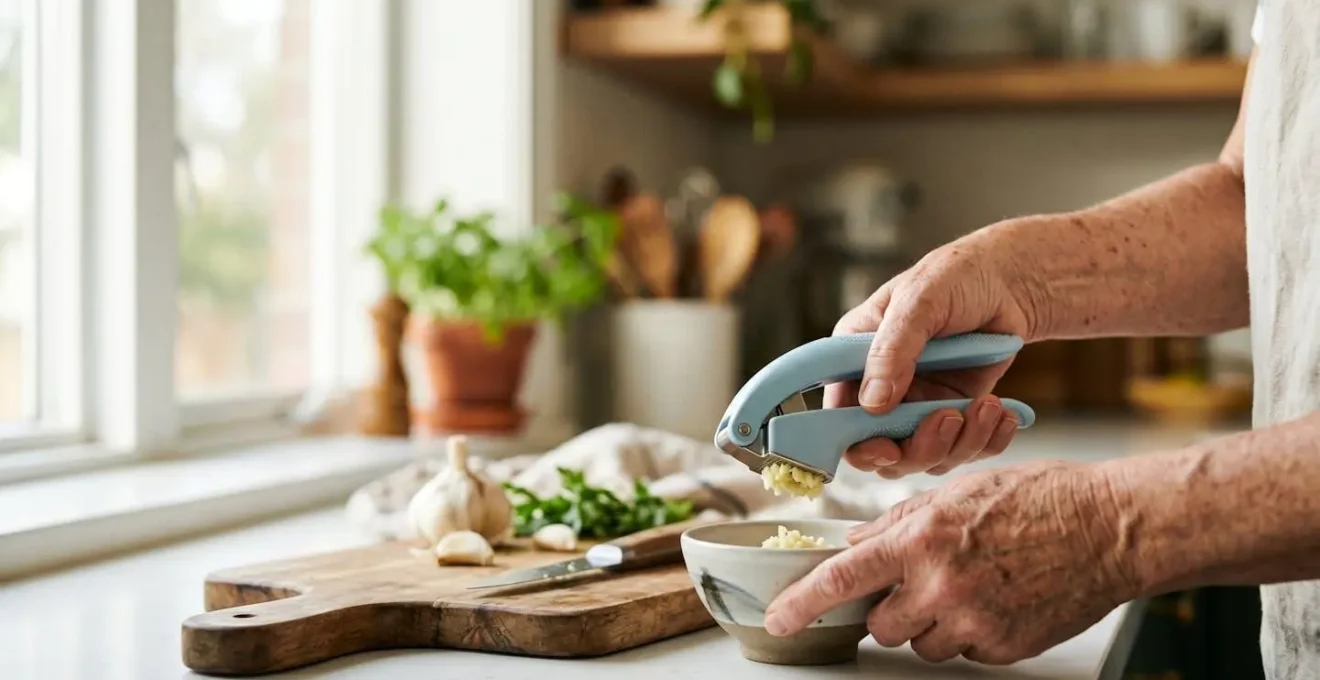
The key to cooking confidently with arthritis isn’t just buying gadgets, but understanding the biomechanical principles that make them effective.
- Neutral wrist and joint alignment is the foundation for pain-free chopping, lifting, and stirring.
- Energy conservation techniques, like using tippers or sitting, prevent fatigue and allow for longer, safer cooking sessions.
Recommendation: Focus on adapting the task and environment first, then select the tool that best supports these new, safer habits for long-term independence.
The sizzle of onions in a pan, the scent of fresh-baked bread, the simple joy of preparing a meal for yourself or a loved one—these are fundamental comforts. But when arthritis settles into your hands, wrists, and shoulders, the kitchen can transform from a place of creativity into a battlefield of painful twists, heavy lifts, and frustrating challenges. You may start to fear that this cherished part of your life is slipping away.
Many will offer simple advice: “just get a better jar gripper” or “buy an electric can opener.” While these tools have their place, they are only a small part of the picture. As an Occupational Therapist specializing in hand function, I know that true, lasting independence doesn’t come from a drawer full of gadgets. It comes from understanding the *principles* of joint protection and energy conservation. It’s about learning to work smarter, not harder, and adapting your environment to support your body, not fight against it.
This guide moves beyond a simple shopping list. We will explore common kitchen challenges through the eyes of a therapist, focusing on the biomechanics of each task. You will learn not just *what* tool to use, but *why* it works, empowering you to make informed choices that protect your joints, reduce your pain, and restore your confidence. We will delve into the science of leverage, the importance of neutral posture, and how to create an ergonomic ecosystem that allows you to cook with joy and safety once more.
This article breaks down key kitchen challenges and provides solutions grounded in therapeutic principles. The following summary outlines the specific areas we will cover to help you reclaim your culinary independence.
Summary: A Therapist’s Guide to an Arthritis-Friendly Kitchen
- Why a vacuum-release tool works better than a gripper for weak wrists?
- How to pour boiling water safely without lifting the kettle?
- Angled handle vs Electric knife: which allows you to chop veg pain-free?
- The slicing error that causes serious kitchen injuries in seniors
- When to lower the worktop (or sit down) to improve leverage for chopping?
- How to vacuum without bending using lightweight cordless tech?
- How to position lights to avoid blinding glare on kitchen worktops?
- How the NHS assesses “Activities of Daily Living” for care funding?
Why a vacuum-release tool works better than a gripper for weak wrists?
The stubbornly sealed pasta sauce jar is a classic kitchen villain, especially for hands weakened by arthritis. The common instinct is to reach for a gripper to increase torque. However, this approach still relies on brute force—force that translates directly into painful stress on your wrist and finger joints. For the 30 million Americans with arthritis, applying this kind of shearing force can cause inflammation and pain that lasts long after the jar is open.
The occupational therapy approach prioritizes joint protection. Instead of fighting the lid, we change the nature of the problem. A vacuum-sealed jar is held tight by air pressure, not just a sticky seal. A simple, inexpensive vacuum-release tool—often the hook on a bottle opener—works by gently prying the edge of the lid to let in a tiny bit of air. The “pop” you hear is the pressure equalizing, instantly releasing the lid’s grip. This requires almost zero twisting motion and minimal force, completely protecting your vulnerable wrist joints.
Thinking in terms of a hierarchy of solutions is a key strategy for energy conservation. You start with the least effortful method and only escalate if necessary. This preserves your strength and reduces cumulative strain throughout the day.
Here is a therapeutically-sound approach to opening jars, from simplest to most supportive, as advocated by experts at patient-focused organizations like CreakyJoints:
- Tap the jar lid edge lightly but firmly on the counter to break the seal.
- Use a rubber band around the lid edge to create extra grip if a small twist is still needed.
- Apply a vacuum-release tool or bottle opener to equalize air pressure.
- Place a non-slip mat under the jar to keep it from moving, reducing the need to grip it tightly with your other hand.
- Use a fully automatic, electric jar opener for a completely hands-free, zero-effort solution for particularly difficult days.
By focusing on releasing the vacuum rather than overpowering the lid, you transform a painful struggle into a simple, effortless task. This small shift in strategy is a perfect example of how understanding the “why” leads to a better, safer solution.
How to pour boiling water safely without lifting the kettle?
Lifting a kettle full of boiling water—weighing upwards of 4-5 pounds (around 2kg)—is one of the most high-risk activities in the kitchen. The combination of weight, high temperature, and the need for a strong, stable grip puts tremendous strain on the wrist, elbow, and shoulder. For someone with arthritis, this can lead to instability, spills, and severe burns. The principle of energy conservation dictates that we should avoid lifting heavy objects whenever possible.
Two key adaptive aids address this problem directly: kettle tippers and hot water dispensers. A kettle tipper is a simple, effective cradle that holds your existing kettle. You fill the kettle in place, boil it, and then simply tilt the cradle to pour the water into a mug or pot placed directly in front. The weight of the kettle is fully supported by the tipper and the countertop, requiring only a gentle push from your hand. This eliminates all lifting and carrying, drastically reducing strain and spillage risk.
A hot water dispenser is a more permanent appliance that keeps a reservoir of water at a near-boiling temperature, ready for instant use. Operation is as simple as pressing a button or lever, similar to a water cooler. This solution eliminates lifting, pouring, and even waiting. While it has a larger countertop footprint and higher energy consumption, it offers the ultimate in convenience and safety for those who make numerous hot drinks throughout the day.
The choice between these two solutions depends on your specific needs, budget, and kitchen space. The following table provides a clear comparison to help you decide which is the right fit for your home.
| Feature | Kettle Tipper | Hot Water Dispenser |
|---|---|---|
| Safety (Spill Risk) | Low – tilting mechanism keeps kettle stable on base | Very Low – stationary dispenser with controlled tap |
| Energy Consumption | Moderate – heats full kettle each time | Higher – maintains temperature continuously |
| Countertop Footprint | Medium – requires stable base area | Large – permanent installation required |
| Single Cup Use | Excellent – precise pour control | Excellent – instant hot water on demand |
| Physical Effort Required | Minimal – gentle tilt motion only | None – tap operation only |
Both options embody the therapeutic goal of adapting the task to fit the person’s ability. By taking the weight out of the equation, they make a potentially dangerous activity safe, easy, and stress-free.
Angled handle vs Electric knife: which allows you to chop veg pain-free?
Chopping vegetables requires downward pressure and a stable grip, two things that can be excruciating for arthritic hands. A traditional knife forces the wrist into a bent (flexed or extended) position, which compresses the carpal tunnel and puts direct stress on the small joints of the wrist and hand. The goal of an adaptive knife is to allow you to cut effectively while maintaining a neutral wrist position—a straight line from your elbow to your knuckles.
The angled handle knife, or “rocker knife,” is a marvel of ergonomic design. The handle is positioned vertically, directly above the blade. This allows you to grip it in a “handshake” position, keeping your wrist perfectly straight and neutral. The cutting force comes from your larger, stronger shoulder and chest muscles, not from your wrist. You simply push down and rock the curved blade through the food. This design completely removes the painful twisting and pressure from your hand and wrist joints.
An electric knife also works to reduce effort, but through a different mechanism. It uses a motor to move two serrated blades back and forth, doing the sawing motion for you. This eliminates the need for forceful back-and-forth movement, which is a major benefit. However, most electric knives still have a traditional horizontal handle, which may require you to bend your wrist to some degree. They are fantastic for carving roasts or slicing bread, but can be cumbersome for the finer dicing and chopping of vegetables.
For daily vegetable preparation, the angled handle rocker knife is often the superior choice from a joint protection standpoint because it is specifically designed to promote a neutral wrist posture. The electric knife is an excellent solution for tasks that require significant sawing force. In an ideal world, an OT might recommend having both: the rocker knife for daily prep and the electric knife for tougher, less frequent jobs.
The slicing error that causes serious kitchen injuries in seniors
While a sharp, well-designed knife is an essential tool, it can also be a source of serious injury if not used correctly. The single most dangerous slicing error, especially for individuals with decreased sensation or grip strength in their hands, is cutting with a flat hand and exposed fingertips. When you lay your guiding hand flat on the food to hold it, your fingertips are positioned directly in the path of the blade. A dull knife that requires extra pressure can easily slip off a round or tough vegetable and cause a severe laceration.
This is where adopting a professional technique is not just about efficiency, it’s about fundamental safety. The “Claw Grip” is the technique taught to all chefs, and it’s a non-negotiable for anyone with compromised hand function. To do it, you curl the fingers of your guiding hand inward, as if you were holding a ball. You then hold the food with your fingertips tucked safely away, using your knuckles as a guide for the side of the knife blade. Your knuckles act as a protective barrier, making it physically impossible to cut your fingertips.
Adopting this technique may feel awkward at first, but it is a critical habit for joint protection and safety. It should be practiced alongside other essential knife safety principles to create a secure cutting environment. A dull knife is far more dangerous than a sharp one because it requires excessive force, increasing the likelihood of a slip. Keeping blades sharp and the cutting board stable are just as important as how you hold the knife.
Your 5-Point Knife Safety Audit
- Adopt the ‘Claw Grip’: Always curl your fingertips under and use your knuckles as a safe guide for the blade. Never use a flat hand with exposed fingertips.
- Check Blade Sharpness: A dull blade requires excessive pressure and is more likely to slip. Use a knife sharpener regularly to maintain a safe, effective edge.
- Stabilize Your Cutting Board: Place a damp paper towel or a non-slip mat underneath to lock the board in place and prevent dangerous sliding during cuts.
- Create a Flat Base: Before chopping round vegetables like potatoes or onions, slice a small piece off one side to create a stable, flat surface to work from.
- Use the Right Tool for the Job: Choose a knife appropriate for the task. A serrated bread knife prevents crushing, and an electric knife can eliminate hand-carving pressure entirely.
Mastering these safety fundamentals transforms chopping from a high-risk activity into a controlled, confident, and pain-free part of your cooking routine.
When to lower the worktop (or sit down) to improve leverage for chopping?
The height of your kitchen work surface has a profound impact on your ability to work efficiently and without pain. A standard countertop is designed for the average person standing up. If the surface is too high for you, you’re forced to hike your shoulders and use weak, easily fatigued muscles to chop and mix. This leads to neck, shoulder, and upper back pain. The key ergonomic principle here is leverage.
For tasks like chopping, the ideal work surface height allows your elbow to be bent at a comfortable 90-degree angle, with your shoulder relaxed. This posture lets you use your body weight and core strength to apply downward pressure, rather than relying on your smaller, weaker hand and wrist muscles. If your worktop is too high to achieve this, you have two primary options: bring yourself up, or bring the work down. Since lowering your countertops is a major renovation, the most practical solution is often to sit down.
Using a stool or chair of the correct height can instantly transform your posture and improve your leverage. A kitchen perching stool is particularly effective. It allows you to be in a supported, semi-seated position that is easy to get in and out of, while placing you at the perfect height relative to the counter. This simple change takes a huge load off your back and legs, conserving energy and allowing you to work for longer periods in comfort.
If you must stand for long periods, an anti-fatigue mat is a crucial addition to your kitchen. The cushioned surface encourages micro-movements in your leg muscles, which improves circulation and significantly reduces stress on the joints in your feet, ankles, knees, and back. It’s another example of how modifying the environment is a cornerstone of protecting your body.
How to vacuum without bending using lightweight cordless tech?
Housekeeping is an essential Activity of Daily Living (ADL), and a clean home contributes to overall well-being. However, traditional vacuuming involves bending, pushing, and managing cumbersome cords, all of which can be a nightmare for someone with arthritis. Modern lightweight, cordless stick vacuums have been a game-changer, but from a therapeutic perspective, not all are created equal. The key is not just total weight, but weight distribution and ergonomic design.
Many popular cordless vacuums are top-heavy, with the motor and dustbin located near the handle. While the total weight may be low, all of that weight is borne by your hand and wrist, leading to significant strain. For arthritic hands, this design is a major flaw. It’s the equivalent of holding a small dumbbell at arm’s length. The better choice is a model where the motor and heavier components are positioned near the floor at the cleaning head.
This design makes the vacuum feel virtually weightless in your hand, as the floor is supporting the load. You are simply guiding the machine, not carrying it. This is a critical distinction for preserving joint integrity and conserving energy.
Case Study: The Ergonomics of Effortless Cleaning
Vacuum ergonomics research shows that a unit’s perceived weight depends more on weight distribution than total mass. Models with motors positioned near the floor feel significantly lighter to arthritic hands and wrists than top-heavy designs of identical weight. Critical features often overlooked include: triggers that lock in the ‘on’ position eliminating continuous pressure, dustbins that empty with a single-button press without manual twisting, and highly articulated cleaning heads that swivel easily around furniture, reducing forceful pushing and awkward wrist angles. For ultimate accessibility, robotic vacuums completely eliminate the physical strain of this chore, preserving the user’s limited energy budget for more fulfilling activities.
When selecting a cordless vacuum, look beyond the marketing and total weight figure. Pick it up. Feel where the weight is. Check for a lock-on trigger and an easy-empty bin. These small design details make a world of difference in reducing the daily strain of keeping a clean home.
How to position lights to avoid blinding glare on kitchen worktops?
Good vision is a critical component of kitchen safety. As we age, our eyes become more sensitive to glare and require more light to see clearly. The wrong kind of lighting can be just as dangerous as too little light. A single, bright overhead light source creates harsh shadows and bounces off shiny countertops, appliances, and knife blades, creating blinding glare. This can obscure what you’re doing, cause eye strain and headaches, and increase the risk of an accident.
The solution is a layered lighting approach, with a strong emphasis on task lighting. Task lighting is directed light that illuminates the specific area where you are working—your “work envelope.” In the kitchen, the most effective and important form of task lighting is under-cabinet lighting. LED strips or pucks mounted under your upper cabinets flood the countertop with bright, even light, right where you need it for chopping, measuring, and reading recipes.
The key to preventing glare is the positioning. The light source is located between you and your work area. This means the light falls directly onto your task without shining back into your eyes. It also eliminates the shadows cast by your own body when relying on an overhead light. Look for dimmable, warm-white (around 3000K) LED options and ensure they are installed towards the front of the cabinet, not the back, to best illuminate the work surface.
By combining good ambient (overall) lighting with well-positioned, glare-free task lighting, you create a visual environment that is safer, more comfortable, and less fatiguing. It allows you to see clearly without strain, reducing the mental effort of cooking and making the entire experience more enjoyable.
Key Takeaways
- Prioritize Joint Protection: Always choose the method that puts the least amount of stress and torque on your joints, like using a vacuum-release over a gripper.
- Conserve Your Energy: Adapt tasks to avoid lifting and carrying. A kettle tipper or sitting on a stool are simple changes with a massive impact on your daily fatigue levels.
- Modify Your Environment: Your kitchen should work for you. Adjusting lighting, work surface height, and flooring makes a safer, more comfortable space for cooking.
How the NHS assesses “Activities of Daily Living” for care funding?
All the tools and techniques we’ve discussed are designed to support one fundamental goal: maintaining your independence in “Activities of Daily Living” or ADLs. In the world of occupational therapy and healthcare, ADLs are the essential tasks of self-care, like bathing, dressing, and, crucially, preparing food. The ability to cook for oneself is not a luxury; it is a cornerstone of health, well-being, and autonomy. When a condition like arthritis, which affects nearly half of U.S. adults aged 65 and older, threatens this ability, it becomes a healthcare issue.
Health systems like the UK’s NHS, and similar private/public programs worldwide, use ADL assessments to determine a person’s need for support, care, and funding for adaptive equipment. An Occupational Therapist (OT) will conduct an assessment to see how your condition impacts your ability to perform these tasks safely and independently. They don’t just look at you; they use models like the PEO (Person-Environment-Occupation) model to analyze the interaction between you, your environment (your kitchen), and the occupation (the task of cooking).
This holistic assessment is what leads to official recommendations for things like angled knives, kettle tippers, or even major home modifications. These recommendations form the basis of your application for funding or support. You are not just asking for a gadget; you are providing evidence-based justification for a piece of durable medical equipment that is essential for maintaining your health and independence. To build a strong case, documentation is key.
Here are the universal steps you can take to start the process of securing support:
- Keep a ‘Difficulty Diary’ for one week, documenting specific kitchen tasks you struggle with. Note the task, the pain you experience, and how long it takes. This creates concrete evidence.
- Request an Occupational Therapist (OT) assessment through your doctor or local health authority. They will provide a professional evaluation and recommendations.
- Explore national health services (like the NHS) or public funding programs in your country specifically for adaptive equipment and accessibility modifications.
- Check your private health insurance policy under ‘Durable Medical Equipment’ (DME) or ‘Occupational Therapy Services’ clauses for coverage.
- Contact condition-specific non-profits and charities (such as the Arthritis Foundation) or seniors’ support agencies, as many offer equipment grants or financial assistance.
Understanding that these aids are recognized medical necessities—not just conveniences—is a powerful mindset shift. It validates your struggles and opens up official pathways to getting the help you need to stay in control of your life and your kitchen.
Take the first step towards reclaiming your kitchen by starting your ‘Difficulty Diary’ today and exploring the assessment options available to you. Your independence is worth fighting for, and the right support is out there.