
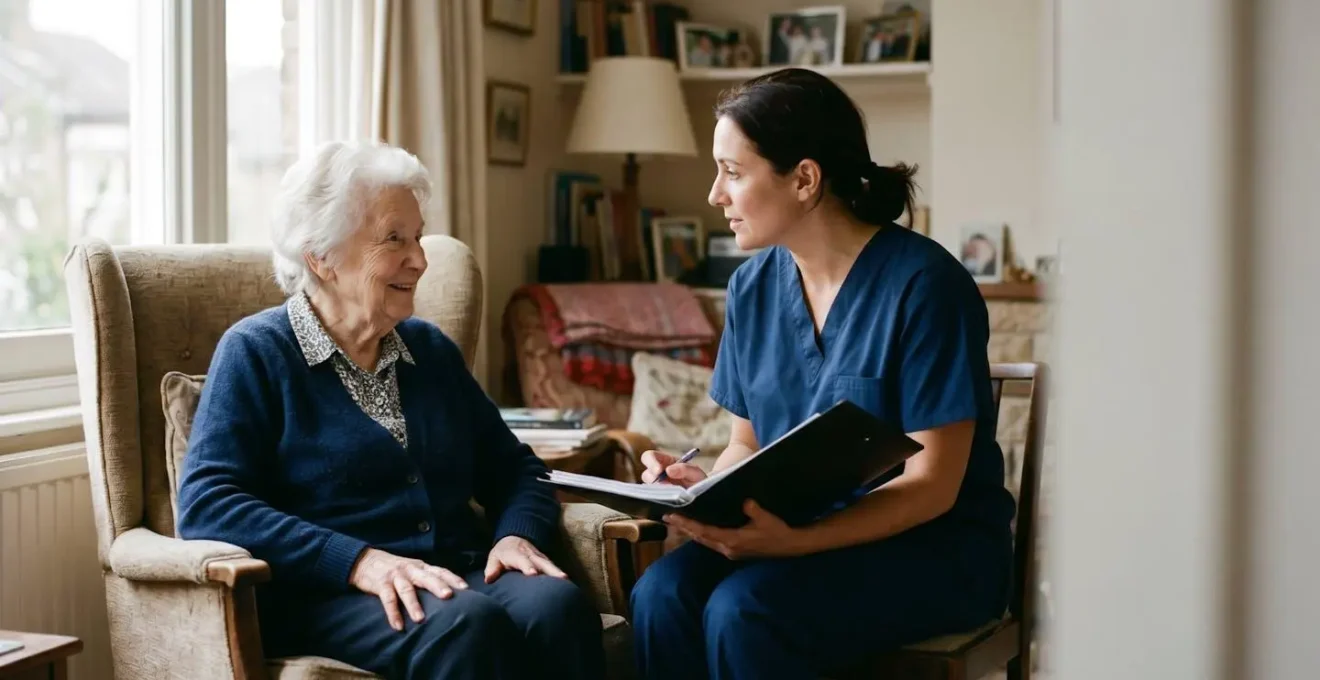
Securing NHS care funding is not about describing struggles; it’s about providing structured, undeniable evidence that maps directly onto the assessor’s own eligibility criteria.
- Instrumental Activities (IADLs) like managing money are as critical as basic Activities of Daily Living (ADLs) like washing, especially for demonstrating cognitive decline.
- Meticulous documentation, framed as a “Care and Support Needs Log,” is the single most powerful tool a family has to counteract the “good day” assessment fallacy.
Recommendation: Shift your mindset from “carer” to “case manager.” Start documenting every interaction, near-miss, and prompt using the specific domains of the NHS Decision Support Tool.
For families navigating the labyrinthine process of securing state-funded care, the NHS assessment can feel like an adversarial and opaque ordeal. You live the daily reality of your relative’s decline, the constant vigilance, the invisible support that keeps them safe. Yet, when faced with a social worker or nurse assessor, the conversation often seems to drift towards generic checklists about washing and dressing, completely missing the complex tapestry of needs, especially those related to cognitive function.
The common advice is to “keep a diary,” but this is a profound oversimplification. A simple list of difficulties is easily dismissed. The true challenge, and the key to unlocking funding, is not just to state what is wrong, but to present the evidence in a way that the system is statutorily obliged to recognise. This involves understanding the crucial difference between Activities of Daily Living (ADLs) and Instrumental Activities of Daily Living (IADLs), and knowing how to document fluctuations in health to counter the “good day” phenomenon.
This guide departs from generic advice. It provides a strategic framework, informed by the Care Act’s own principles, to translate your lived experience into the bureaucratic language of care domains and eligibility thresholds. We will not just tell you *what* to do; we will explain *why* it works from an assessor’s perspective. By the end, you will have a clear methodology for building a robust case file that presents an undeniable picture of need, forcing the system to provide the support your relative is entitled to.
This article provides a detailed breakdown of the strategic approach required for a successful needs assessment. The following summary outlines the key areas we will cover, from understanding the nuances of different daily activities to presenting your evidence in the most impactful way.
Summary: A Strategic Guide to NHS Care Funding Assessments
- Why “Managing Money” (IADL) matters as much as “Washing” (ADL) for dementia diagnosis?
- How to document daily struggles so the social worker sees the real picture?
- Strip wash vs Shower: which maintains hygiene with less exhaustion?
- The mistake of being assessed on a “good day” and losing funding eligibility
- When to introduce a raised toilet seat to preserve privacy?
- Why the NHS voucher scheme might not cover the lightweight chair you actually need?
- Why you need both types of Power of Attorney (and not just the money one)?
- Agency vs Private Carer: Which is safer and cheaper for daily visits?
Why “Managing Money” (IADL) matters as much as “Washing” (ADL) for dementia diagnosis?
In the framework of a Continuing Healthcare (CHC) assessment, there is a common and dangerous misconception that only basic personal care tasks, or Activities of Daily Living (ADLs) like washing, dressing, and toileting, are given significant weight. However, for a condition like dementia, it is often the decline in Instrumental Activities of Daily Living (IADLs)—complex tasks like managing finances, medication, or transport—that provides the earliest and most compelling evidence of cognitive impairment. An assessor must consider all evidence presented to them, and framing IADL failures correctly is a critical strategy.
The NHS is not just looking for physical incapacity. For CHC eligibility, the NHS Decision Support Tool evaluates needs across 12 care domains, which include Cognition, Behaviour, and Psychological & Emotional Needs. Financial mismanagement is a powerful indicator within these domains. The failure isn’t just about an unpaid bill; it’s about the confused process, the distress it causes, and the risk it creates. For example, failing to pay a heating bill (an IADL failure) can directly lead to a dangerously cold home, making it unsafe to conduct a basic ADL like bathing.
Your role is to connect these dots for the assessor. Instead of stating “they struggle with money,” you must provide a detailed, evidence-based narrative. This means documenting specific incidents and mapping them to the official domains. You must show the cognitive-financial domino effect. This approach shifts the focus from a simple list of problems to a clinical demonstration of cognitive decline impacting safety and wellbeing, which an assessor cannot ignore.
- Document the ‘Cognitive-Financial Domino Effect’: Show how IADL failure (not paying the heating bill) directly causes ADL failure (being too cold to bathe safely).
- Focus on the process of confusion, not just outcomes: Record the time taken (e.g., two hours for one bill), emotional distress, and specific errors (e.g., trying to pay with a library card).
- Map financial mismanagement to official domains: Explicitly link these incidents to ‘Cognition’, ‘Behaviour’, and even ‘Altered States of Consciousness’ in your notes for the CHC Decision Support Tool.
- Provide concrete examples: Instead of ‘they struggle with money,’ state ‘On [date], they attempted to pay the gas bill three times with an expired library card, became distressed, and abandoned the task, leaving the house without heating.’
How to document daily struggles so the social worker sees the real picture?
A social worker or CHC assessor can only make a decision based on the evidence presented at a specific point in time. They cannot see the 2 AM wandering episode, the sudden aggressive outburst, or the hours of gentle coaxing it takes to complete a simple meal. Your primary task is therefore to build an “Evidence Bundle”—a systematic and organised collection of records that paints a comprehensive and undeniable picture of the true level of need. A verbal account is subjective; a dated log is evidence.
This is not a simple diary. It is a ‘Care and Support Needs Log’. This document must be factual, objective, and, crucially, quantified. Instead of “Dad was difficult today,” your log should read: “14th May, 10:00-11:30 AM: Attempted to assist with shower. Required 4 verbal prompts to enter bathroom. Exhibited verbal aggression (shouting) for 10 mins. Physical assistance required to wash back. Carer strain rated 8/10.” This level of detail provides a pattern of behaviour and a measure of the care intensity that an assessor can use to justify a higher level of need.
Photographic evidence, used with consent and respect for dignity, can be powerful. A photo of unexplained bruises (a potential sign of falls), an unsafely prepared meal, or a hazardous living environment can communicate more than a paragraph of text. The goal is to pre-emptively answer the assessor’s questions and provide them with the raw data they need to complete their forms accurately, reflecting the worst days, not just the single, potentially “good” day of the assessment.
The key is to organise this evidence in a way that mirrors the assessor’s own process. By pre-sorting your notes using the 12 CHC Care Domains (‘Mobility’, ‘Nutrition’, ‘Skin Integrity’, ‘Cognition’, ‘Behaviour’, etc.), you are doing the assessor’s work for them. You are translating the chaotic reality of care into the structured language of their bureaucracy. This “Evidence Bundle Strategy” transforms you from a pleading family member into a credible and organised reporter of fact.
Strip wash vs Shower: which maintains hygiene with less exhaustion?
The choice between a full shower and a simpler strip wash is not merely a matter of convenience; it is a strategic decision in energy management and risk reduction that has direct relevance for a care needs assessment. Assessors are trained to evaluate the safest and most sustainable way to meet a person’s needs. Framing this choice correctly can demonstrate a higher level of clinical need than might be apparent if the person is “managing” with exhaustive or risky routines.
A full shower, while seemingly the “gold standard” of hygiene, can be a high-risk, high-energy activity for a frail individual. It can involve dozens of complex movements, balance challenges, and the risk of falls on wet surfaces. The physical and cognitive effort can lead to exhaustion, agitation, or even refusal, compromising hygiene in the long run. From an assessment standpoint, successfully completing a shower with great difficulty and subsequent exhaustion for the rest of the day is not a sign of independence; it’s a sign of an inappropriate and unsustainable care strategy.
In contrast, a strip wash can be presented as a clinically justified intervention. It is a lower-energy alternative that conserves the individual’s strength for other essential activities like eating or mobilising. It reduces the risk of falls and can be less distressing, making it a more reliable method for maintaining skin integrity and overall hygiene. When documenting care, it is vital to frame this choice not as a preference, but as a deliberate “energy preservation strategy” or “risk reduction measure.” This demonstrates a sophisticated understanding of the person’s fluctuating needs and proves that their baseline level of function requires careful management, which is a core principle of establishing a need for care funding. This is particularly crucial given that, depending on location, CHC eligibility rates vary from 3.4% to 57.9%, making robust justification for every care decision paramount.
Case Study: Energy Management in ADL Assessments
An NHS assessment must consider what a person can and cannot do safely and repeatedly. It examines physical health, mental health, daily living activities, and the impact on carers. A practical decision like opting for a strip wash over a shower can be effectively framed as a necessary risk reduction and energy preservation strategy. This transforms the choice from a simple preference into a clear demonstration of clinical need, which is a much stronger argument for funding eligibility.
The mistake of being assessed on a “good day” and losing funding eligibility
Perhaps the single most common and devastating mistake a family can make is allowing a loved one to be assessed on a “good day” without providing context. Many individuals, particularly from older generations, have a tendency to put on a “brave face” for visitors, including assessors. They may rally their energy, present as lucid and capable for the hour the assessor is present, and then collapse from the effort afterwards. The assessor, bound by what they have witnessed, records a misleadingly positive picture, and the funding application is denied.
It is a fundamental principle of CHC assessment that needs should be evaluated based on their nature, intensity, complexity, and unpredictability. The variability of a condition is, in itself, a key part of the need. Therefore, you must proactively and systematically counter the “Good Day Fallacy.” This begins before the assessor even arrives. As the expert authority Dementia UK advises, you must prepare to represent the full picture. In their “Guide to continuing healthcare (CHC) funding,” they are unequivocal.
Focus on describing the person’s needs on a bad day – not a good or average day, or the day of the assessment.
– Dementia UK, Guide to continuing healthcare (CHC) funding
This means using pre-emptive verbal framing. At the start of the meeting, you should state clearly: “I’m glad you’re seeing Mum on a good day today. To give you a full picture, I have brought our care log which documents what her needs are like on more typical, and more difficult, days.” This immediately reframes the entire assessment. You are not being difficult; you are providing essential data. A visual calendar marking ‘good’, ‘medium’, and ‘bad’ days is a powerful, at-a-glance tool to demonstrate this variability. The core message is that the person’s stability is not a sign of low need, but a direct result of the constant, intensive, and proactive care intervention they are already receiving.
- Create a visual calendar: Mark ‘good’, ‘medium’, and ‘bad’ days over a month to show variability patterns.
- Use pre-emptive verbal framing: Start the assessment by acknowledging it’s a good day and immediately present your log of difficult days.
- Prepare a written statement: “Today Dad is lucid and calm. On Tuesday, he was verbally aggressive for 3 hours. On Thursday, he left the house at 2am in his nightclothes.”
- Address the ‘Brave Face’ phenomenon: Gently prepare your loved one beforehand, and respectfully interject during the assessment with specific examples from your log.
- Emphasize unpredictability: Explain that well-managed needs are only stable because of the constant care intervention you provide.
When to introduce a raised toilet seat to preserve privacy?
The introduction of simple equipment like a raised toilet seat is often seen as a minor domestic adjustment. However, in the context of a care needs assessment, it should be presented as a significant, preventative intervention. The timing is crucial: it should be introduced at the first sign of difficulty, long before a crisis, and meticulously documented as a measure to maintain independence, preserve dignity, and delay the need for more costly, hands-on care.
From an assessor’s perspective, the need for a raised toilet seat is an evidence-based indicator of declining mobility, strength, and stability. The key is to justify its introduction as a cost-effective preventative measure. You are not just making life easier; you are actively preventing a fall that could lead to a hospital admission, which is a far greater cost to the NHS. This argument is compelling and aligns with the NHS’s own goals of promoting independence and preventing acute incidents. It is also important to understand the wider financial context; if NHS CHC funding is not granted, care may fall under local authority means-testing, where if savings are below £23,250 in England, the council may contribute.
The justification for such equipment should be based on observation and testing. The “Sit-to-Stand” test is a simple yet effective method: document if the person needs to use their hands to push off their knees, a wall, or a nearby sink to stand up from the current toilet. This is a clear functional deficit. Documenting near-misses, stumbles, or expressions of fear related to using the toilet further strengthens the case. By framing the £30 piece of plastic as a “dignity-enabling tool” that postpones the need for a carer’s physical presence in the bathroom, you are making a powerful case for proactive and intelligent care management.
Action Plan: Justifying Equipment as a Preventative Measure to the NHS
- Initial Framing: Articulate the equipment as a ‘dignity-enabling tool’ that maintains independence and privacy, thereby delaying the need for more intrusive physical assistance.
- Objective Testing: Conduct and document a ‘Sit-to-Stand’ test. Record any reliance on pushing off walls, sinks, or other aids to stand from the toilet.
- Cost-Benefit Analysis: Present the equipment as a cost-effective intervention. Clearly state that a £30 raised toilet seat is a measure to prevent a fall that could result in a costly hospital admission.
- Formal Request: During a needs assessment, proactively request a home adaptation assessment from an occupational therapist, allowing for grab rails and the toilet seat to be considered together.
- Evidence Compilation: Include the justification in your care needs evidence bundle. Photograph the current toilet setup and log any incidents, near-falls, or expressions of difficulty.
Why the NHS voucher scheme might not cover the lightweight chair you actually need?
When an individual is assessed as needing a wheelchair, the NHS often provides one through its services. However, the “standard issue” chair is frequently a heavy, basic model that may not be suitable for the user’s specific needs or home environment. The NHS Personal Wheelchair Budget (PWB), often taking the form of a voucher, is designed to offer more choice, but it comes with a significant bureaucratic hurdle: the voucher’s value is based on the cost of the standard chair you are eligible for, not the more expensive, lightweight, or specialised chair you may actually need.
The core challenge is to prove the “clinical unsuitability” of the standard option. This requires a detailed, evidence-based argument. For instance, if the standard chair is too wide for the doorways in your home, preventing access to the bathroom, this is a clear case of unsuitability. If it is too heavy for a family carer with their own health issues to lift into a car, it fails to meet the need for community access. Your job is to document these specific functional and environmental barriers.
The system offers a choice, as explained in guidance on the Personal Wheelchair Budget. You can accept the NHS’s provision, or you can use the voucher’s value towards a different model. Under the “Third Party option,” you can buy a more suitable chair from an independent supplier, but you then become responsible for its maintenance and insurance. The critical takeaway is that the voucher is not free money; it is the amount the NHS would have spent on its standard provision. Successfully arguing for a higher-value contribution requires a robust case, complete with measurements, carer limitations, and specific examples of how the standard model fails to meet the assessed clinical need for mobility and independence.
Therefore, before accepting the voucher, you must build a case file. Measure your doorways, weigh the standard chair, and document the physical strain on the carer. Presenting this data to the wheelchair service is your only leverage to demonstrate that providing a more suitable, albeit more expensive, chair is the only way to genuinely meet the assessed need, as the voucher’s value is based on the NHS cost, not your personal need.
Why you need both types of Power of Attorney (and not just the money one)?
A Lasting Power of Attorney (LPA) is a critical legal tool, but families often make the mistake of only setting up the “Property and Financial Affairs” LPA. They overlook its equally vital counterpart: the “Health and Welfare” LPA. In the context of an NHS care assessment, the absence of a Health and Welfare LPA can render a family powerless at the most crucial moments, unable to speak authoritatively on behalf of a loved one who has lost capacity.
The Property and Finance LPA allows you to manage bank accounts and pay bills. This is important, but it does not grant you the legal right to make decisions about your loved one’s care or to be the primary decision-maker in discussions with healthcare professionals. When a person lacks the mental capacity to consent to their own care or participate in an assessment, decisions fall to doctors and social workers under a “best interests” framework. While they should consult the family, the final say is theirs.
The Health and Welfare LPA changes this dynamic entirely. It gives the attorney the legal authority to make decisions about daily care, medical treatment, and living arrangements. It grants you the right to be in the room, to receive copies of assessment reports, and to advocate forcefully for a particular course of action. As leading CHC navigators Beacon CHC note, its importance cannot be overstated when capacity is in question.
If the person in question does not have capacity to give their consent, the health or social care professional should check to see whether you have appointed someone to have Lasting Power of Attorney on welfare matters.
– Beacon CHC, Guide to Continuing Healthcare Assessments
Without it, your intimate knowledge of your loved one’s preferences and needs is merely “input.” With it, your voice carries legal weight. It is the key that unlocks the door to meaningful participation in the assessment process. The crucial point is that both LPAs must be made while the person still has the capacity to make the decision. Waiting until it is needed is too late.
- A Health & Welfare LPA grants you the legal right to discuss health needs with assessors and receive copies of assessment reports.
- A Property & Finance LPA allows you to manage finances to pay for private care services that may supplement any NHS provision.
- The H&W LPA empowers you to instruct carers on specific care requirements and share their professional reports with NHS assessors as formal evidence.
- Without a H&W LPA, critical care decisions are made by doctors and social workers under the ‘best interests’ principle, not necessarily guided by the family’s intimate knowledge.
- It is imperative to apply for both types of LPA early, as they can only be created while the individual still possesses the mental capacity to make the decision.
Key takeaways
- Domain Mapping is Non-Negotiable: You must actively link every documented incident (e.g., confusion, falls, refusal of care) to one of the 12 official CHC care domains (Cognition, Behaviour, etc.).
- The Fluctuation Principle Wins Cases: Never allow an assessment to be based on a single “good day.” Use logs and calendars to prove the unpredictability and variability of the condition.
- Frame Everything as Clinical Justification: Every choice, from a strip wash to a raised toilet seat, must be presented not as a preference, but as a deliberate, risk-reducing, and clinically necessary intervention.
Agency vs Private Carer: Which is safer and cheaper for daily visits?
When arranging daily care, families face a pivotal choice: engage a regulated care agency or directly employ a private carer. The decision has significant implications for cost, flexibility, and, most importantly, the type of evidence you can generate for an NHS assessment. A common misconception is that a private carer is always cheaper, but this often ignores significant hidden costs and administrative burdens.
From a funding assessment perspective, a CQC-regulated care agency holds a distinct advantage. The evidence they produce—such as official care notes, professional reports, and CQC inspection ratings—carries significant weight with assessors. Agencies handle all administrative overheads, including payroll, National Insurance contributions, liability insurance, and arranging cover for sickness or holidays. While the hourly rate is higher, it is an all-inclusive figure, providing cost certainty and a high degree of credibility.
Employing a private carer offers greater flexibility and the potential for a strong, consistent relationship. The base hourly rate is typically lower. However, the family then becomes an employer, legally responsible for employer’s liability insurance, payroll administration (PAYE), pension contributions, and finding and paying for replacement cover during holidays or sickness. These “hidden costs” in both time and money can quickly erode the initial savings. Furthermore, the evidence produced by a private carer, while valuable, may be seen as less objective by an assessor than reports from a regulated body. However, under the Care Act 2014, eligible families can receive direct payments, which gives them the flexibility to manage their own budget and choose their provider, including directly employing a private carer if they are prepared for the administrative responsibilities.
The following table outlines the key differences from the perspective of preparing for a needs assessment:
| Factor | Care Agency | Private Carer |
|---|---|---|
| Evidence for NHS | CQC ratings, official care notes, professional reports | Informal records, limited professional documentation |
| Hourly Rate | Higher (includes agency overheads) | Lower base rate |
| Hidden Costs | None (agency covers insurance, payroll, replacement cover) | Employer’s liability insurance, payroll admin, holiday/sickness cover, time managing them |
| Credibility for Assessments | High – regulated by CQC, professional staff can write reports | Variable – depends on individual’s qualifications and record-keeping |
| Flexibility | Lower – set schedules, multiple carers | Higher – direct relationship, consistent carer |
| Funding Route | Accepted by council direct payments and NHS CHC | Requires direct payment arrangement, more admin for family |
Ultimately, navigating the NHS care funding system requires you to become a proactive and informed advocate. By shifting your approach from simply describing problems to systematically documenting them within the NHS’s own framework, you provide an assessor not with a story, but with an undeniable case file. Begin compiling your evidence-based Care and Support Needs Log today; it is the most powerful tool you have to secure the care and dignity your relative deserves.