
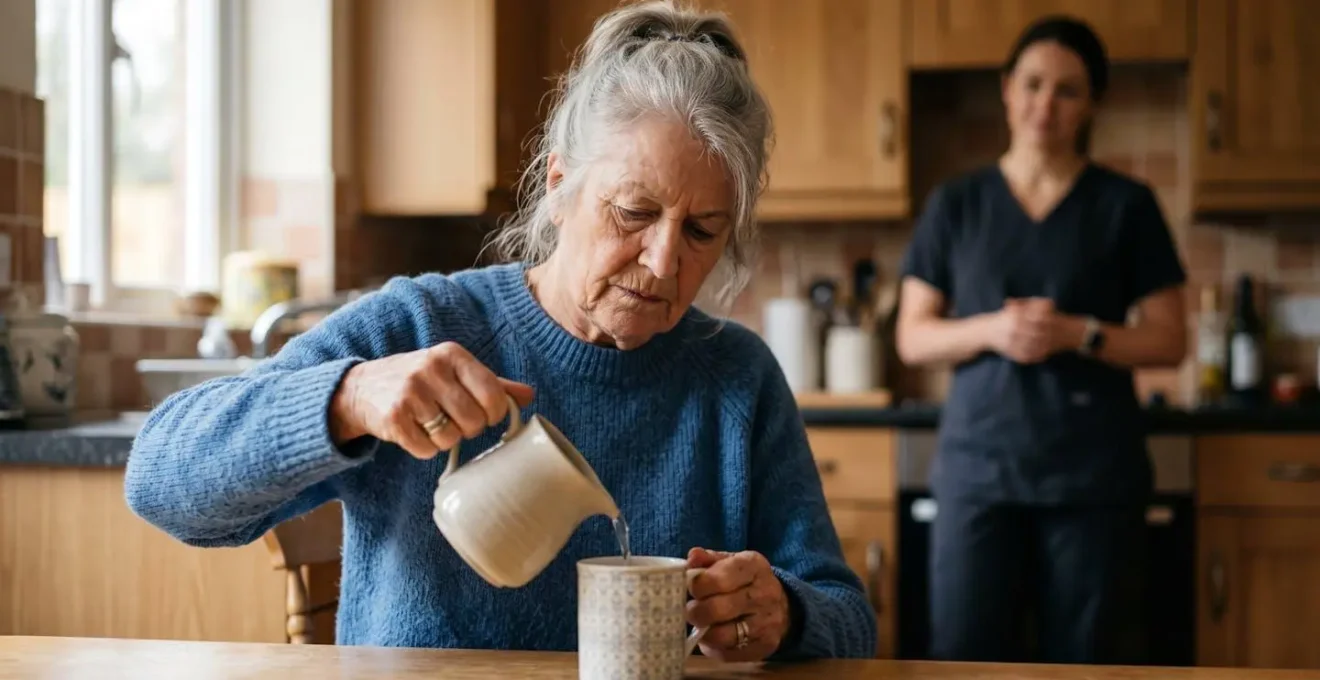
Reablement is the proven strategy to transform your recovery into a project of empowerment, not passive survival, by focusing on what you *can* do.
- True recovery means actively participating in tasks, even if it’s a struggle, because effort builds strength and confidence.
- The goal of effective care is for it to decrease over time as your own capability increases, giving you back control.
- This approach is a mental shift: you are not a patient being cared for, but the protagonist of your own comeback story.
Recommendation: Start by shifting your mindset from “what can’t I do?” to “what can I try to achieve today?” and partner with your care team on this new goal.
The period after a fall, stroke, or significant health event can feel disempowering. Suddenly, simple tasks feel monumental, and well-meaning people start doing things *for* you. Your home, once your sanctuary of independence, can start to feel like a place where you are simply a recipient of care. The standard conversation revolves around managing your condition, ensuring your safety, and providing support for the things you can no longer do easily. This is the survival model of care: it keeps you safe, but it can unintentionally shrink your world and your sense of self.
But what if the entire premise of care was flipped? What if, instead of focusing on your limitations, the focus was on rebuilding your capabilities? This is the core of reablement, a proactive and empowering approach that sees you not as a patient to be managed, but as an active participant in your own recovery. It’s a philosophy built on a powerful truth: true, lasting independence is not given; it is reclaimed. This isn’t just about physical therapy; it’s about applying a capability mindset to every aspect of daily life, from the kitchen to the community.
This guide is your introduction to that mindset. As an occupational therapist, I have seen firsthand how this shift transforms lives. It’s the difference between being bed-bound and walking to your own bathroom, between feeling like a burden and feeling like the master of your own home. We will explore how to make care your collaborator in regaining skills, when to challenge the “need” for care, and how to measure progress not just in medical terms, but in the currency of a life fully lived. Your comeback story starts now.
This article provides a detailed roadmap for your reablement journey, breaking down the practical steps and mindset shifts needed to reclaim your independence. Explore the sections below to understand how to apply these principles to your daily life.
Summary: The “Reablement” Approach: How to Use Care to Regain Skills, Not Just Survive
- Why your carer should watch you make tea rather than making it for you?
- How to move from “bed-bound” to “toilet independent” in 6 weeks?
- Hoist vs Two Carers: which preserves dignity and reduces intrusion?
- The error of keeping the full care package when you have regained strength
- When to reduce visits from 4 to 2 per day safely?
- The “resting too much” error that accelerates muscle atrophy in 3 months
- How to increase walking distance by 10% a week without breathless episodes?
- Live-in Care vs Care Home: Cost and lifestyle comparison for advanced needs?
Why your carer should watch you make tea rather than making it for you?
It might seem counter-intuitive. A carer’s job is to help, so why would they stand back and watch you struggle to make a cup of tea? The answer lies at the very heart of the reablement philosophy: it’s about “purposeful struggle.” When a carer makes tea for you, you get a cup of tea. When you make it for yourself, you engage in a complex therapeutic activity. You practice balance, sequencing tasks, fine motor skills, problem-solving, and endurance. Each step—filling the kettle, reaching for a mug, pouring the hot water—is a small victory that rebuilds neural pathways and physical strength.
This is not about being unkind or unhelpful. It’s about shifting the goal from task completion to skill acquisition. Your carer becomes a coach, offering guidance, ensuring safety, and providing encouragement, rather than simply being a service provider. This changes the dynamic from passive dependence to active partnership. The pride and confidence gained from achieving a task on your own, however small, is a powerful motivator that fuels the entire recovery process. It’s the first step in agency reclamation, proving to yourself that you are still in control.
This concept is backed by extensive research. As one study puts it, the goal of this approach is to enable people to engage in what they value. An authoritative study from the ReableDEM research network highlights that reablement is an approach that enables older people to participate in meaningful daily and social activities. Making your own tea is a profoundly meaningful daily activity, a cornerstone of independence in your own home. It signals that you are not just surviving; you are living.
How to move from “bed-bound” to “toilet independent” in 6 weeks?
The journey from being confined to a bed to achieving toilet independence is a milestone that represents a monumental leap in quality of life and dignity. It’s a core goal in many reablement plans and, with a structured approach, can often be achieved within a six-week timeframe. This journey is not about sudden, grand gestures but a series of small, consistent, and progressive steps. It’s your personal independence blueprint, built one movement at a time.
The process starts with in-bed mobility. A therapist will guide you through passive and active range-of-motion exercises to maintain joint flexibility and awaken muscles. The next crucial phase is learning to sit up, first with support and then independently, before progressing to dangling your legs over the side of the bed. This simple act helps your body readjust to gravity and prevents dizziness. Only then does the focus shift to standing, transferring to a commode or walker, and eventually, walking the few crucial feet to the bathroom. Each stage is mastered before moving to the next, ensuring safety and building confidence.
The hands in this image tell a story of determination and effort—the very definition of “dignity in effort.” This is not weakness; it is the visible sign of strength being rebuilt. The key is consistent, daily practice, turning every transfer into a training session. This structured progression demystifies the goal, breaking it down into manageable daily targets.
Your Action Plan: Progressive Mobilization Protocol
- Maintain Flexibility: Perform passive range-of-motion (ROM) exercises frequently while in bed to keep joints mobile and prevent stiffness.
- Build Self-Efficacy: Actively participate in activities of daily living (ADLs) and avoid unnecessary assistance to prevent worsening immobility and build confidence.
- Master the Transfer: Practice progressive mobilization by first dangling your legs over the edge of the bed, then getting out of bed slowly when transferring to a chair.
- Mobilize Early and Often: Aim to mobilize as soon as medically safe and to the fullest extent possible, progressing from dangling legs to sitting in a chair.
- Optimize Your Position: For bed-bound periods, ensure the head of the bed is elevated to 30-45 degrees and you are turned and repositioned every two hours to protect your skin and lungs.
Hoist vs Two Carers: which preserves dignity and reduces intrusion?
For individuals with significant mobility challenges, transfers are a daily necessity. The traditional method often involves two carers physically lifting and moving the person—a “two-person lift.” While effective, this can be intrusive, undignified, and physically risky for both the individual and the carers. It can feel crowded and impersonal, with carers often chatting over the person being moved. The reablement approach encourages us to ask: is there a better way that prioritizes dignity and personal space?
Modern patient lifting hoists, particularly ceiling track systems, offer a compelling alternative. A common misconception is that hoists are cumbersome and require multiple people. However, today’s systems are often designed for single-carer operation. This immediately reduces the number of people in your personal space during intimate moments like being moved from bed to a commode or into a bath. Instead of two people, there is one trained professional focused entirely on you and the task at hand. This simple reduction in personnel can profoundly increase a person’s sense of privacy and control.
Using a hoist is not “giving in.” It’s a strategic choice to use technology to maintain dignity, reduce the risk of injury, and enable a single, trusted carer to manage transfers safely. This preserves your energy and the carer’s physical health, allowing more time and focus to be spent on other reablement goals, like conversation, exercises, or engaging in hobbies.
Case Study: How Modern Hoists Empower Single-Carer Operation
While older mobile hoists often required two carers for safety, an analysis from hoist specialists confirms that current ceiling track hoists can be operated safely by one person. These systems incorporate features like automated track components and intuitive controls, facilitating smooth and efficient transfers. This evolution in technology directly addresses the issue of social intrusion; it eliminates the need for multiple carers to be present, and often talking amongst themselves, during a transfer. This empowers both the resident, who experiences less intrusion, and the caregiver, who can perform the task with less physical strain and greater focus on the individual.
The error of keeping the full care package when you have regained strength
As you progress on your reablement journey, a strange and unexpected obstacle can appear: the care package itself. A package designed for your moment of greatest need can become a barrier to further independence if it isn’t adjusted as you regain strength. If carers continue to perform four visits a day, completing tasks you are now capable of attempting yourself, it can inadvertently foster dependency. This is the moment for agency reclamation, where you must actively advocate for your own progress.
The goal of reablement is, paradoxically, to need less of it. Keeping a full care package out of habit, fear, or a lack of review is a common error. It can lead to “learned helplessness,” where you lose confidence in your own abilities because someone is always there to do it for you. It’s crucial to have regular, honest reviews with your care provider or social worker to reassess your needs. The conversation should shift from “What help do you need?” to “What are you able to do now, and what is the next skill you want to reclaim?”
This isn’t always easy. Some funding systems can unintentionally create inertia. As researchers Matthew Parsons and Paul Rouse noted, some funding models can discourage providers from reducing care packages when a client’s function improves. However, the evidence for the success of this approach is compelling. Remarkably, evidence from some areas shows that with the right approach, as many as 80% of people require no ongoing care after a focused reablement programme. This powerful statistic should be your motivation to continually challenge the status quo of your care.
When to reduce visits from 4 to 2 per day safely?
Reducing the number of daily care visits—for instance, from four to two—is a significant and positive milestone in your reablement journey. It signifies a substantial increase in your independence. However, the decision must be made safely and strategically, based on evidence of your growing capabilities, not just a desire to reduce costs. The key is to see this reduction not as a loss of support, but as a planned graduation to the next level of self-sufficiency.
The decision should be data-driven. Are you now able to get your own lunch, which was previously handled by a midday visit? Have you mastered using the toilet independently, making a late-evening visit for personal care unnecessary? These are the objective markers of progress. A reablement-focused team will work with you to identify these achievements and build a plan to consolidate tasks into fewer visits. For example, the morning carer might help you prepare a sandwich and leave it in the fridge for your lunch, eliminating the need for a separate noontime call.
This process should be gradual and with a safety net. You might trial a reduction for a week, with telecare or a check-in call as a backup, to build your confidence. The goal is to stretch your capabilities within a safe framework. It is a collaborative decision, empowering you to take ownership of your schedule and routine. Scientific evidence confirms this is a sustainable path.
Evidence: Reablement Leads to Decreased Need for Home Care
A prospective intervention study provided strong evidence for the effectiveness of this approach. The findings, published in a leading scientific journal, showed that individuals in a reablement group achieved and maintained better physical function and a higher quality of life compared to those receiving usual care. Crucially, the hours of home care services decreased for the reablement group over the six-month follow-up period, while they increased for the usual care group. This demonstrates that reablement is not just beneficial in the short term but is a more sustainable model that actively reduces dependency on services over time.
The “resting too much” error that accelerates muscle atrophy in 3 months
After a health crisis, the instinct to rest is strong. “Take it easy,” everyone says. And while appropriate rest is essential for healing, there is a profound danger in “resting too much.” Prolonged inactivity is the enemy of recovery. It is a direct cause of muscle atrophy—the wasting away of muscle tissue—which can happen alarmingly fast. For an older person, significant muscle loss can occur in a matter of weeks, not months, making the path back to mobility exponentially harder. This is where the capability mindset must conquer the instinct to remain passive.
Every day spent predominantly in bed or in a chair is a day you are actively losing strength. Your cardiovascular system deconditions, your joints stiffen, and your muscles weaken. It creates a vicious cycle: weakness leads to fear of falling, which leads to more inactivity, which in turn leads to more weakness. Breaking this cycle is a non-negotiable part of reablement. The mantra is not “rest as much as possible,” but “move as much as is safely possible.”
This means finding opportunities for movement throughout the day. It means performing chair-based exercises during a television ad break. It means walking to the kitchen instead of asking for a drink to be brought to you. It means seeing every small movement not as a risk, but as a deposit into your “strength bank.” An OT or physiotherapist can provide a tailored programme of safe exercises, but the mindset of seeking movement must come from you. Remember, muscles grow from being challenged, not from being coddled. Fighting against the comfort of the chair is one of the most important battles in your recovery.
How to increase walking distance by 10% a week without breathless episodes?
Regaining the ability to walk outside your home is a liberating goal. It means reconnecting with your community, running errands, or simply enjoying fresh air. A common ambition is to increase walking distance, but pushing too hard can lead to breathlessness, fatigue, or a fear of falling, setting you back. The reablement approach uses a principle of “graded exposure”—a systematic, gradual increase in activity. Aiming for a 10% increase in distance or duration per week is a smart, achievable, and safe target.
First, establish your baseline. How far can you comfortably walk right now? Is it to the end of your driveway? To the lamppost on the corner? This is your starting point, with no judgment. Your goal for the next week is to walk that distance, plus 10% more. If your baseline is 50 metres, you’re aiming for 55 metres. This small, almost imperceptible increase is key. It allows your body to adapt and build stamina without triggering a stress response like severe breathlessness.
Using environmental landmarks, like the postbox or tree in this image, is a fantastic OT technique. Instead of counting steps, your goal becomes “walk to the red postbox.” Next week, it’s “walk to the big oak tree just past the postbox.” This turns the exercise into a journey with a clear, visible purpose. It’s far more motivating than staring at a pedometer.
The Power of Progressive Mobilization
The principle of gradually increasing activity is a cornerstone of physical rehabilitation. As outlined in progressive mobilization protocols, this method uses muscle flexion and a gradual increase in joint range of motion to build tolerance safely. The key is systematic progression rather than attempting to push through fatigue. By applying this logic to walking, you can safely build stamina and confidence. According to expert guidance on physical rehabilitation, these interventions are proven to be safe, reduce disability, and result in very few adverse events, making it the ideal strategy for rebuilding your walking endurance.
Key Takeaways
- Adopt a “capability mindset”: Focus on what you can do and build from there, rather than dwelling on limitations.
- Embrace “purposeful struggle”: View challenging tasks as training opportunities that build strength, skill, and confidence.
- Your care needs should evolve: The goal of reablement is to decrease dependency, so regularly review and adjust your care package to match your growing abilities.
Live-in Care vs Care Home: Cost and lifestyle comparison for advanced needs
There may come a point where, despite progress, ongoing, significant support is required. This is not a failure of reablement, but a new phase requiring a strategic decision. The two main options are often a residential care home or arranging for live-in care. This choice is deeply personal and involves weighing costs, lifestyle, and what “home” means to you. A reablement mindset helps you frame this choice not as an ending, but as a strategic move to best support your desired quality of life.
A care home provides a ready-made community, 24/7 on-site support, and eliminates the burdens of home maintenance. However, it means leaving a familiar environment and can sometimes lead to a loss of individual identity—becoming “the resident in room 12.” Live-in care allows you to stay in your own home, surrounded by your possessions and memories, and maintain connections with neighbours and your local community. The trade-off can be a loss of absolute privacy and the responsibility of being an employer, along with managing household costs.
From a purely financial perspective, the comparison is complex. While care home fees are often all-inclusive, they can be high. Live-in care costs can be comparable but may have “hidden” extras like utility bills and food for the carer. However, reablement has a significant impact on public sector costs. As an evaluation of English reablement services showed, the costs of healthcare and social care falling on the public sector were greatest prior to reablement, with major reductions in hospital stays. This highlights that investing in independence at home can have wider financial benefits.
The table below outlines some of the key, often overlooked, factors to consider, moving beyond the simple sticker price to the real-world impact on your life and dignity.
| Factor | Live-in Care | Care Home |
|---|---|---|
| Social Connection | Preserves existing social capital (neighbors, local community, family networks) | Ready-made community of residents, but risk of losing connection to previous social networks |
| Identity vs Privacy Trade-off | Risk of never being truly alone in your own home; loss of privacy | Risk of becoming ‘the resident in room 12’; loss of individual identity |
| Hidden Costs | Increased utility bills, carer’s food budget, home maintenance, respite care to cover carer’s holidays | Top-up fees, personal phone lines, non-covered therapies, private excursions |
| Care Approach | Enables person-centered reablement in familiar environment; supports independence through daily activities | Structured care model with potential for passive care approach unless reablement principles explicitly applied |
Your journey back to strength starts not with a single step, but with a single decision to try. Begin the conversation with your family, your doctor, and your care provider today about building your personal reablement plan and taking back control of your future.