
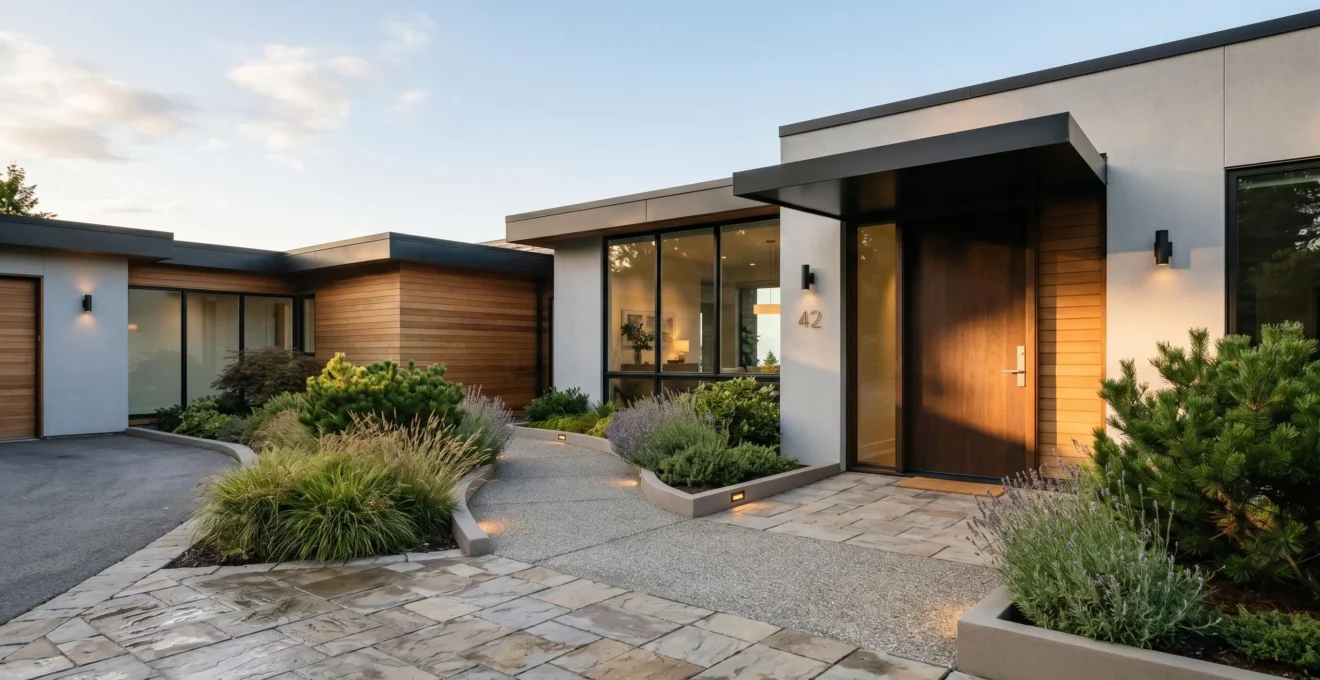
Accessibility doesn’t require sacrificing your home’s beauty for a clinical-looking ramp; it demands better design.
- Successful accessible entry is achieved by creating an “integrated pathway” using thoughtful landscaping, not by simply adding a utilitarian ramp.
- The entire “arrival sequence”—from the approach to the keyhole—must be designed holistically, considering lighting, shelter, and security.
Recommendation: Approach accessibility as a design-led opportunity to enhance your home’s value and aesthetic, rather than a purely functional compromise.
The very mention of “home accessibility” often conjures an image homeowners dread: a cold, industrial metal ramp bolted onto the front of a beautiful house. It feels like an admission of defeat, a functional necessity that inevitably compromises decades of cultivated curb appeal. Many believe they face a stark choice between a home that is safe and accessible, and a home that is elegant and retains its value. This is a false dichotomy, born from a lack of imagination, not a lack of options.
As a landscape architect, I see this challenge not as a problem to be solved with a piece of equipment, but as a design opportunity. The goal isn’t to hide a ramp, but to create a solution so beautifully integrated that the concept of a separate “ramp” disappears entirely. It’s about designing an entire arrival sequence that is inherently accessible, safe, and welcoming for everyone, regardless of their mobility. This approach moves beyond mere compliance and into the realm of thoughtful, high-value design.
This article will deconstruct the arrival experience, moving from the macro challenge of slopes down to the micro-detail of the keyhole. We will explore how principles of landscape architecture can provide elegant solutions that a purely medical or construction-based approach often misses. We will show you how to enhance, not diminish, your home’s aesthetic while ensuring seamless and dignified access.
Summary: Designing an accessible home entrance that enhances curb appeal
- Why a “low” threshold is still a barrier for electric wheelchairs?
- How to landscape a gentle slope so you don’t need a metal ramp?
- Video doorbell or Intercom: which is safer for seniors with slow mobility?
- The porch lighting mistake that leaves the keyhole in total darkness
- Why a canopy is essential for seniors taking 2 minutes to unlock a door?
- Why installing a through-floor lift might limit your buyer pool in suburbia?
- How to check a utility worker’s ID card properly before unlocking the chain?
- Concrete or Modular: Which ramp suits a steep UK driveway best?
Why a “low” threshold is still a barrier for electric wheelchairs?
The final obstacle in any journey to the front door is the threshold itself. Homeowners often assume that a “low” threshold of an inch or two is negligible. From a design and mobility standpoint, this assumption is flawed and often dangerous. While a manual wheelchair user might be able to gather momentum to overcome a small bump, a heavy electric wheelchair operates with different physics. The small front caster wheels can easily get caught, bringing the several-hundred-pound machine to an abrupt and jarring halt.
This isn’t just an inconvenience; it’s a significant barrier to independence. A 2020 study of wheeled mobility device users confirmed this, noting that even small vertical edges and door thresholds were among the most frequently reported barriers in community settings. The jolt can be unsettling, potentially dislodging items or causing discomfort for the user. For a truly seamless entry, the ideal is a zero-step threshold, where the exterior landing and the interior floor are perfectly flush.
Achieving this requires careful architectural planning, involving specialized weather-sealed saddles and proper grading of the exterior surface to ensure water drains away from the house. It’s a technical detail that is far easier to implement during construction or a major renovation, but it represents the gold standard of accessible design. It completely removes the final physical and psychological barrier, transforming the act of entering from a potential struggle into a smooth, effortless transition.
How to landscape a gentle slope so you don’t need a metal ramp?
The most common and visually jarring accessibility solution is the metal ramp. The most elegant solution is to make the ramp disappear entirely, not by hiding it, but by replacing it with an integrated pathway that is part of the garden’s inherent design. The secret lies in using landscape grading and materials to manage the change in elevation so gracefully that it feels like an intentional design feature, not a medical necessity. Instead of a steep, direct line to the door, the design embraces a longer, more scenic route.
This approach transforms a purely functional requirement into a primary landscape element. By creating a beautiful, meandering path, you not only achieve the gentle gradient required for safe access (typically a 1:12 or 1:20 slope) but also add value and beauty to your property. The pathway becomes a pleasant journey through the garden, a place to be enjoyed rather than a utility to be endured. This requires a shift in thinking: from “how do I add a ramp?” to “how do I redesign my front garden’s circulation?”
Your Action Plan: Four Strategies for an Integrated Pathway
- Design a meandering pathway: Make the path cover more ground to create an almost imperceptible slope, turning the access route into a primary landscape feature.
- Create integrated terracing: Use stylish retaining walls to break the slope into flat ‘rest areas’ connected by very short, gentle inclines that blend into the garden design.
- Excavate a ‘sunken path’: Gradually descend the path to door level, flanked by raised garden beds that make it feel intentional while providing subtle safety barriers.
- Achieve material unification: Use the exact same high-quality paving material for the driveway, accessible path, and patio to create visual cohesion that erases the separation between zones.
The image below perfectly illustrates how terracing and quality materials can create an accessible route that is also the garden’s most stunning feature. Notice how the wide, stone pathways connect different levels without a single visible step or ramp.
As you can see, the solution feels completely organic to the landscape. The retaining walls add structure and planting opportunities, while the generous width of the path is welcoming to all. This is the essence of design-led accessibility—where the functional solution is also the most beautiful one.
Video doorbell or Intercom: which is safer for seniors with slow mobility?
The arrival sequence doesn’t end when a person reaches the door; it includes the interaction with who is on the other side. For a senior with slow mobility, the sound of a doorbell can trigger a “tyranny of the urgent”—a frantic rush to answer before the visitor leaves. This haste is a major safety risk. In the United States, for example, research shows older adults sustain about 36 million falls per year, and any situation that encourages rushing increases this danger.
This is where modern technology offers a superior solution to a traditional intercom. A simple audio intercom still creates the pressure to get to the door to see who is there. A video doorbell completely changes the dynamic. It allows the resident to see and speak to the visitor from a smartphone or dedicated screen, anywhere in the house, without taking a single step. This immediately diffuses the urgency.
The resident can calmly assess the situation. Is it a delivery driver who can be instructed to leave the package? A friend who can be told, “I’m on my way, take your time”? Or an unsolicited salesperson who can be dismissed without ever opening the door? This ability to screen visitors remotely provides not only immense safety and security but also a sense of control and dignity. It eliminates the physical and psychological pressure to rush, directly mitigating a common fall risk at the home’s most critical entry point.
The porch lighting mistake that leaves the keyhole in total darkness
Excellent porch lighting seems simple: install a bright light. Yet, the most common lighting setup—a single, powerful overhead fixture—creates the very problem it’s meant to solve. When a person stands in front of their door to find their keys, their own body casts a deep shadow directly over the door handle and keyhole. This is known as the “body shadow” problem, and it turns the simple act of unlocking a door into a fumbling, frustrating, and potentially unsafe task, especially for someone with declining vision or dexterity.
The professional solution is not more light, but smarter light. A landscape architect approaches this by designing a layered lighting scheme. This strategy uses multiple light sources with different functions to create a safe, welcoming, and shadow-free entryway. The three essential layers are:
- Ambient Light: A general overhead light (often on a dimmer) provides broad, soft illumination for the entire porch area, preventing glare.
- Path Lighting: Low-level lights along the walkway guide the approach safely from the curb to the door, defining edges without dazzling.
- Task Lighting: This is the crucial, often-missed layer. A small, focused, and shielded fixture is aimed directly at the lockset and handle, eliminating the body shadow and illuminating the critical work area.
By specifying warm color temperature bulbs (2700K-3000K), we also reduce glare sensitivity for aging eyes, which provides clear visibility without causing discomfort.
This image demonstrates a perfect execution of task lighting. The handle and lock are bathed in warm, clear light, making them instantly visible and usable. This isn’t just about aesthetics; it’s about providing the right amount of light in exactly the right place to make the final step of the arrival sequence effortless and safe.
Why a canopy is essential for seniors taking 2 minutes to unlock a door?
The final moment of the arrival sequence—the “threshold moment”—is the most vulnerable. Finding the right key, aligning it with the lock, and turning it can be a swift action for some, but for a senior with arthritis, Parkinson’s, or simply unsteady hands, this process can take one or two full minutes. Now, imagine performing this delicate, two-handed operation while being pelted by rain, fumbling with an umbrella, or having snow pile up on your shoulders. The environmental pressure adds immense stress and increases the risk of a fall.
This is why a well-designed canopy, porch roof, or overhang is not a decorative flourish; it is an essential piece of accessibility hardware. It provides critical shelter from the elements precisely where it is needed most. As home accessibility specialists at Lifeway Mobility point out, accessible entrances should include protective overhangs to shield users from weather during the extended time required for key management. A proper canopy creates a safe, dry, and sheltered “staging area” at the doorway.
Within this protected space, a person can pause, put down their bags, find their keys, and focus on the task of unlocking the door without being rushed by the weather. It grants them the time and stability needed to operate the lock safely. From a design perspective, a canopy also helps to architecturally define the entrance, adding depth and importance to the facade. It’s a perfect example of a feature that dramatically improves both the function and the form of a home’s entrance.
Why installing a through-floor lift might limit your buyer pool in suburbia?
Homeowners are often concerned that significant accessibility modifications, like a through-floor lift, will be perceived as overly specialized and thus limit the property’s appeal upon resale. It’s a valid concern: a highly visible, medical-style installation can pigeonhole a home, making it seem suitable only for a niche market. Buyers who don’t need the lift may see it as a functional and aesthetic liability they’ll have to pay to remove, reducing their offer price.
However, this perspective often misses the broader demographic shift. The true risk isn’t in making a home accessible, but in doing so with a solution that is visually intrusive and inflexible. The key is to differentiate between a *specific medical device* and a *universal design feature*. A through-floor lift is the former. An elegant, integrated pathway, a zero-step entry, or even a beautifully designed residential elevator that looks like a luxury feature is the latter.
The demand for accessible homes is, in fact, drastically outpacing supply. Consider that, according to data from the U.S. Census Bureau, only 10 percent of American homes are considered ‘aging ready.’ As the population ages, a home with thoughtfully and aesthetically integrated accessibility features is not a liability but a significant asset. A home that allows a family to age in place, or to comfortably host an aging parent, has a market value that will only increase. The goal, therefore, is not to avoid modifications, but to invest in design-led solutions that enhance livability for everyone.
How to check a utility worker’s ID card properly before unlocking the chain?
A secure arrival sequence also means controlling who gets to complete it. For seniors living alone, the front door can be a point of vulnerability to scams or intrusions. Criminals often pose as utility workers to gain trust and access. Therefore, having a strict, unbreakable protocol for verifying identity is a crucial layer of home security, and it must be practiced without exception.
The biggest mistake is opening the door, even if it’s on a chain, before verification is 100% complete. This relinquishes control. As home security experts warn that criminals often target older homeowners, assuming they may be more trusting. A video doorbell is the first line of defense, but the protocol remains the same even if you are speaking through the door. The key is to verify independently, never relying on information provided by the person at the door.
Here is the four-step protocol that should be followed every time:
- View Remotely: Use a peephole or video doorbell to see the visitor. Ask them to hold their ID card up to the camera or lens. The door remains fully locked.
- Inspect the ID: Look for authenticity markers: company holograms, a clear photo, and a professional appearance. Be wary of laminated cards that look easily forged.
- Verify Independently: This is the most critical step. Keep the door closed. Find the utility company’s official phone number from a bill or their public website (NEVER use a number the person gives you). Call and ask them to confirm that they have a scheduled work order for your address and to verify the employee’s name.
- Question Urgency: Be suspicious of any unscheduled “emergency” visit. Almost all legitimate utility work is scheduled in advance. Treat any unexpected, urgent request as a red flag that requires independent verification.
Only after you have received verbal confirmation from the company via an independently sourced phone number should you consider opening the door. This protocol removes any opportunity for deception and keeps control firmly in your hands.
Key Takeaways
- Integrate, Don’t Just Add: The best accessible design is invisible, woven into the landscape and architecture of the home.
- Design the Entire Arrival Sequence: True accessibility considers the whole journey, from curb to keyhole, including lighting, shelter, and security.
- Good Design Adds Value: An aesthetically pleasing, functional, and accessible entry enhances your home’s curb appeal and market value, making it a long-term asset.
Concrete or Modular: Which ramp suits a steep UK driveway best?
When gentle landscaping is not an option due to a steep gradient or limited space, a structural ramp becomes necessary. The choice of material and construction method is critical, with permanent concrete and adaptable modular systems being two primary options. Each has significant implications for cost, aesthetics, installation time, and even neighborly relations, especially in densely populated areas. The decision should be based on a careful evaluation of site-specific factors.
A landscape architect or certified accessibility specialist will consider a range of variables before recommending a solution. For a steep driveway, factors like the exact gradient, the turning space available at the top and bottom, and the local climate’s impact on surface traction are paramount. The following table compares these two popular ramp systems across several key factors relevant to challenging sites.
| Factor | Concrete Ramps | Modular Aluminum Ramps |
|---|---|---|
| UK Planning Permission | Often requires council approval as permanent structure | Typically classified as ‘temporary’ – may bypass planning process |
| UK Climate Performance | Prone to moss/algae growth in damp conditions; frost heave damage risk | Galvanised steel with non-slip mesh designed for wet weather |
| Space Flexibility | Fixed footprint after installation; inflexible for narrow UK driveways | Configurable sections adapt to tight spaces and shared access |
| Installation Timeline | Weeks for curing; weather-dependent | Days; can be installed in poor weather |
| Removal & Resale | Demolition required; affects property value | Fully portable; can be relocated or sold |
| Neighbour Considerations | May block light – potential ‘Right to Light’ disputes | Lower profile open-mesh design reduces light obstruction |
While a concrete ramp offers permanence and can be finished to match existing surfaces, a modular system provides unparalleled flexibility, speed, and removability. For a steep or complex site, the ability to configure a modular ramp around obstacles and its superior performance in wet conditions often make it the more practical, if not always the most aesthetically integrated, choice.
Ultimately, by approaching accessibility as a design challenge rather than a medical requirement, you transform a potential detraction into a beautiful, valuable, and welcoming feature. A thoughtfully designed entrance serves everyone better and ensures your home remains a source of pride and comfort for years to come.