
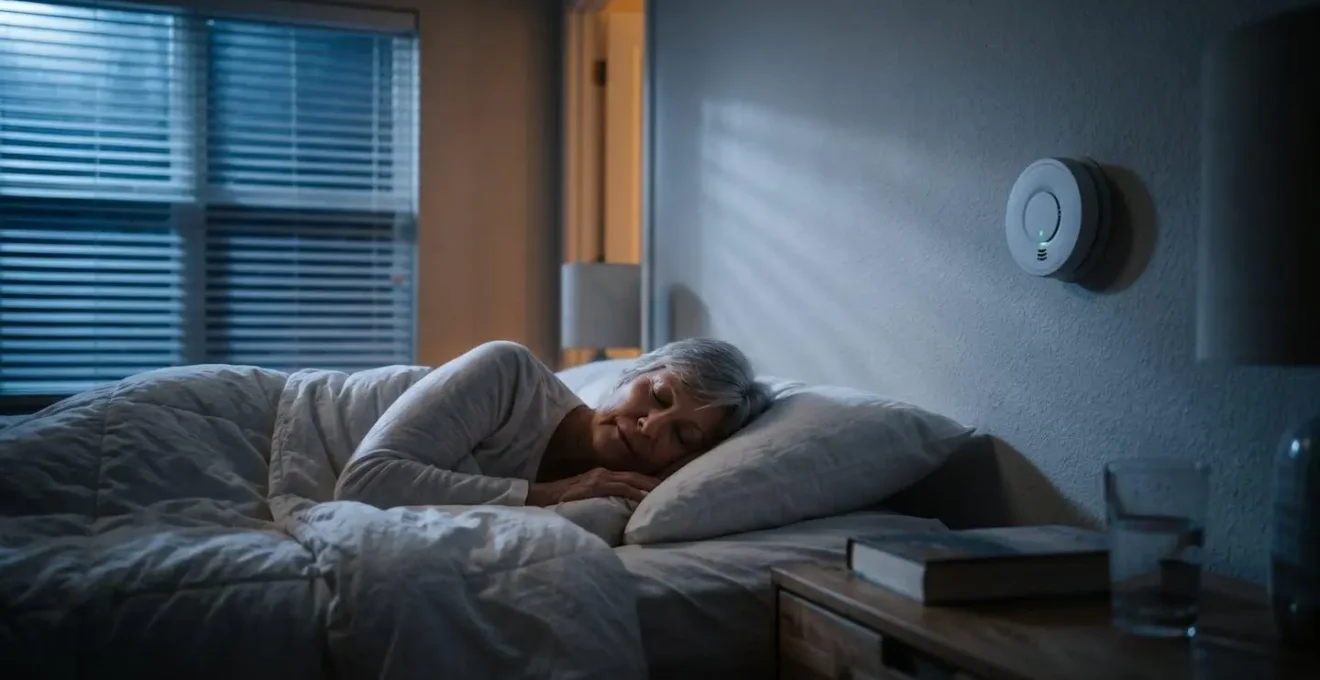
Contrary to common belief, a standard smoke alarm is not sufficient protection for seniors with sensory decline; it often creates a dangerous false sense of security.
- Standard high-pitch alarms are frequently inaudible to individuals with age-related hearing loss or those in a deep sleep.
- Passive alarms that require a resident to hear, process, and react are ineffective in cases of cognitive decline or disorientation.
Recommendation: True safety requires a fundamental shift from single, passive devices to an integrated ecosystem of interconnected, multi-sensory, and automated home safety systems.
As a Fire Service prevention officer, I have seen the devastating consequences of fires that should have been preventable. A common and dangerous misconception is that a single, battery-operated smoke alarm is a complete safety solution. For the general population, it is a critical first step. However, for seniors, particularly those with hearing loss, mobility issues, or living in older properties, a standard beeping alarm is often little more than a source of false confidence. These devices rely on a person’s ability to hear a specific frequency, wake immediately, and react rationally—abilities that can be compromised by age, health conditions, or deep sleep.
The standard advice to “check your batteries” is not enough. We must look beyond the device and evaluate the entire safety system. The core problem is that a passive alarm fails to account for human factors. This guide moves beyond simplistic advice. It addresses the critical system failures that standard alarms do not, and provides an authoritative overview of the specific technologies and strategies required to create a genuinely safe environment. We will examine why interconnectedness is non-negotiable, how automation can compensate for cognitive decline, and why multi-sensory alerts are the only reliable way to wake someone who cannot hear a traditional alarm.
This article details the specific environmental hazards that seniors face and outlines the necessary preventative measures. The following sections break down the critical components of a comprehensive safety system, explaining not just what to do, but why these specific measures are essential for survival.
Summary: Carbon Monoxide and Fire: A System-Based Approach to Senior Safety
- Why the Kitchen Alarm Must Trigger the Bedroom Alarm to Wake You Up?
- How an Automatic Stove Shut-off Device Prevents Kitchen Fires in Dementia?
- CO Detector vs Temperature Sensor: Ensuring the Heating Hasn’t Failed in Winter?
- The “Daisy Chain” Mistake That Causes Electrical Fires in Old Sockets
- When to Ask the Fire Service for a Free “Safe and Well” Visit?
- Why a Lighted Path from Bed to Toilet Prevents 30% of Night Falls?
- Shower-proof vs Submersible: Can You Really Wear It in the Bath?
- The Red Button Stigma: Why 60% of Seniors Refuse to Wear Their Fall Pendant?
Why the Kitchen Alarm Must Trigger the Bedroom Alarm to Wake You Up?
A fire can double in size every 60 seconds. If a fire starts in the kitchen, an alarm sounding only in that room is dangerously insufficient for someone sleeping in a bedroom, especially with the door closed. Sound loses intensity over distance and through barriers. For a person with hearing loss or who is a deep sleeper, a distant, high-pitched alarm is effectively no alarm at all. The only acceptable solution is an interconnected system where all alarms sound simultaneously, regardless of which one is triggered. This ensures the alert is immediate and delivered at maximum volume where it is needed most: the bedroom.
Furthermore, the type of sound is critical. Research has shown that the standard high-frequency tone of most smoke alarms is less effective at waking people. One study found that a lower-frequency, 520 Hz square wave signal was significantly more effective. As Bruck and colleagues reported in Fire Safety Science, the conventional high-pitched alarm was markedly less successful at waking young adults compared to a 520 Hz tone or a human voice recording. This principle is even more critical for seniors with age-related hearing loss, which often affects higher frequencies first.
For those with severe hearing impairment, sound alone is not enough. A truly effective system must be multi-sensory. This includes high-intensity strobe lights to provide a visual warning and, most importantly, a bed shaker (or pillow shaker) that provides a powerful tactile alert. When a kitchen alarm triggers a bed shaker and a strobe light in the bedroom, it is no longer relying on the occupant’s hearing. It is creating an unmissable, multi-sensory event that compensates for the sensory deficit, dramatically increasing the chances of waking up in time to escape.
How an Automatic Stove Shut-off Device Prevents Kitchen Fires in Dementia?
For individuals living with dementia or cognitive decline, memory lapses are not a matter of simple forgetfulness; they are a neurological reality. Leaving a stove or hob on is one of the most common and dangerous outcomes. In this context, an alarm that sounds after a fire has already started is a sign of failure. The goal must be prevention, not just detection. An automatic stove shut-off device is an active safety system designed to prevent the fire from ever starting.
These devices work on a simple but effective principle. They use a motion sensor to monitor activity in the kitchen and a timer that controls power to the stove. If a person leaves the kitchen while cooking, the timer begins a countdown. If they do not return within a pre-set period, the device automatically cuts the power to the stove, eliminating the heat source before a fire can ignite. This is not a convenience; it is a critical life-saving intervention that compensates for memory impairment, as cooking remains the leading cause of home fire injuries for seniors.
Case Study: Fire Averted by Automated Technology
In a real-world example reported by a caregiver, the iGuard automatic stove shut-off device was credited with preventing a major fire. A mother with dementia began cooking bacon and then wandered away from the kitchen. The unattended pan began to overheat, creating the perfect conditions for a grease fire. However, because the caregiver had installed the device, it detected the lack of movement and, after the preset time elapsed, automatically shut off the power to the stove. The potential disaster was averted without any human intervention, demonstrating the profound effectiveness of active, automated safety systems.
Relying on a person with dementia to remember to turn off the stove or to react appropriately to a smoke alarm is an unrealistic and dangerous expectation. An automatic shut-off device removes this reliance on human memory and reaction, creating a layer of safety that is both passive and foolproof. It is an essential component for enabling safer independent living for those with cognitive challenges.
CO Detector vs Temperature Sensor: Ensuring the Heating Hasn’t Failed in Winter?
While fire is an active and visible threat, other environmental hazards are silent killers. Carbon Monoxide (CO) is an odourless, colourless gas produced by the incomplete combustion of fuels, including gas used in boilers, water heaters, and fires. It is a poison that can incapacitate and kill in minutes. A standard smoke alarm will not detect it. A dedicated CO detector is a non-negotiable requirement in any home with fuel-burning appliances. The scale of this threat is significant; recent research on accidental non-fire carbon monoxide poisoning shows that 28,900 people died globally in 2021 alone.
However, another, more insidious threat exists in winter: heating failure. For an elderly person, especially one with mobility issues or who is less sensitive to cold, a broken boiler can lead to a gradual, dangerous drop in body temperature known as hypothermia. This can happen overnight without the person even realizing there is a problem until it is too late. This is where a low-temperature sensor provides a critical safety net. These devices, often integrated into telecare systems, monitor the ambient temperature of a room.
If the temperature drops below a pre-set safe level (e.g., 16°C or 60°F) for a sustained period, the sensor sends an alert to a monitoring centre or a designated family member. This is not an alarm for the resident, but a notification for help. It allows for intervention—a welfare check, a boiler repair—before the situation becomes a medical emergency. While a CO detector protects against a malfunctioning appliance producing a deadly gas, a temperature sensor protects against an appliance failing to function at all. Both are essential for winter safety, protecting against the two primary risks associated with central heating systems.
These two sensors address fundamentally different problems but are equally vital parts of a comprehensive environmental monitoring system. One protects from an active poison, the other from a passive, creeping danger. Both must be considered essential.
The “Daisy Chain” Mistake That Causes Electrical Fires in Old Sockets
Older properties often have an insufficient number of wall sockets for the demands of modern life. A common, and extremely dangerous, response is “daisy-chaining”: plugging one extension lead into another to gain extra outlets. This creates a cascade of risks. Each connection point adds resistance, generating heat. By plugging multiple leads together, you are drawing a current far greater than the single wall socket was ever designed to handle. The wiring inside the walls can overheat, insulation can melt, and a fire can start where it is least visible.
This risk is compounded by the fact that sockets in older homes may already be worn, with loose internal connections that create electrical arcing—a major fire-starter. Overloading these aging systems with multiple appliances through a daisy chain is a recipe for disaster. The rule is simple and absolute: one extension lead per socket, and never plug an extension lead into another extension lead. Furthermore, high-draw appliances like space heaters, kettles, or irons should always be plugged directly into a wall socket, never into an extension lead.
It is imperative to be vigilant for the signs of an overloaded or failing electrical system. A system under strain will provide warnings before it fails catastrophically. Recognizing these signs is a critical preventative skill. A regular audit of the home’s electricals can identify risks before they escalate into a fire hazard. Ignoring these signs is equivalent to ignoring a smoke alarm.
Action Plan: Electrical System Safety Audit
- Check for flickering lights: Observe lights when major appliances like a refrigerator or washing machine turn on. Flickering indicates the circuit is heavily loaded.
- Feel for warmth at outlets: Periodically and carefully touch the faceplates of outlets and switches. Any warmth indicates a potential problem with wiring or resistance buildup.
- Listen for buzzing sounds: Place your ear near outlets. A faint buzzing or sizzling sound can indicate dangerous electrical arcing within the wall or outlet itself.
- Monitor circuit breakers: If a circuit breaker trips frequently, it is doing its job of protecting against an overload. Do not simply reset it repeatedly. Identify and remove the cause of the overload.
- Maintain clearance for heaters: Ensure any portable space heaters are kept at least 3 feet (approximately 1 meter) away from combustible materials like curtains, bedding, or furniture.
When to Ask the Fire Service for a Free “Safe and Well” Visit?
Recognizing that you or a loved one might be at high risk is the first step towards preventing a tragedy. The statistics are sobering: the National Fire Protection Association notes that seniors 65 and older carry twice the risk of dying in a home fire compared to the general population. This increased risk is due to a combination of factors, including potential mobility issues, health conditions, and the effects of medication, which can slow reaction times. The Fire Service is not just an emergency response organization; it is a primary resource for prevention.
Most local fire services offer a program, often called a “Safe and Well” or “Home Fire Safety” visit, which is a free service designed to identify and mitigate risks in the home. This is not an inspection meant to find fault. It is a friendly, professional consultation to help make your home safer. A trained officer or community safety advisor will visit the home to provide personalized advice on fire safety, escape planning, and the proper installation and type of smoke alarms.
You should request a visit if you or a family member meet any of the following criteria:
- Are over the age of 65.
- Live with a disability, mobility issue, or sensory impairment (hearing or sight loss).
- Live with cognitive decline, such as dementia.
- Are concerned about home safety and want expert advice.
The visiting officer can assess specific needs and often provide and install specialized alarms free of charge. This is particularly important for addressing the sensory compensation needs discussed earlier. As the U.S. Fire Administration officially advises:
If you can’t hear your smoke alarm, consider getting one that has a different sound or one that comes with a bed shaker or strobe light.
– U.S. Fire Administration, Fire Safety for Older Adults
Do not wait for a near-miss to take action. Proactively engaging with your local Fire Service is one of the most effective steps you can take to ensure a safe living environment.
Why a Lighted Path from Bed to Toilet Prevents 30% of Night Falls?
While this guide focuses on fire and CO, overall home safety is an interconnected system, and falls are a primary threat to a senior’s health and independence. The journey from the bed to the toilet at night is one of the most hazardous trips made in the home. Waking from sleep, often disoriented and in low light, significantly increases the risk of tripping, misjudging distances, and falling. Turning on a bright overhead light is not an ideal solution, as it can be jarring, cause temporary blindness, and make it difficult to get back to sleep.
The solution is not to flood the area with light, but to provide a low-level, targeted illumination of the pathway. Modern motion-activated LED lighting strips are a simple, inexpensive, and highly effective tool for this purpose. These strips can be installed along skirting boards, under the bed frame, or along the hallway floor. They remain off until they detect motion, at which point they emit a soft, warm glow—typically amber or warm white—that is bright enough to illuminate the path and any obstacles without disrupting night vision or being unpleasantly bright.
This automated pathway lighting serves several critical functions. It clearly defines the safe walking area, highlights potential trip hazards like rugs or furniture, helps with orientation in the dark, and provides a sense of security. By making the path to the bathroom safe and visible, it significantly reduces the hesitation and uncertainty that can lead to falls. While the exact percentage of fall prevention can vary, the principle is sound: a well-lit path is a safer path. It is a proactive environmental modification that addresses a specific, high-risk behaviour, turning a potentially dangerous journey into a safe and routine one.
This simple intervention is a perfect example of how a small, automated change to the environment can have a major impact on safety, preventing injuries that could lead to hospitalization and a loss of independence.
Key Takeaways
- Interconnection is Non-Negotiable: An alarm in one room must trigger all alarms, especially in the bedroom. A single, isolated alarm is a system failure.
- Automation Compensates for Risk: For dangers related to cognitive decline or electrical overload, automated systems (like stove shut-offs) that prevent incidents are superior to alarms that detect them.
- Multi-Sensory Alerts Save Lives: For those with hearing loss or who are deep sleepers, safety systems must include visual (strobe lights) and tactile (bed shakers) alerts. Sound alone is not reliable.
Shower-proof vs Submersible: Can You Really Wear It in the Bath?
Personal alarm pendants are vital tools, but their effectiveness is nullified if they are not worn during high-risk activities. Bathing and showering are leading causes of falls, yet many users remove their pendants for fear of water damage. Understanding the water resistance rating of a device is therefore not a technical triviality; it is a matter of life and death. The rating is typically expressed as an “IP” (Ingress Protection) code. The two most common for wearables are IP67 and IP68.
Knowing the difference is essential for giving correct advice and ensuring the device is used safely. A device rated IP67 is protected against splashes and can be submerged in up to 1 meter of water for a short time, making it “shower-proof.” A device rated IP68 offers a higher level of protection, typically able to withstand submersion in up to 1.5 meters of water for a longer duration, making it “submersible.” The following table, based on official guidance, clarifies the practical differences for a wearable safety device.
| Feature | IP67 (Shower-proof) | IP68 (Submersible) |
|---|---|---|
| Water Resistance | Can withstand spray and splashing | Can be submerged in water |
| Depth Rating | Protected against temporary immersion (up to 1m) | Protected against continuous immersion (up to 1.5m+) |
| Shower Use | Safe to wear | Safe to wear |
| Bath Use | Not recommended for submersion | Can handle brief submersion |
| Soap/Chemical Exposure | May degrade seals over time | May degrade seals over time |
| Best Practice | Wear on wrist or neck during shower | Wear on wrist or neck, avoid prolonged submersion |
Even with an IP68 rating, it is crucial to note that these tests are conducted in pure water. Soaps, shampoos, and bath oils contain chemicals that can degrade the rubber seals over time, compromising the water resistance of any device. The official advice should always be to wear the device, but to avoid deliberately submerging it for long periods. For bathing, keeping the pendant on the side of the bath within easy reach may be a safer long-term strategy for the device’s integrity, provided the user can reliably reach it after a fall.
The Red Button Stigma: Why 60% of Seniors Refuse to Wear Their Fall Pendant?
The most technologically advanced personal alarm system is utterly useless if it is sitting on a bedside table. The “red button stigma” is a powerful and dangerous phenomenon. Many seniors perceive wearing a pendant as a visible admission of frailty, a symbol of lost independence. They may feel it makes them look old or vulnerable, leading them to only wear it “when they think they might need it,” which tragically is never when an unexpected fall occurs. Overcoming this stigma requires reframing the conversation from one of weakness to one of empowerment.
The decision to wear a pendant should be positioned not as a surrender, but as a proactive, intelligent choice to maintain independence for longer. It is a tool, no different from wearing a seatbelt in a car or a helmet on a bicycle. It does not prevent the accident, but it dramatically mitigates the consequences. A fall without a means to call for help can lead to a “long lie,” where a person is trapped on the floor for hours, leading to complications like hypothermia, pressure sores, and dehydration that can turn a minor injury into a life-changing event.
The underlying reasons for needing such a device are not about personal failure; they are a pragmatic response to physiological changes. An official from the Cedar Rapids Fire Department explains this with stark clarity:
Decreased mobility, health, sight, and hearing may limit the quick action necessary in a fire emergency. They may be on medication that affects their ability to make quick decisions.
– Cedar Rapids Fire Department, Older Adult Fire Safety Information
This same logic applies directly to falls. The pendant is not a sign of weakness; it is a vital tool that compensates for these exact risks. Modern designs are also helping to reduce stigma, with devices that look like smartwatches or stylish jewellery. The conversation must shift from “You need this because you are old” to “This tool will help you stay safe and independent in your own home.”
The time for relying on inadequate, single-point solutions has passed. The principles outlined in this guide are not suggestions; they are the new minimum standard of care. Conduct an immediate and thorough review of your own or your loved one’s home safety system today. Implementing an interconnected, multi-sensory, and automated system is the only way to provide genuine security and peace of mind.