
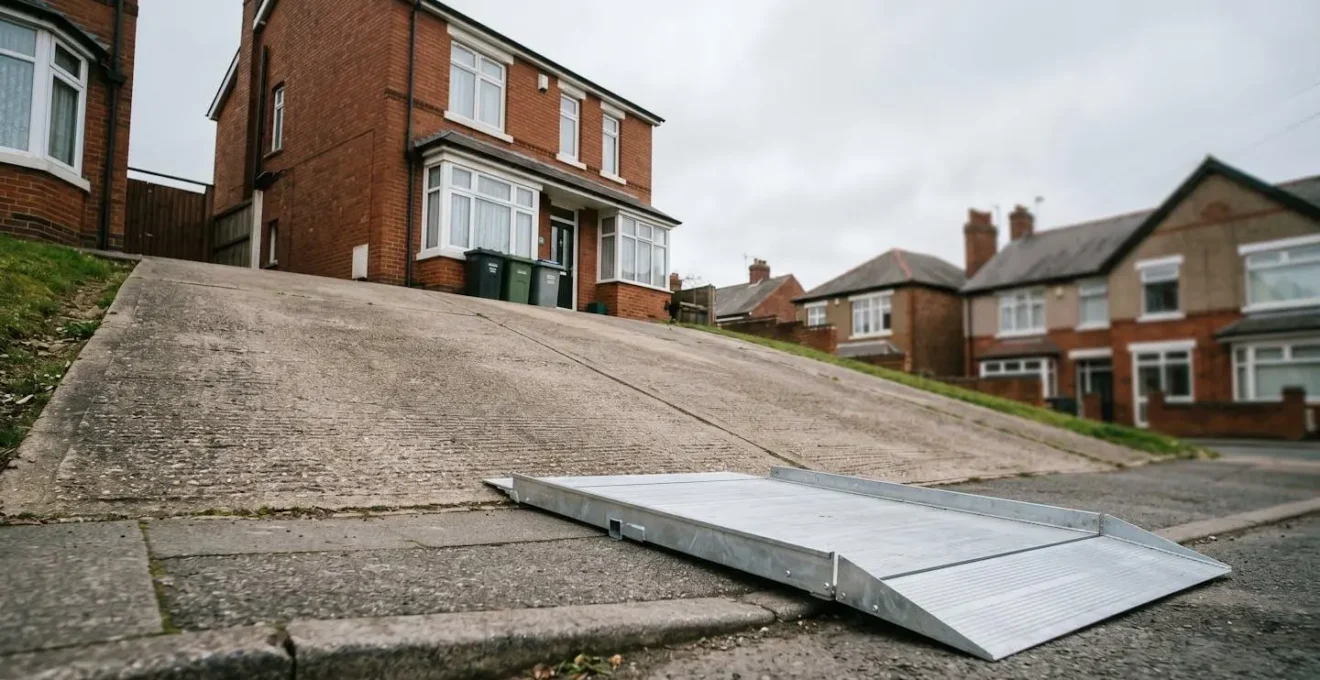
The critical choice between a concrete and modular ramp is not about materials, but about risk management for your specific circumstances.
- A permanent concrete ramp carries significant upfront financial risk and inflexibility, whereas a modular system offers adaptability for uncertain futures.
- Ignoring UK building regulations on gradients and handrails is not a cost-saving measure; it’s a direct safety risk to the user and can jeopardise grant funding.
- Operational risks, like a British winter turning a metal ramp into an ice hazard, require a specific maintenance strategy to ensure safety without causing corrosion.
Recommendation: Before committing to any solution, a professional site assessment is essential to analyse the specific gradient, turning circles, and regulatory constraints of your property.
Facing the urgent need for wheelchair access at home, particularly on a steep driveway, forces a rapid and high-stakes decision. The immediate question seems to be a simple choice between a permanent concrete structure and a metal modular system. Most advice revolves around the obvious: concrete is forever, modular is adaptable. But this binary view misses the most crucial element of the decision-making process for a UK homeowner. The real challenge isn’t choosing a material; it’s navigating a complex web of financial pressures, stringent safety regulations, and the unpredictable personal circumstances that accompany a change in health.
The conversation must shift from “what is it made of?” to “what risks does it mitigate?”. A ramp is not merely a construction project; it is a critical piece of medical and safety equipment. Its design and installation have direct consequences on user safety, household finances, and future property value. This involves understanding the nuances of the Disabled Facilities Grant (DFG) system, the non-negotiable safety standards of Part M of the Building Regulations, and the practical realities of maintaining access through a harsh British winter. Focusing on these factors transforms the choice from a simple purchase into a calculated strategic plan.
This guide will deconstruct the decision-making process from a specialist installer’s perspective. We will move beyond the superficial material comparison to analyse the underlying financial, regulatory, and safety implications. By assessing each option through a lens of risk management, you can determine which solution truly provides the safest and most sustainable path for ageing in place with dignity and security.
To navigate these critical considerations effectively, this article is structured to address each key challenge in sequence. The following summary outlines the path we will take to build a comprehensive understanding, from initial financial planning to the practicalities of daily use.
Summary: A Strategic Guide to UK Ramp Installation
- How to plan ageing in place in the UK without draining your life savings?
- How to keep a metal ramp ice-free during a British winter without corrosion?
- Rental ramps vs Concrete: financial strategy for a terminal illness prognosis
- The safety error of installing a ramp without double-height handrails
- Where to place landing platforms on a long ramp to prevent fatigue?
- How to apply for a Disabled Facilities Grant (DFG) without getting rejected?
- How to use “Google Maps” accessible transit settings for city trips?
- Electric vs Manual: Which wheelchair fits a typical UK public transport commute?
How to plan ageing in place in the UK without draining your life savings?
The prospect of funding significant home adaptations can be daunting, but a robust financial strategy is the bedrock of successful ageing in place. In the UK, the primary mechanism for support is the Disabled Facilities Grant (DFG), administered by your local council. This is not a benefit but a mandatory grant designed to help with the costs of making essential changes to your home. Understanding its scope and limitations is the first step in mitigating financial risk.
The grant is means-tested for adults, meaning your household income and savings will be assessed to determine your potential contribution. However, the grant is not means-tested for adaptations for a disabled child. It’s crucial to know that while substantial funds are allocated, there are limits. The current maximum grant in England, for instance, is £30,000, as stated in the House of Commons briefing on disabled facilities grants. This figure may or may not cover the entire cost of a complex ramp on a steep driveway, making it vital to secure accurate quotes early on.
Effective planning involves treating the DFG application not as a hopeful request but as a formal project proposal. This means working with an Occupational Therapist (OT) to provide the clinical justification for the ramp, and engaging experienced installers who understand the council’s requirements. By framing the adaptation as a necessary and cost-effective solution, you build a strong case that aligns with the council’s objectives, thereby maximising your chances of securing the full funding you are eligible for and protecting your personal savings.
How to keep a metal ramp ice-free during a British winter without corrosion?
A modular aluminium ramp offers speed and flexibility, but it introduces a significant operational risk: winter weather. Ice and snow can render a metal ramp dangerously slippery, while the wrong de-icing method can cause long-term damage. The primary safety rule is to clear the ramp of any accumulation as soon as possible, always working from the top down to prevent slipping on lower sections. Crucially, never use a metal shovel, which will scratch and dent the aluminium surface, creating areas where water can pool and freeze.
The choice of de-icing agent is a critical technical decision. Standard rock salt, which contains sodium chloride, is highly corrosive to aluminium and steel and should be avoided at all costs. It will pit the surface and weaken the structure over time. The correct and safe alternative is a non-corrosive de-icer that uses magnesium chloride as its primary melting agent. This compound is effective at melting ice at low temperatures without attacking the ramp’s material or its galvanised handrails.
A proactive approach is always superior. Applying the de-icer *before* an expected frost or snowfall can prevent a thick layer of ice from bonding to the ramp surface, making it much easier to clear. For maximum safety, also check that handrail fasteners are tight before winter sets in and consider applying the same non-corrosive de-icer to the handrails themselves if they become slippery. Finally, ensure the ramp is well-lit, as the shorter daylight hours of a British winter increase the risk of accidents.
Rental ramps vs Concrete: financial strategy for a terminal illness prognosis
When an urgent accessibility need arises due to a terminal illness or a prognosis with an uncertain timeline, the financial strategy shifts dramatically. The decision is no longer about a 20-year investment but about providing immediate, safe access without creating a long-term financial burden. In this context, the high upfront cost and permanence of a concrete ramp become significant liabilities. The average cost of a permanent wheelchair ramp installation in the UK is around £1,800, but this can escalate significantly for steep or complex sites.
This is where modular ramp rental becomes a powerful strategic tool. A rental agreement removes the large capital outlay and the issue of what to do with a permanent structure if it’s only needed for a limited period. UK suppliers offer rental periods starting from as little as one week, with no maximum limit, providing complete flexibility. The cost includes installation, maintenance, and eventual removal, creating a predictable, manageable expense. This approach preserves capital that may be needed for other care-related costs.
Furthermore, a permanent concrete ramp can be perceived by future buyers as a detriment, potentially impacting the property’s saleability or value. A modular ramp, by contrast, is removed without a trace, returning the property to its original state. For situations defined by uncertainty, a rental solution mitigates financial risk, eliminates future complications, and delivers the necessary accessibility with speed and dignity. It aligns the financial commitment directly with the period of need, which is the most sensible and compassionate strategy.
The safety error of installing a ramp without double-height handrails
One of the most common and dangerous errors in non-specialist ramp installations is the omission or incorrect fitting of handrails. A handrail is not an optional extra; it is an integral safety system. For wheelchair users, it provides stability and control during ascent and descent. For ambulatory users who may also use the ramp, it is essential for balance. UK Building Regulations are explicit on this point for a reason: to prevent falls and injuries.
Part M of the Building Regulations and the associated standard BS 8300 are clear. A compliant ramp must have a continuous handrail on both sides. The regulations specify that the top of the handrail should be at a height between 900mm and 1000mm from the ramp surface. For ramps intended for general public use, a second, lower handrail at around 600mm is often required to support a wider range of users, including children. While not always mandatory for private dwellings, installing this dual-height system is a best-practice measure that significantly enhances safety for everyone.
Crucially, the handrail must extend horizontally by at least 300mm beyond the start and end of the ramped section. This extension provides support for the user as they transition from the level landing to the sloped surface and vice-versa, the moments when they are most vulnerable to losing balance. A ramp installed without compliant, continuous, and extended handrails is not just non-compliant; it is an active hazard. It exposes the user to unnecessary risk and the homeowner to potential liability.
Where to place landing platforms on a long ramp to prevent fatigue?
The gradient of a ramp is only one part of the safety equation. For any ramp of significant length, especially on a steep driveway, the inclusion of level landing platforms is a regulatory requirement and a physical necessity. A long, uninterrupted slope is exhausting and dangerous for a manual wheelchair user and can even strain the batteries of a powered chair. Landings provide essential resting points, preventing fatigue and loss of control.
UK Building Regulations (Part M) provide clear, non-negotiable specifications for this. For ramps in public spaces, which serve as the gold standard for safety, a level landing is required for every 10 metres of ramp length. For shallower gradients (1:20 or less), this can be extended, but for steep domestic situations, the 10-metre rule is a sensible maximum to follow. If the ramp changes direction, a landing must be provided at the turn to allow the user to reorient safely. These intermediate landings should be at least 1200mm long and as wide as the ramp.
Furthermore, every ramp must have a substantial level landing at both the top and bottom. These landings provide a safe, stable area to stop, open doors, or prepare for the transition. The regulations dictate a minimum size of 1500mm x 1500mm for these top and bottom platforms, clear of any door swing. This ensures a wheelchair user has adequate space to manoeuvre without the risk of rolling backwards onto the slope. Placing these platforms correctly is a fundamental aspect of safe ramp design, not an optional feature.
How to apply for a Disabled Facilities Grant (DFG) without getting rejected?
Securing a Disabled Facilities Grant is often the key to affording a safe and compliant ramp, yet the application process can feel like a minefield. With a UK Parliament report indicating that only 7% of homes in England have even basic accessibility features, the need is vast and council resources are stretched. A rejected or delayed application can be devastating, so submitting a “bulletproof” case from the outset is the best risk-mitigation strategy. Success hinges on demonstrating that the proposed adaptation is “necessary and appropriate” and “reasonable and practicable.”
The single most important step is to engage an Occupational Therapist (OT). The OT’s report is the clinical backbone of your application. It must clearly state why a ramp is the most cost-effective and clinically essential solution to meet the user’s needs, detailing the specific risks to health and safety *without* the ramp. Do not approach builders first. The OT’s recommendation must lead the process, not the other way around. Furthermore, some councils ask if you need planning permission for a wheelchair ramp in the UK; a comprehensive DFG application prepared with an experienced installer often integrates this, as compliant ramps can fall under permitted development.
To prove your proposal is “reasonable,” you must provide competitive quotes. Obtain at least two, preferably three, quotes from contractors experienced with DFG projects. This shows the council you are seeking good value. It is also wise to have informal conversations with the council’s DFG team before formal submission to understand their local policies and preferences. By aligning your application with their requirements and providing irrefutable clinical and financial justification, you dramatically reduce the risk of rejection.
Your checklist for a robust DFG application
- Work with an Occupational Therapist (OT) to frame the ramp as the most cost-effective and clinically essential solution.
- Obtain multiple quotes from DFG-experienced contractors to demonstrate competitive pricing.
- Ensure the OT report explicitly details risks to health and safety without the adaptation.
- Prepare clear architectural plans that meet Part M regulations before submission.
- Have informal conversations with the council’s DFG team before submitting to gauge their preferences.
How to use “Google Maps” accessible transit settings for city trips?
Once a ramp provides safe access out of the home, the next challenge is navigating the wider world. While Google Maps’ “Wheelchair accessible” route option is a good starting point for planning trips on public transport, it is not infallible. A specialist approach involves using the tool as part of a multi-layered pre-trip intelligence-gathering process to mitigate the risk of encountering unexpected barriers.
The most powerful, underused feature is Street View. Before you travel, “drop the Pegman” at the station or bus stop exit and virtually travel the route to your destination’s front door. This is the only way to spot real-world obstacles that the algorithm misses, such as:
- A lack of dropped kerbs at a critical crossing.
- Unexpected short flights of steps.
- Rough cobblestone surfaces that are difficult for casters.
- Narrow pavements blocked by street furniture.
Cross-reference your findings with other tools. Use the “Measure Distance” feature to identify a plan B—an alternative station or bus stop that is still a manageable distance away in case of a last-minute lift failure or service disruption. It’s also vital to scan the user-submitted photos within a destination’s Google Maps profile. Often, these unofficial galleries provide the only visual evidence of an entrance ramp, a step, or the presence (or absence) of an accessible toilet. Combining the automated route with this manual reconnaissance provides a far more reliable picture of a journey’s true accessibility.
Key takeaways
- The decision between concrete and modular ramps is a risk management exercise, not just a material choice.
- Strict adherence to UK Building Regulations (Part M) for gradients, handrails, and landings is a non-negotiable safety requirement.
- Securing a Disabled Facilities Grant (DFG) requires a strategic application led by an Occupational Therapist’s clinical assessment.
Electric vs Manual: Which wheelchair fits a typical UK public transport commute?
The final element in the accessibility chain is the wheelchair itself. The choice between a manual and an electric model has profound implications for navigating a typical UK public transport commute, and the “best” chair depends entirely on the balance between user independence and system constraints. A ramp provides access to the transport network, but the chair must be compatible with the vehicles themselves.
A manual wheelchair’s key advantages are its low weight and portability. Most models can be folded, making them easier to store in tight spaces and compatible with virtually all designated wheelchair spaces on buses and trains. However, they demand significant upper body strength from the user, making steep station ramps, long platform distances, and self-propulsion in crowded environments a major physical challenge. An electric wheelchair, or powerchair, offers complete independence in terms of propulsion, easily handling gradients and long distances. This independence comes at the cost of weight and size. A heavy powerchair may exceed the safe working load of older train-to-platform ramps, and its larger footprint might not fit within the designated space on some regional bus services. There is also the operational risk of “range anxiety” if journeys are delayed.
The following table breaks down the key compatibility factors for a typical UK commute, highlighting the trade-offs a user must consider when selecting a wheelchair for use beyond the home.
| Criteria | Manual Wheelchair | Electric Wheelchair |
|---|---|---|
| Weight (typical) | 15-25 kg | 50-120 kg (inc. battery) |
| Folding capability | Most models fold for storage | Limited; often non-folding |
| Bus designated space fit | Fits standard UK bus space easily | May exceed width limits on some services |
| Train ramp compatibility | Compatible with standard ramps | Weight may exceed some train ramp limits |
| Platform maneuverability | Requires upper body strength | Independent navigation on crowded platforms |
| Battery considerations | N/A | Requires charging; risk of range anxiety on delays |
| Weather resilience | User exposed to elements | Joystick controls can malfunction in heavy rain |
| Steep ramp performance | Challenging; may require assistance | Powerful motor handles gradients independently |
To ensure you make the safest, most financially sound, and compliant decision for your property, the next logical step is to arrange for a professional site survey. An experienced installer can assess the specific challenges of your driveway and provide a detailed plan that mitigates risk and meets all your accessibility needs.